News Headline
Training programme on collaboration among digital societies commences in capital

NEW DELHI: Delegates from 24 countries are participating in a training programme on “Collaborative Regulation for Digital Societies” being hosted by the Telecom Regulatory Authority of India (TRAI).
Teleom Disputes Settlement and Appellate Tribunal Chairman Justice Shiva Kirti Singh inaugurated the programme organized between 23 and 25 August 2017 by TRAI jointly with International Telecommunication Union (ITU) on ‘Collaborative regulation for digital societies.’
The delegates are particularly from the Asia-Pacific region. Besides, this training programme is being attended by large number of domestic participants representing various stakeholders such as government departments, telecom service providers, telecom vendors, academia etc.

This ITU-TRAI International Training Programme 2017 aims to build skills to address the policy and regulatory issues in the emerging era beyond convergence of telecommunications and information technology. The Programme will highlight the building blocks required to ensure that regulatory measures remain relevant and appropriate for the new environment. It will bring together international experiences in this area with a focus on India’s experiences and the lessons learnt.
The theme of this training programme is extremely relevant for all the economies worldwide. Collaborative regulation in ICT sector has various facets. In the converged ICT era, the physical boundaries would cease to exist. The seamless communication would transcend across geographical boundaries and therefore requires fine tuning of existing regulations. The Cloud computing technologies has made revolutionary trends in data storage and management. The need for developing ecosystems for launch of new services has become inevitable. With ever increasing subscriber base, there is a great need for optimum utilization of available spectrum through harmonization. With technological development, the task of harmonization of spectrum has become much easier and has become important.
Cross sectoral collaboration is one of the most important aspects of regulating ICT sector. Governments should aim to improve coordination across regulators for the ultimate benefit of consumers and for coherent and consistent economic regulations across different sectors. Collaboration of regulators with researchers and academicians is another aspect of ICT regulations. Collaborative regulations can result in significant benefits for competition and the economy as a whole if working synergies are created through ongoing dialogue and regulatory cooperation.
This three day training programme has been divided into 12 sessions and each session will be dealing with pertinent issues related to regulation of digital societies. The sessions will deal with topics such as ‘Regulatory approaches for smart societies’, ‘Converged Licensing Regime’, ‘Spectrum Planning and Management – Strategies for SG’, ‘Building Trust in Digital World’, ‘Internet of Things (loT)/Machine to Machine (M2M) Communications’ etc. This training programme will assist in building institutional capacity by sharing experiences and successful case studies for potential collaboration in all these areas.







NEW DELHI: Hamdard Laboratories gathered a cross-section of India’s achievers in New Delhi on Friday, handing out the Hakeem Abdul Hameed Excellence Awards to figures who have left their mark across healthcare, education, sport, public service and the arts.
The ceremony, attended by minister of state for defence Sanjay Seth and senior officials from the ministry of Ayush, celebrated individuals whose work blends professional success with a sense of public purpose. It was as much a roll call of achievement as it was a reminder that influence is not measured only in profits or podiums, but in people reached and lives improved.
Among the headline awardees was Alakh Pandey, founder and chief executive of PhysicsWallah, recognised for turning affordable digital learning into a mass movement. On the sporting front, Arjuna Awardee and kabaddi player Sakshi Puniya was honoured for her contribution to the game and for pushing women’s participation onto bigger stages.
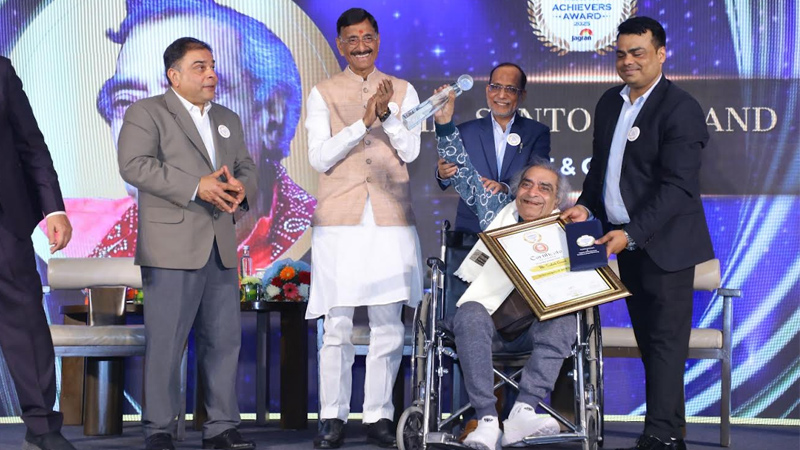
The cultural spotlight fell on veteran lyricist and poet Santosh Anand, whose songs have echoed across generations of Hindi cinema. At 97, Anand accepted the honour with characteristic humility, reflecting on a life shaped by perseverance and hope.
Healthcare honours spanned both modern and traditional systems. Manoj N. Nesari was recognised for strengthening Ayurveda’s place in national and global health frameworks. Padma shri Mohammed Abdul Waheed was honoured for his research-backed work in Unani medicine, while padma shri Mohsin Wali received recognition for his long-standing contribution to patient-centred care.
Education and social development also featured prominently. Padma shri Zahir Ishaq Kazi was honoured for decades of work in education, while former Meghalaya superintendent of Police T. C. Chacko was recognised for public service. Goonj founder Anshu Gupta received an award for his dignity-centred rural development initiatives, and the Hunar Shakti Foundation was honoured for empowering women and young girls through skill development.
The Lifetime Achievement Award went to former IAS officer Shailaja Chandra for her long career in public healthcare and governance, particularly in the traditional systems under Ayush.
Speaking at the event, Hamdard chairman Abdul Majeed said the awards were a tribute to those who combine excellence with empathy. “These awardees reflect Hakeem Sahib’s belief that healthcare, education and public service must ultimately serve humanity,” he said.
Minister Seth struck a forward-looking note, saying India’s young population gives the country a unique opportunity to become a global destination for learning, health and wellness by 2047.
The ceremony also featured the trailer launch of Unani Ki Kahaani, an upcoming documentary starring actor Jim Sarbh, set to premiere on Discovery on 11 February.
Instituted in memory of Unani scholar and educationist Hakeem Abdul Hameed, the awards have grown into a national platform that celebrates those building a more inclusive and resilient India. For one evening at least, the spotlight was not just on success, but on service with substance.








