News Headline
Trai vs broadcasters: Impact could be larger than expected


Mumbai: The TV industry is eagerly awaiting the outcome of the court battle between the Telecom Regulatory Authority of India (Trai) and TV broadcasters led by the Indian Broadcasting Foundation (IBF) on the new tariff order (NTO) 2.0 case that will be heard on 30 November.
The decision taken by the Supreme Court in the final hearing will significantly alter the dynamics of the TV broadcast industry that have been in place for more than a decade. The conflict essentially from Trai’s point of view is the fight for consumer’s choice that is being taken away by broadcasters.
There are 346 pay-TV channels available to consumers, out of which leading broadcasters own and operate 255 pay channels. It’s standard industry practice to offer their pay channels in a bouquet that has a significant discount. This way the broadcasters can cross-subsidise their channels in a way that even a weak channel has an opportunity to get viewership.

There are driver channels whose viewership is self-driven and niche channels that have a small but dedicated viewership. Trai’s contention is that broadcasters are pushing these ‘extra’ channels on to consumers to increase their revenues from advertising which accounts for two-thirds of their overall revenues.
A senior expert in the broadcasting industry remarked that this view of Trai does not consider the complexities of the sector and understand what the broadcast consumer wants. “India is a price-sensitive market – we want everything to be free or at the cheapest but, at the same time, the best-in-class service,” he said requesting anonymity.
There’s always going to be content on TV that the consumer doesn’t want to watch. On linear TV if the consumer wants to watch different content, he/she may switch the channel and watch something else. That’s why it makes sense for the consumer to have the option of multiple channels available.
With the agenda of allowing consumers to pay only for the channels that they want, Trai mandated that broadcasters announce a-la-carte tariffs of their channels. To ensure that broadcasters do not entice consumers into opting for bouquets that are heavily discounted it created provisions in the amendment order to counter the practice. It mandated that a channel must have MRP no greater than Rs 12 to be included in a bouquet. It also prescribed a linkage between the a-la-carte price and bouquet by mandating that the sum of the a-la-carte price of channels in a bouquet will not be more than 1.5 times the bouquet price.
Whatever consequence Trai had intended, the outcome of the NTO 2.0 has been very different. While the case is being fought in the SC, on 15 October broadcasters announced their reference interconnection offers (RIOs) and new channel rates adhering to the regulator’s order. If the consumer chooses to keep the same number of channels, then his/her content costs are likely to go up when the new tariffs come into effect on 1 December. They have listed the MRP price of their popular channels greater than Rs 12 which means that none of these channels will be a part of the broadcaster’s bouquets.
There isn’t enough data to predict the resulting consumer behaviour after the implementation of the amendment order. The only example of a-la-carte implementation is the conditional access system (CAS) in 2007. CAS is a digital mode of transmission of TV channels via set-top-box (STB) and was rolled out in select metros – Mumbai, Delhi, Kolkata, and Chennai.
“When CAS was implemented on a small population the consumer had opted for about 5-15 pay channels,” said a senior official from a leading cable operator on condition of anonymity.
Note that this was a period when Star India was offering about eight channels versus 76 it is offering today. “Back then you had to offer every channel a-la-carte and Trai had fixed a ceiling price for pay channels at Rs 5,” he added.
NTO 2.0 implementation will have an impact on a much larger scale. There is a huge economic divide between TV viewing audiences in India. As the official from the cable company puts it, “On the one hand, you have a consumer who decides to be economical and only watch FTA channels. We estimate that there are 30-50 million audiences who only watch Doordarshan on DD Free Dish. On the other hand, you have consumers who are ready to pay Rs 2, 000 to get an OTT subscription including Netflix, Prime Video, Disney+ Hotstar, SonyLIV, ZEE5, and Voot and they will have access to all their TV content as well. The rest of the consumers fall in between these two extremes.”
So, what will be the consequence of broadcasters pulling their MRP channels out of the bouquet? “Personally, I have yet to see a car (niche channels) run without an engine (driver channels)” said the cable operator spokesperson. “Till date, driver channels have taken other channels to the same viewership level.”
According to Trai, broadcasters are exploiting the freedom afforded to them by the NTO 2.0 provisions for a-la-carte pricing and have arbitrarily hiked the prices of their channels and that the new tariffs do not reflect consumer demand. The Tamil Nadu Digital Cable TV Operators Association has gone as far as to send a legal notice to Trai demanding that it intervene and ask broadcasters to reduce channel prices. It claimed that the new tariffs may inflate consumer bills by 100-200 per cent.
“The distributed platform operators (DPOs) have begrudged broadcasters who are not only able to launch more channels, but they also get advertisement revenue. This has led to a corporate rivalry where unfortunately Trai has lent an ear to DPOs without understanding what’s best for the consumer and the larger creative ecosystem,” said an expert from the broadcast business.
“The success of over-the-top platforms proves that without an overzealous regulator and fragmented/unruly intermediary, the content creators are able to know the pulse of their audience and cater to their needs and tastes. Additionally, content and carriage are neatly differentiated with transparency and accountability,” he added.
OTT platforms have a mix of blockbuster and long-tail content that they offer to consumers. Most consumers come to OTT platforms to watch their blockbuster content, and some may also enjoy their longtail content. The OTT player can continue making enormous investments in fresh content because of the steady monthly subscription fee that it charges the viewer.
It’s clear that the implementation of the NTO 2.0 based on the tariffs announced by leading broadcasters will essentially increase content costs for the consumer. The consumer must either opt for fewer channels to keep TV bills at the same levels or pay a higher cost in subscriptions. Trai has said that it will keep an eye on the industry and ensure that consumer bills do not go up.





NEW DELHI: Hamdard Laboratories gathered a cross-section of India’s achievers in New Delhi on Friday, handing out the Hakeem Abdul Hameed Excellence Awards to figures who have left their mark across healthcare, education, sport, public service and the arts.
The ceremony, attended by minister of state for defence Sanjay Seth and senior officials from the ministry of Ayush, celebrated individuals whose work blends professional success with a sense of public purpose. It was as much a roll call of achievement as it was a reminder that influence is not measured only in profits or podiums, but in people reached and lives improved.
Among the headline awardees was Alakh Pandey, founder and chief executive of PhysicsWallah, recognised for turning affordable digital learning into a mass movement. On the sporting front, Arjuna Awardee and kabaddi player Sakshi Puniya was honoured for her contribution to the game and for pushing women’s participation onto bigger stages.
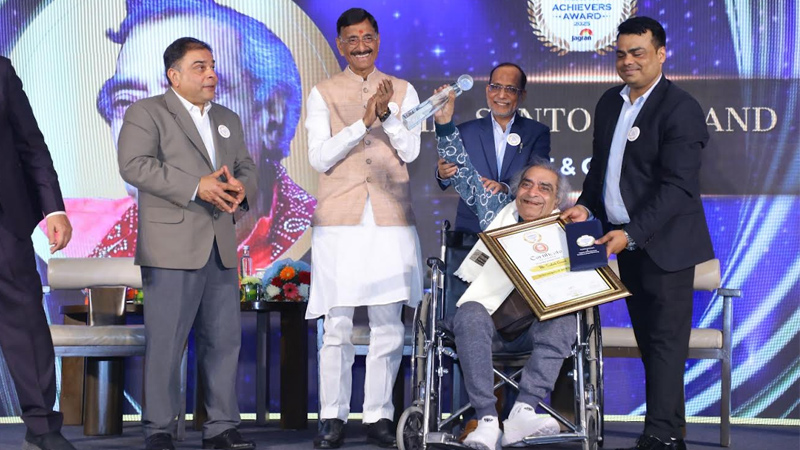
The cultural spotlight fell on veteran lyricist and poet Santosh Anand, whose songs have echoed across generations of Hindi cinema. At 97, Anand accepted the honour with characteristic humility, reflecting on a life shaped by perseverance and hope.
Healthcare honours spanned both modern and traditional systems. Manoj N. Nesari was recognised for strengthening Ayurveda’s place in national and global health frameworks. Padma shri Mohammed Abdul Waheed was honoured for his research-backed work in Unani medicine, while padma shri Mohsin Wali received recognition for his long-standing contribution to patient-centred care.
Education and social development also featured prominently. Padma shri Zahir Ishaq Kazi was honoured for decades of work in education, while former Meghalaya superintendent of Police T. C. Chacko was recognised for public service. Goonj founder Anshu Gupta received an award for his dignity-centred rural development initiatives, and the Hunar Shakti Foundation was honoured for empowering women and young girls through skill development.
The Lifetime Achievement Award went to former IAS officer Shailaja Chandra for her long career in public healthcare and governance, particularly in the traditional systems under Ayush.
Speaking at the event, Hamdard chairman Abdul Majeed said the awards were a tribute to those who combine excellence with empathy. “These awardees reflect Hakeem Sahib’s belief that healthcare, education and public service must ultimately serve humanity,” he said.
Minister Seth struck a forward-looking note, saying India’s young population gives the country a unique opportunity to become a global destination for learning, health and wellness by 2047.
The ceremony also featured the trailer launch of Unani Ki Kahaani, an upcoming documentary starring actor Jim Sarbh, set to premiere on Discovery on 11 February.
Instituted in memory of Unani scholar and educationist Hakeem Abdul Hameed, the awards have grown into a national platform that celebrates those building a more inclusive and resilient India. For one evening at least, the spotlight was not just on success, but on service with substance.