News Broadcasting
TRAI to mandate STB norms, channel pricing, ad duration

NEW DELHI / MUMBAI: In what is seen as addressing a crying need of the industry, the government today, through a notification, entrusted the Telecom regulatory Authority of India (TRAI) with additional responsibility of overseeing broadcasting and cable services as a regulator.
What is interesting is that, taking advantage of the various clauses in the Act, broadcasting and cable services have been redesignated as telecommunication services, fuelling speculation that now big time telecom players like Reliance, Tatas and Bharti would get very active in this sector and that the powers of the information and broadcasting ministry have diminished.
Asked whether TRAI would put a stop to the implementation of CAS, being carried out in South Delhi, as an interim measure, Baijal, however, did not give a direct reply. According to him, “CAS is not something new. It is prevalent in other countries too. But we’ll have to sit down with the industry people to understand the issue better before we can say something specific in this regard.”

It needs noting here that TRAI’s role as a regulator would be recommendatory in nature and the final call on decisions relating to policies would be taken by the government.
One of the important functions of the broadcasting regulator would be to protect collective consumer interest. Some of the functions of the Authority that will now apply to the broadcasting sector include the following:
a. Recommendations on measures to facilitate competition and promote efficiency in the operation of broadcasting services so as to facilitate growth in such services;
b. Recommendations on technological improvements in the services provided by the service providers;
c. Ensure compliance of terms and conditions of license;
d. Ensure technical compatibility and effective interconnection between different service providers;
e. Regulate arrangements amongst service providers of sharing their revenue derived from providing broadcasting and cable services;
f. Lay down the standards of quality of service to be provided by the service providers and ensure the quality of service and conduct periodical survey of such a service provided by the service providers so as to protect the interests of the consumers of the service.
In addition to these functions, the notification reflects the government’s concern for consumers’ interests and provides for the following:
a. The terms and conditions on which the “addressable systems such as set top boxes”, are to be provided to customers;
b. The parameters for regulating maximum time for advertisements in pay channels as well as other channels;
c. To prescribe standard norms for and periodicity of revision of rates of pay channels, including interim measures.
Though it is expected that the establishment of a regulatory authority for the broadcasting sector would result in greater transparency among the various stakeholders and better safeguarding of consumers’ interests, the industry came up with mixed reaction to this development.
Welcoming the move, Zee Telefilms vice-chairman Jawahar Goel said, “It is a positive initiative and I am sure TRAI would do full justice to faith that has been rested in it by the government and subsequently the industry too.”
He added that TRAI would now have to confabulate with the various stakeholders to get a “better understanding of the intricacies” of the industry.
Star India CEO Peter Mukerjea struck a cautionary note while pointing out that the way cable had spread in the country was very different from telecom services. Said Mukerjea, “On principal it’s a good thing because there is too much grayness in the way the industry is evolving at present. With accusations flying back and forth between broadcasters and cable operators, it is the consumer who is caught in the middle.” Mukerjea added, “If a regulator can bring in a sense of order to the proceedings then it would be good for the industry as a whole.”
SET India CEO Kunal Dasgupta, while pointing out that he had still to examine the notification in detail, said it appeared to be more distributor oriented and had no answers as far as content matters were concerned. He was referring to the part of the order which says TRAI would “prescribe standard norms for and periodicity of revision of rates of pay channels, including interim measures.”
HTMT group director and CTO KV Seshasayee also pointed to practical matters when he said, “Without a comprehensive broadcast legislation in place a regulator can only take arbitrary decisions from time to time. There will be no regime which binds all the parties in a fair way.”
“Additionally, we should not repeat the mistake of the convergence bill, where everyone wanted the bill but the legislation did not reflect the need of the market,” Seshasayee said.
Hathway CEO K Jayaraman struck a more positive note when he said, “As far as the issue of terms and conditions of providing addressable services is concerned, because it will be government mandated, consumers will not be able to raise objections in future.”
National Cable & Telecom Association president Vikki Chowdhry, however, was not so bullish. According to him, TRAI is already an “overburdened organisation” and giving it additional responsibilities would not make matters easy.
“TRAI is so deep into the hyperactive telecom sector, that it may not be able to devote adequate time to broadcasting and cable industry, where the complex nature of various issues demand a thorough knowledge,” Chowdhry added.
What is a niggling worry in some people’s mind is whether this heralds the end of the I&B ministry as a lot of powers would get transferred to TRAI and the department of telecom where a forceful minister in Arun Shourie presides over the matter.
A senior government official explained that per se it would appear so, but the notification has been worded so as to get over the technicalities.






News Broadcasting
News18 India launches Command Centre war explainer with Arya
New show shifts from debates to decoding global conflicts and impacts
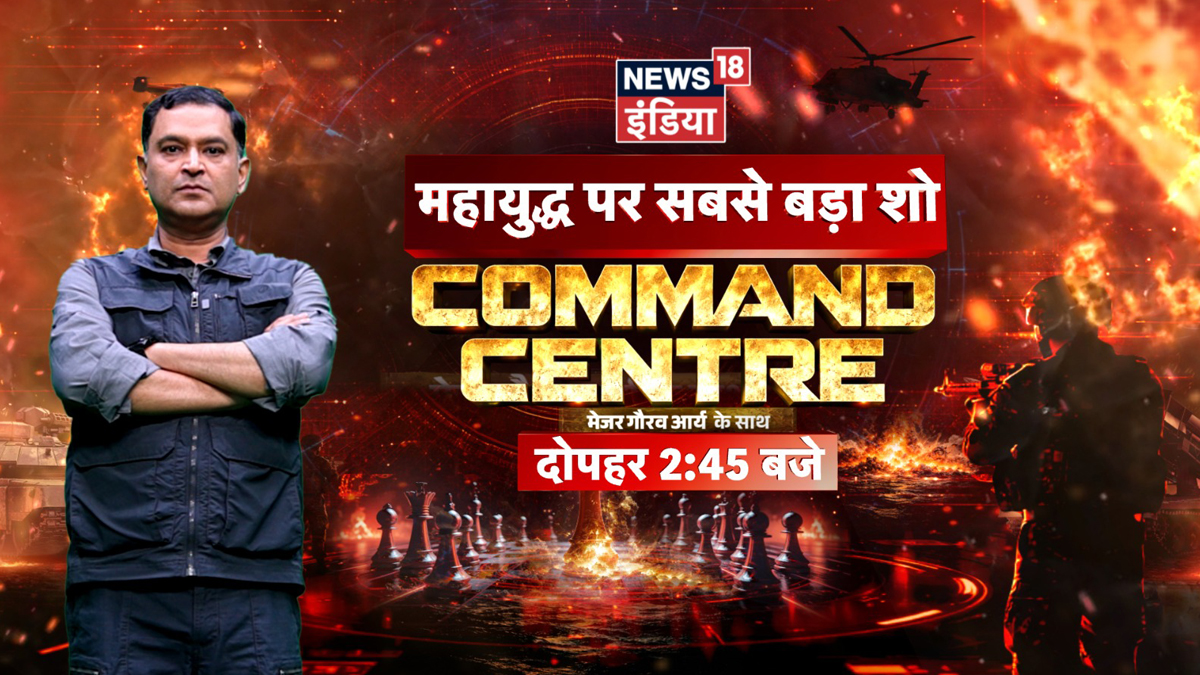
MUMBAI: News18 India has rolled out a new war-focused programme, Command Centre, featuring Gaurav Arya, as it looks to offer viewers a sharper, more grounded take on global conflicts amid rising tensions in West Asia.
Positioned as an “insider war room”, the show moves away from conventional panel debates and instead focuses on explaining military developments, decoding strategy and connecting global events to their everyday impact, from fuel prices to economic shifts.
The format leans heavily on visuals and data. The studio has been designed like a command hub, complete with large LED war maps, real-time graphics and an alert system to track developments as they unfold.
At the centre of it all is Arya, who brings his military background to simplify complex war strategies for viewers. His signature line, “Seedhi baat samjhiye”, anchors the show’s promise of clarity over noise.
News18 India managing editor Jyoti Kamal said, “Command Centre, featuring Major Gaurav Arya is designed to deliver accurate insights and a clear perspective on how evolving conflicts impact everyday life, from household budgets to national security. With expert voices analysing every development in real time, the show goes beyond headlines to decode what’s happening now, what it means, and what could come next.”
Echoing the intent, Gaurav Arya added, “In times of war, confusion is the biggest threat. With News18 India’s Command Centre, we are bringing viewers inside the war room, decoding strategies, tracking every escalation, and explaining, in the simplest terms, what it means for India and for every household. Seedhi baat samjhiye, this is where you understand not just what is happening, but what happens next.”
The weekday show will air in the afternoon slot and will also feature Gaurav Shukla, adding to its editorial depth.
With its mix of analysis, visuals and a clear focus on impact, the show reflects a broader shift in news consumption. Viewers are no longer just watching events unfold, they are looking to understand what those events mean for them.






