News Headline
TRAI suggests auction of 200 khz band for digital radio broadcast

NEW DELHI: While recommending financial incentives by government, the Telecom Regulatory Authority of India (TRAI) today recommended auctioning of 200 KHz bandwidth spectrum in VHF-II band for providing digital radio broadcasting services.
“Auction should be carried out in phases, starting with cities of category A+ and A, and subsequently in cities of other categories,” TRAI said while releasing a series of recommendations for ushering in digital radio broadcasting services in India.
TRAI further added: “Immediately after the successful auction of spectrum for digital radio broadcasting, an offer should be made to the existing FM radio broadcasters to get their existing frequency bandwidth of +100 KHz, already allocated through auction in Phase-III of FM radio, liberalised and provide digital radio broadcasting services in simulcast mode with analog FM radio services.”

Suggesting further liberalisation of existing spectrum, already allocated to the FM radio broadcasters in Phase-III of FM radio, according to TRAI, the existing FM players will have to pay an amount equal to the difference of auction determined price of equivalent spectrum for digital radio broadcasting in a city and amount paid for allocation of FM radio frequency.
At present, analog terrestrial radio broadcast in India is carried out in medium wave (MW) short wave (SW) and VHF-II (FM band) spectrum bands. AIR, the public service broadcaster, has established 467 radio stations encompassing 662 radio transmitters, which include 140 MW, 48 SW and 474 FM transmitters. Private sector radio broadcasters are licensed to transmit programs in FM frequency band (88-108 MHz) only and presently operate through 322 radio stations in 86 cities. Presently, radio signals are largely transmitted in analog mode in the country.
Analog terrestrial radio broadcasting, when compared with digital mode, is inefficient and suffers from operational restrictions. With the advancement in technologies, digital radio technologies around the globe have been developed and adopted by a number of countries in order to offer more choice to listeners along with efficient use of spectrum. Digital Radio broadcasting provides a number of advantages over analog radio broadcasting. The biggest advantage of digital radio is that it is possible to broadcast three to four channels on a single frequency carrier, while ensuring excellent quality of audio for all the channels whereas analog mode broadcasts only one channel on a frequency carrier.
The TRAI said it hopes the recommendations would enable a smooth transition from analog to digital radio broadcasting services, without disruption of the existing FM Radio services.
The salient features of the recommendations are as follows:
— Government should notify the policy framework for digital radio broadcasting in India in time bound manner with clear roadmap for rollout of digital radio broadcasting services.
— The WPC wing of telecoms Ministry should carry out necessary amendments in NFAP- 2011 for permitting digital radio broadcasting in MW, SW, and VHF-II frequency bands.
— Private sector should .be permitted to provide digital radio broadcasting services within the existing frequency band of 88 -108 MHz used for FM radio broadcasting.
— Frequency and geographical area coverage planning for digital radio broadcasting using the vacant 600 KHz spectrum in VHF-II (88 -108 MHz) and VHF-III (174-230 MHz) bands should be completed by BECIL, AIR, and WPC together in phased manner.
— 200 KHz bandwidth spectrum in VHF-II band should be auctioned for providing digital radio broadcasting services.
— In case market determined price of 200 KHz for digital radio broadcasting is less than or equal to the price paid by FM radio broadcasters then FM radio broadcasters will not be required to pay any additional amount and it will be permitted to provide digital radio broadcasting services also for the remaining period of permission.
— The broadcasters should be allowed to make use of any available digital technology, recognised by ITU, within the allocated/liberalised spectrum for providing digital radio broadcasting services subject to adaptation, if any, recommended by MIB/TRAI from time to time.
— No date for digital switch over of radio broadcasting services should be declared at this stage.
— Existing analog FM radio channels should be allowed to remain operational for the remaining period of their Phase-III permissions.
— The continuance of operation of existing analog FM radio channels that do not migrate to digital radio broadcasting should be reviewed after the expiry of their existing Phase-III permissions.
— The auction of remaining channels of Phase-III should be done by delinking them from technology. Broadcasters should be permitted to use any technology (analog or digital or both) for radio broadcasting on the frequency allocated to them through auction in future.
— For initial three years after declaration of digital radio broadcasting policy, the government should grant fiscal incentives in the form of lower tax rates to manufacturers of digital radio receivers.
Also Read:
TRAI seeks to regulate online streaming platforms
Trai paper seeks to streamline uplinking, downlinking norms






NEW DELHI: Hamdard Laboratories gathered a cross-section of India’s achievers in New Delhi on Friday, handing out the Hakeem Abdul Hameed Excellence Awards to figures who have left their mark across healthcare, education, sport, public service and the arts.
The ceremony, attended by minister of state for defence Sanjay Seth and senior officials from the ministry of Ayush, celebrated individuals whose work blends professional success with a sense of public purpose. It was as much a roll call of achievement as it was a reminder that influence is not measured only in profits or podiums, but in people reached and lives improved.
Among the headline awardees was Alakh Pandey, founder and chief executive of PhysicsWallah, recognised for turning affordable digital learning into a mass movement. On the sporting front, Arjuna Awardee and kabaddi player Sakshi Puniya was honoured for her contribution to the game and for pushing women’s participation onto bigger stages.
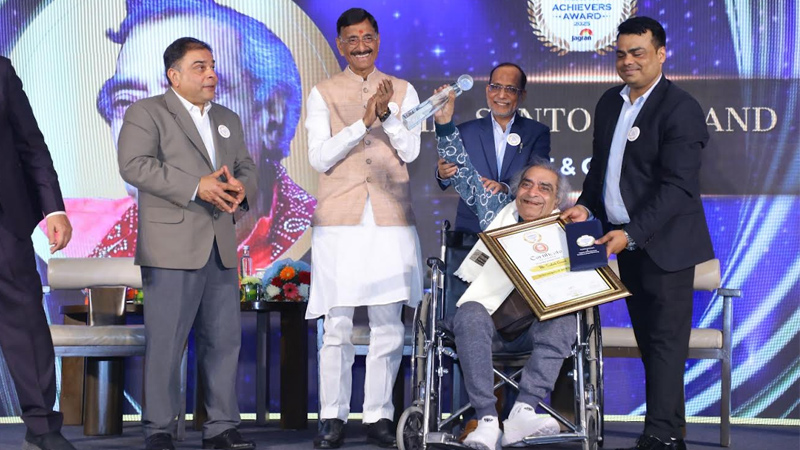
The cultural spotlight fell on veteran lyricist and poet Santosh Anand, whose songs have echoed across generations of Hindi cinema. At 97, Anand accepted the honour with characteristic humility, reflecting on a life shaped by perseverance and hope.
Healthcare honours spanned both modern and traditional systems. Manoj N. Nesari was recognised for strengthening Ayurveda’s place in national and global health frameworks. Padma shri Mohammed Abdul Waheed was honoured for his research-backed work in Unani medicine, while padma shri Mohsin Wali received recognition for his long-standing contribution to patient-centred care.
Education and social development also featured prominently. Padma shri Zahir Ishaq Kazi was honoured for decades of work in education, while former Meghalaya superintendent of Police T. C. Chacko was recognised for public service. Goonj founder Anshu Gupta received an award for his dignity-centred rural development initiatives, and the Hunar Shakti Foundation was honoured for empowering women and young girls through skill development.
The Lifetime Achievement Award went to former IAS officer Shailaja Chandra for her long career in public healthcare and governance, particularly in the traditional systems under Ayush.
Speaking at the event, Hamdard chairman Abdul Majeed said the awards were a tribute to those who combine excellence with empathy. “These awardees reflect Hakeem Sahib’s belief that healthcare, education and public service must ultimately serve humanity,” he said.
Minister Seth struck a forward-looking note, saying India’s young population gives the country a unique opportunity to become a global destination for learning, health and wellness by 2047.
The ceremony also featured the trailer launch of Unani Ki Kahaani, an upcoming documentary starring actor Jim Sarbh, set to premiere on Discovery on 11 February.
Instituted in memory of Unani scholar and educationist Hakeem Abdul Hameed, the awards have grown into a national platform that celebrates those building a more inclusive and resilient India. For one evening at least, the spotlight was not just on success, but on service with substance.






