News Headline
TRAI says it favours auctioning of entire spectrum in any LSA


NEW DELHI: The Telecom Regulatory Authority of India has told the Department of Telecommunications that holding back some of the spectrum in 700 MHz (i.e. 15+15 MHz) from this auction and selling it after a gap of certain period of time from now would lead to non-utilization of this scarce natural resource for that period, though it has the potential to be reused and reallocated.
Responding to a lengthy note by the DoT on various issues relating to auction of spectrum, the TRAI has by and large stuck to its original recommendations on most questions raised before it.
It said any delay in award of spectrum or non-utilization of spectrum would turn into irreversible loss to the Government (in the form of levies and taxes) and to the society (in the form of better services, contribution to other related activities etc.).

Even if it is assumed that greater revenue can be generated by auctioning a part of spectrum in 700 MHz band in future, deferring the revenue receipts now may not be of economic prudence keeping in view the impact of telecom services on the other sectors and overall GDP growth. Telecom connectivity is now the basic infrastructure in any society for networking, conveying important economic and social benefits.
The Authority emphasised that the broadband connectivity is the first pillar of ‘Digital India’ Programme of the government, which can be fulfilled quickly if sufficient quantity of spectrum is made available. Further, National Telecom Policy-2012 envisages making available additional 300 MHz spectrum by the year 2017 and 500 MHz by the year 2020 for IMT services. If all the available spectrum is put to auction, it will result in increased availability of spectrum which will result in serving larger subscriber base, increased data speed as well as growth and overall increase in economic and other networked activities. This will result in more recurring revenue to the government in terms of license fee, spectrum usage charges, service tax, etc.
Spectrum being a scarce resource, auction of spectrum is primarily to solve the allocative problem in an open, transparent manner and revenue maximization cannot be (and should not be) the only objective of auction where the Government is an auctioneer. The government has to a strike a balance between its fiscal targets and its responsibility to promote and encourage growth of the telecom sector.
Presently, India is way behind in the broadband penetration and the internet speeds in the world and 700 MHz band can prove to be a vital band for proliferation of broadband in the country. In view of the above, the authority is of the opinion that entire spectrum in the 700 MHz band is required to be made available for commercial use without any delay. Accordingly, the authority reiterates its earlier recommendation that entire available spectrum (2x35MHz) in the 700 MHz band should be put to auction in the upcoming auction.
The authority has been in favour of auctioning of all the available spectrum in entire LSA(s). However, the authority had recommended that partial spectrum available in Bihar, Rajasthan and North-East LSAs should not be put to auction till such time it becomes available in at least 75% of total number of districts of the LSA including the state capital(s). As 1.0 MHz of spectrum in 1800 MHz band is available in entire service area of Rajasthan it should be put to auction. Moreover, DoT is carrying out process of harmonisation of spectrum in this band, therefore, issue of partial spectrum may not arise.
It said telecom service providers feel that the escalation in the number of mobile drops, especially in urban and metro areas, can also be attributed to spectrum related issues, including shortage of spectrum supply. In order to serve the telecom needs of ever increasing subscriber base, the authority has recommended to DoT, from time to time, for making additional spectrum available in existing as well as new bands for commercial use. Further, in all the spectrum auctions held since 2012, the authority has been recommending to put to auction the entire available spectrum with the DoT. I
As stated in the recommendations dated 27 January 2016, 700 MHz band is a sought after band for LTE deployment around the world due to its efficiency and higher penetration inside buildings. Due to lower frequency, it provides wider coverage which reduces number of towers required for setting up the LTE network and thus significantly cuts down capital expenditure involved in making the network live. In 42 countries commercial networks have been deployed in this band. After the assignment of spectrum in this band in India, it is expected that there will be an accelerated deployment of device eco-system due to ‘economies of scale’ that will be delivered on account of large subscriber base.
The authority is of the view that if a service provider is not utilizing the administratively assigned spectrum without any justification, the licensor should take back the assigned spectrum.
The DoT may take the legal opinion on the above issue and start the process of withdrawal of the spectrum separately. As soon as this spectrum becomes available, the same should be put to auction.
The authority is of the opinion that there is no need for any modification in the provisions of the latest NIA with respect to block size and minimum quantum of spectrum that a new entrant/existing licenses/expiry licensee is required to bid for in 900/1800 MHz band. However, due to limited availability of spectrum in some LSAs in 900/1800 bands minimum spectrum, that a bidder is required to bid for, has been amended in these LSAs.






NEW DELHI: Hamdard Laboratories gathered a cross-section of India’s achievers in New Delhi on Friday, handing out the Hakeem Abdul Hameed Excellence Awards to figures who have left their mark across healthcare, education, sport, public service and the arts.
The ceremony, attended by minister of state for defence Sanjay Seth and senior officials from the ministry of Ayush, celebrated individuals whose work blends professional success with a sense of public purpose. It was as much a roll call of achievement as it was a reminder that influence is not measured only in profits or podiums, but in people reached and lives improved.
Among the headline awardees was Alakh Pandey, founder and chief executive of PhysicsWallah, recognised for turning affordable digital learning into a mass movement. On the sporting front, Arjuna Awardee and kabaddi player Sakshi Puniya was honoured for her contribution to the game and for pushing women’s participation onto bigger stages.
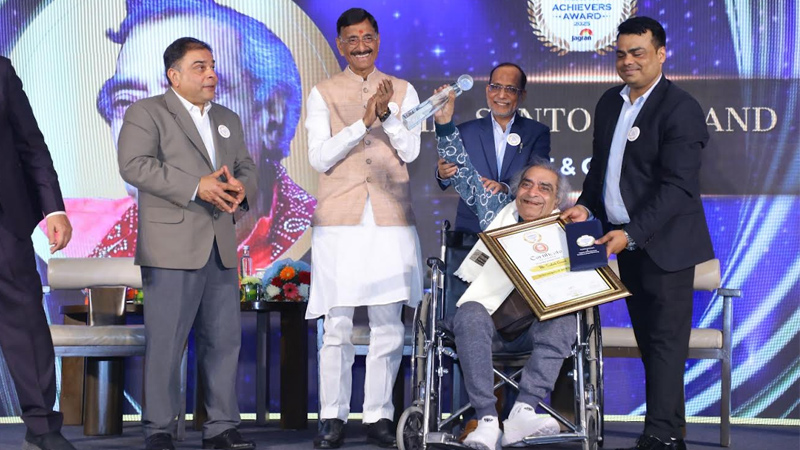
The cultural spotlight fell on veteran lyricist and poet Santosh Anand, whose songs have echoed across generations of Hindi cinema. At 97, Anand accepted the honour with characteristic humility, reflecting on a life shaped by perseverance and hope.
Healthcare honours spanned both modern and traditional systems. Manoj N. Nesari was recognised for strengthening Ayurveda’s place in national and global health frameworks. Padma shri Mohammed Abdul Waheed was honoured for his research-backed work in Unani medicine, while padma shri Mohsin Wali received recognition for his long-standing contribution to patient-centred care.
Education and social development also featured prominently. Padma shri Zahir Ishaq Kazi was honoured for decades of work in education, while former Meghalaya superintendent of Police T. C. Chacko was recognised for public service. Goonj founder Anshu Gupta received an award for his dignity-centred rural development initiatives, and the Hunar Shakti Foundation was honoured for empowering women and young girls through skill development.
The Lifetime Achievement Award went to former IAS officer Shailaja Chandra for her long career in public healthcare and governance, particularly in the traditional systems under Ayush.
Speaking at the event, Hamdard chairman Abdul Majeed said the awards were a tribute to those who combine excellence with empathy. “These awardees reflect Hakeem Sahib’s belief that healthcare, education and public service must ultimately serve humanity,” he said.
Minister Seth struck a forward-looking note, saying India’s young population gives the country a unique opportunity to become a global destination for learning, health and wellness by 2047.
The ceremony also featured the trailer launch of Unani Ki Kahaani, an upcoming documentary starring actor Jim Sarbh, set to premiere on Discovery on 11 February.
Instituted in memory of Unani scholar and educationist Hakeem Abdul Hameed, the awards have grown into a national platform that celebrates those building a more inclusive and resilient India. For one evening at least, the spotlight was not just on success, but on service with substance.






