News Headline
TRAI releases recommendations on media ownership

MUMBAI: The Telecom Regulatory Authority of India (TRAI) has released the much awaited recommendations on media ownership.
Here are the highlights of the recommendation paper:

– The news and current affairs genre will be most important and relevant genre in the product market for formulating cross media ownership rules.
– The relevant geographic market should be defined in terms of the language and the state in which the language is spoken majorly.
– A combination of reach and volume of consumption metrics should be used for computing market shares for the television segment. For calculating market shares, the GRP of a channel should be compared with the sum of the GRP ratings of all channels in the market and the market share of an entity would be the sum of the market shares of all channels controlled by it.
– The Herfindahl Hirschman Index (HHI) be adopted to measure concentration in a media segment in a relevant market.
– The cross-media ownership rules be reviewed three years after the announcement of the rules by the licensor and once every three years thereafter. The existing entities in the media sector which are in breach of the rules, should be given a maximum period of one year to comply with the rules.
– Mergers and Acquisitions (M&A) in the media sector will be permitted only to the extent that the rule based on HHI is not breached.
As far as vertical integration is concerned, the TRAI sticks to the ones given in the ‘Recommendations on Issues related to New DTH Licenses’
The regulator states that six years have passed without any concrete action on its recommendations of 2008 and 2012. It suggests that these be looked at as well.
– The entities (political bodies, religious bodies, urban, local, panchayati raj, and other publicly funded bodies, and Central and state government ministries, departments, companies, undertakings, joint ventures and government-funded entities and affiliates to be barred from entry into broadcasting and TV channel distribution sectors.
– That in case permission to any such organisations have already been granted an appropriate exit route is to be provided;
– That the arm’s length relationship between Prasar Bharati and the government be further strengthened and that such measures should ensure functional independence and autonomy of Prasar Bharati
– That pending enactment of any new legislation on broadcasting, specified disqualifications for the entities in (a) above from entering into broadcasting and/ or TV channel distribution activities should be implemented through executive decision by incorporating the disqualifications into rules, regulations and guidelines as necessary.
– Even surrogates of the entities listed above should be barred from entry into broadcasting and TV channel distribution sectors.
“Advertorials”, or for that matter any content which is paid for, a clear disclaimer should be mandated, to be printed in bold letters, stating that the succeeding content has been paid for. Placing such a disclaimer in fine print will not suffice. Action on advertorials and other material which is paid for may be taken immediately.
On grounds of the inherent conflict of interest, ownership restrictions on corporates entering the media should be seriously considered by the Government and the regulator. This may entail restricting the amount of equity holding/ loans by a corporate in a media company, viz., to comply with provisions relating to control.
Editorial independence must be ensured through a regulatory framework.
With respect to a ‘media regulator’ it recommends the following:
– Government should not regulate the media
– There should be single regulatory authority for TV and print mediums
– The regulatory body should consist of eminent persons from different walks of life, including the media. It should be manned predominantly by eminent non-media persons;
– The appointments to the regulatory body should be done through a just, fair, transparent and impartial process;
– The “media regulator” shall inter alia entertain complaints on “paid news”; “private treaties”; issues related to editorial independence; etc, investigate the complaints and shall have the power to impose and enforce an appropriate regime of penalties.
The Authority also recommends that a commission, perhaps headed by a retired Supreme Court Judge, be set up to comprehensively examine the various issues relating to the media, including the role and performance of various existing institutions, and the way forward.
Click here for the recommendation paper





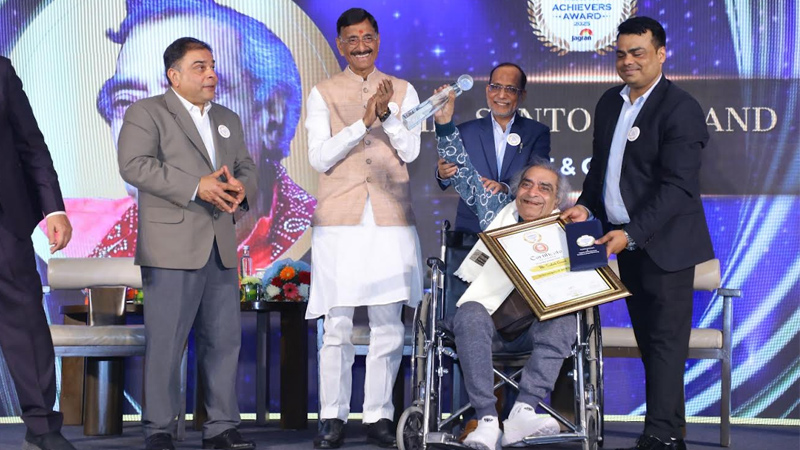
NEW DELHI: Hamdard Laboratories gathered a cross-section of India’s achievers in New Delhi on Friday, handing out the Hakeem Abdul Hameed Excellence Awards to figures who have left their mark across healthcare, education, sport, public service and the arts.
The ceremony, attended by minister of state for defence Sanjay Seth and senior officials from the ministry of Ayush, celebrated individuals whose work blends professional success with a sense of public purpose. It was as much a roll call of achievement as it was a reminder that influence is not measured only in profits or podiums, but in people reached and lives improved.
Among the headline awardees was Alakh Pandey, founder and chief executive of PhysicsWallah, recognised for turning affordable digital learning into a mass movement. On the sporting front, Arjuna Awardee and kabaddi player Sakshi Puniya was honoured for her contribution to the game and for pushing women’s participation onto bigger stages.
The cultural spotlight fell on veteran lyricist and poet Santosh Anand, whose songs have echoed across generations of Hindi cinema. At 97, Anand accepted the honour with characteristic humility, reflecting on a life shaped by perseverance and hope.
Healthcare honours spanned both modern and traditional systems. Manoj N. Nesari was recognised for strengthening Ayurveda’s place in national and global health frameworks. Padma shri Mohammed Abdul Waheed was honoured for his research-backed work in Unani medicine, while padma shri Mohsin Wali received recognition for his long-standing contribution to patient-centred care.
Education and social development also featured prominently. Padma shri Zahir Ishaq Kazi was honoured for decades of work in education, while former Meghalaya superintendent of Police T. C. Chacko was recognised for public service. Goonj founder Anshu Gupta received an award for his dignity-centred rural development initiatives, and the Hunar Shakti Foundation was honoured for empowering women and young girls through skill development.
The Lifetime Achievement Award went to former IAS officer Shailaja Chandra for her long career in public healthcare and governance, particularly in the traditional systems under Ayush.
Speaking at the event, Hamdard chairman Abdul Majeed said the awards were a tribute to those who combine excellence with empathy. “These awardees reflect Hakeem Sahib’s belief that healthcare, education and public service must ultimately serve humanity,” he said.
Minister Seth struck a forward-looking note, saying India’s young population gives the country a unique opportunity to become a global destination for learning, health and wellness by 2047.
The ceremony also featured the trailer launch of Unani Ki Kahaani, an upcoming documentary starring actor Jim Sarbh, set to premiere on Discovery on 11 February.
Instituted in memory of Unani scholar and educationist Hakeem Abdul Hameed, the awards have grown into a national platform that celebrates those building a more inclusive and resilient India. For one evening at least, the spotlight was not just on success, but on service with substance.