News Headline
Trai releases consultation paper on revision of domestic leased circuits’ tariffs


NEW DELHI: Telecom Regulatory Authority of India (Trai) has released a consultation paper proposing a downward revision of tariff applicable for Domestic Leased Circuits.
The Authority in its document, Broadband India: Recommendations of Accelerating Growth of Internet and Broadband Penetration (April, 2004) has identified the high prices of domestic leased circuits and international circuits as one of the major hurdles preventing growth of internet and broadband services.
The factors necessitating for such an exercise include the need to bring down the cost of bandwidth in the country to make user industries of bandwidth globally competitive and to promote broadband and internet access, says a Trai release.

The release has listed out some key points in the consultation paper. It says, the cost based leased line tariffs have been calculated using an optical fiber cable system with STM1 as benchmark capacity. The methodology of cost estimation adopted by Trai in this consultation paper is that of a ‘bottom-up approach’. The cost of various operators was taken into account for calculating the cost of providing the domestic leased circuit. The revised ceiling tariff for capacities of 2 Mbps and 64 Kbps for ‘beyond 500 kms distance’ comes to Rs 8,20,000 and Rs 24,000 respectively.
The proposed revision in tariff in respect of 2 Mbps and 64 Kbps for beyond 500 kms distance would mean a reduction of about 63% and 75% respectively from the existing ceiling tariff in respect of these categories.
It is expected that higher capacities i.e. above 2 Mbps will dominate the demand structure in future. Keeping this in view, price multiples for DS-3 and STM1 capacities have been proposed as eight times and twenty three times respectively the price of E1 capacity. This is based on the fact that there are scale economies arising out of higher capacities and also based on the prevailing price-capacity multiples observed elsewhere in other markets.
Towards implementing the initiatives of ‘Broadband India’, the authority has already issued a consultation paper on ‘Fixation of Ceiling Tariff for IPLC’. This consultation paper proposing revision of existing tariff for domestic leased circuits is sequel to the efforts of the authority in reducing the cost of bandwidth in the country, adds the release.
The newly released consultation paper is available on Trai’s website (www.trai.gov.in). Trai has requested all stakeholders to submit their comments and views on any or all issues raised in this paper on or before 15 July 2004.







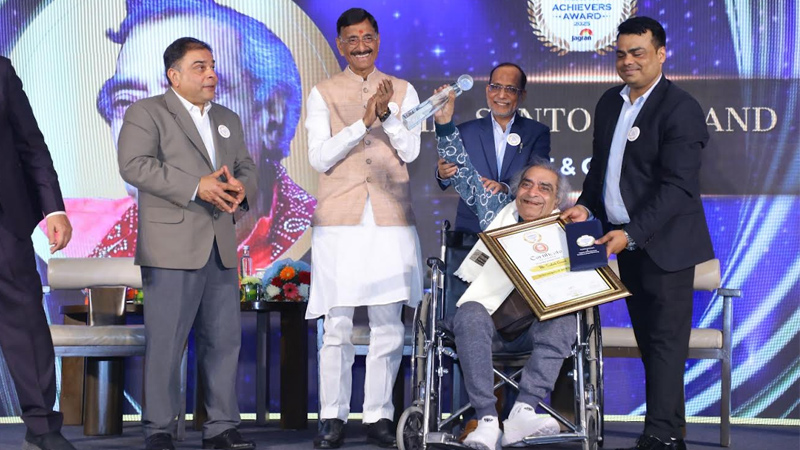
NEW DELHI: Hamdard Laboratories gathered a cross-section of India’s achievers in New Delhi on Friday, handing out the Hakeem Abdul Hameed Excellence Awards to figures who have left their mark across healthcare, education, sport, public service and the arts.
The ceremony, attended by minister of state for defence Sanjay Seth and senior officials from the ministry of Ayush, celebrated individuals whose work blends professional success with a sense of public purpose. It was as much a roll call of achievement as it was a reminder that influence is not measured only in profits or podiums, but in people reached and lives improved.
Among the headline awardees was Alakh Pandey, founder and chief executive of PhysicsWallah, recognised for turning affordable digital learning into a mass movement. On the sporting front, Arjuna Awardee and kabaddi player Sakshi Puniya was honoured for her contribution to the game and for pushing women’s participation onto bigger stages.
The cultural spotlight fell on veteran lyricist and poet Santosh Anand, whose songs have echoed across generations of Hindi cinema. At 97, Anand accepted the honour with characteristic humility, reflecting on a life shaped by perseverance and hope.
Healthcare honours spanned both modern and traditional systems. Manoj N. Nesari was recognised for strengthening Ayurveda’s place in national and global health frameworks. Padma shri Mohammed Abdul Waheed was honoured for his research-backed work in Unani medicine, while padma shri Mohsin Wali received recognition for his long-standing contribution to patient-centred care.
Education and social development also featured prominently. Padma shri Zahir Ishaq Kazi was honoured for decades of work in education, while former Meghalaya superintendent of Police T. C. Chacko was recognised for public service. Goonj founder Anshu Gupta received an award for his dignity-centred rural development initiatives, and the Hunar Shakti Foundation was honoured for empowering women and young girls through skill development.
The Lifetime Achievement Award went to former IAS officer Shailaja Chandra for her long career in public healthcare and governance, particularly in the traditional systems under Ayush.
Speaking at the event, Hamdard chairman Abdul Majeed said the awards were a tribute to those who combine excellence with empathy. “These awardees reflect Hakeem Sahib’s belief that healthcare, education and public service must ultimately serve humanity,” he said.
Minister Seth struck a forward-looking note, saying India’s young population gives the country a unique opportunity to become a global destination for learning, health and wellness by 2047.
The ceremony also featured the trailer launch of Unani Ki Kahaani, an upcoming documentary starring actor Jim Sarbh, set to premiere on Discovery on 11 February.
Instituted in memory of Unani scholar and educationist Hakeem Abdul Hameed, the awards have grown into a national platform that celebrates those building a more inclusive and resilient India. For one evening at least, the spotlight was not just on success, but on service with substance.






