News Broadcasting
TRAI releases CAS consultation note; seeks inputs by 30 Jan


MUMBAI/NEW DELHI: The Telecom Regulatory Authority of India (TRAI), which had promised to come out with a consultation note within ten days of the notification entrusting it with additional responsibility of overseeing broadcasting and cable services as a regulator, has just now released a “consultation note” for the industry.
For the present, TRAI has frozen the prices of cable services in respect of free to air (FTA) and pay channels as on 26 December 2003 for CAS and non CAS areas.
This raises the question over whether connectivity will also be frozen as of 26 December. This is in the light of certain channels claiming that they have not increased their rates, but have reduced the rates, provided the cable ops and MSOs have increased their declared subscription base, which in effect, is tantamount to a rate hike.

TRAI has said it would like written responses by 30 January, 2004 to be sent to “Dr Harsha Vardhana Singh,Secretary, TRAI (trai07@bol.net.in) or to Rajan Singla, Advisor (trai@del2.vsnl.net.in). The fax number of TRAI is 011-26193294,” says the consultation note.
Among the key issues it is seeking inputs for include:
a) The norms for fixing rates (or ceiling rates) for cable subscribers/ cable operators / Multi Service Operators for individual pay channels, bouquets thereof, and distribution of free-to-air channels; whether this should be uniform in areas under CAS and non-CAS areas or whether it should be different; other principles for determining the above mentioned rates, including periodicity of revision.
b) Regulation regarding rates of cable operators, including periodicity of change of monthly cable charges in non-CAS areas and the maximum percentage change to be allowed at any one time.
c) Principles governing the sharing of pay channel charges between broadcasters, Multi Service Operators and local cable operators.
d) The principles for laying down limits as to the extent of bundling of pay channels to be allowed in order to ensure that Cable TV viewers have a genuine choice with regard to selection of pay channels, e.g. to ensure that bundling does not discourage selection of individual channels.
e) The standard terms and conditions under which set top boxes may be made available (sale/rental) to subscribers in CAS areas and refund of charges deemed inappropriate.
f) The conditions under which consumers may return set top boxes
sold or rented to them by service providers and ask for a refund;
g) The compensation to be paid by cable operators to viewers who have
ordered pay channels if transmission is interrupted for more than a
specified portion of prime time (e.g.10%) in a month or in the case of
a sports channel, a similar portion (10%) of the time during an
important sports event. The principles for sharing this compensation between broadcasters, Multi Service Operators and local cable operators.
h) The principles to be followed for laying down the standards of quality of service to be provided by the cable operators / Multi Service Operators / Broadcasters and for ensuring the quality of service and conduct of periodic survey of such service provided by the Cable Operators / Multi Service Operators / Broadcasters so as to protect
the interests of the consumers of Broadcasting and Cable Services.
i) Measures to increase competition, promote efficiency and encourage wider consumer choice in the operation of Broadcasting and Cable services so as to serve consumer interests and to ensure the availability of services in rural and remote areas.
j) Measures for the development of Broadcasting and Cable services technology (including Direct-to-Home and Broadband) and any other matter relatable to this industry, in general.
k. Advertisements on TV channels
(i) the maximum advertising time to be permitted per half-an hour on free-to-air channels along with other conditions that are required to be imposed;
(ii) the further regulation of advertising on pay channels in reference to tariffs for the channels;
(iii) whether the restrictions at (i) & (ii) above should apply to both CAS and non-CAS areas uniformly or whether differential treatment is called for.
8.The note says that comments relating to broadcasters should include issues relevant also for authorised distributors and advertising sales agencies of pay satellite channels.






News Broadcasting
Network18 channels lead YouTube news viewership in March 2026
CNN-News18, News18 India and CNBC channels top categories with record views
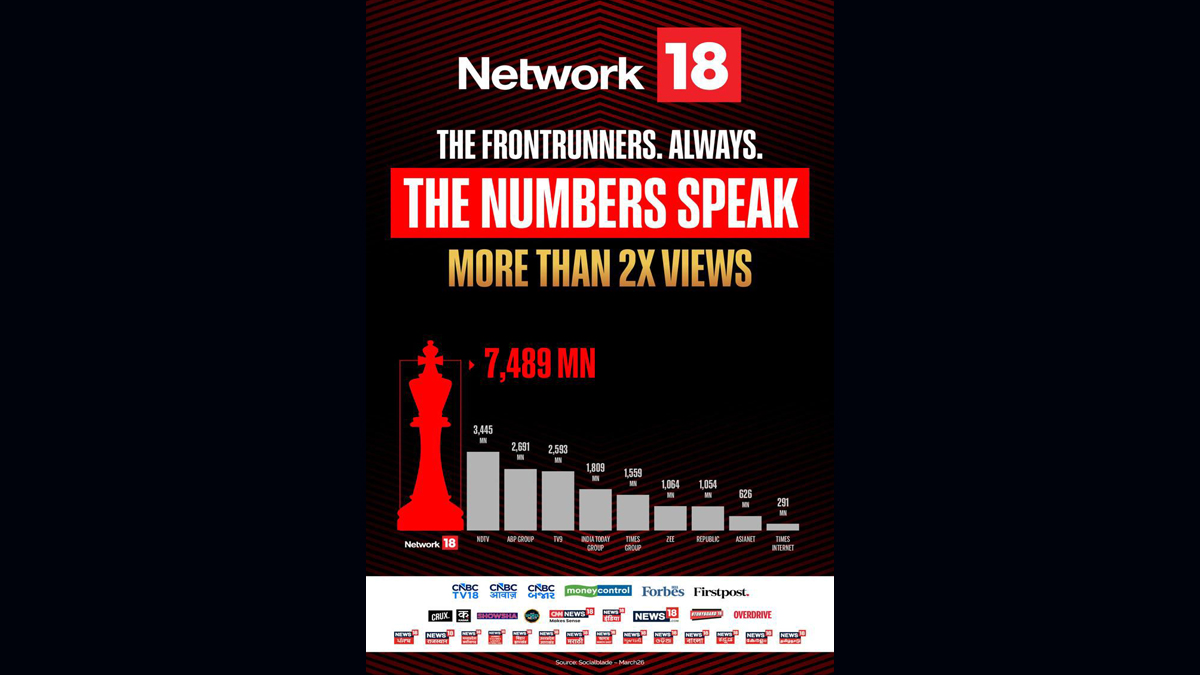
MUMBAI: When the world hit refresh on breaking news, Network18’s channels were already streaming ahead. As geopolitical tensions and war-driven headlines fuelled a surge in global news consumption, the network’s digital playbook delivered big clocking record Youtube viewership across English, Hindi and business news categories in March 2026.
At the forefront was CNN-News18, which emerged as the clear leader in the English news segment with 130 million live and video-on-demand views. The channel edged past competitors such as Times of India (126.5 million), Times Now (101.1 million), India Today (88.2 million) and NDTV (77.5 million), according to Databeings data for March.
In the Hindi news arena, News18 India delivered a commanding performance, racking up a staggering 3,297 million views on YouTube. The channel comfortably outpaced NDTV India, which recorded 3,119 million views, underlining its deep reach and consistent engagement with mass audiences, as per Playboard data.
The network’s dominance wasn’t confined to general news. In the Hindi business segment, CNBC Awaaz topped the charts with 92 million views, narrowly ahead of Zee Business (90 million) and well ahead of ET Now Swadesh (57 million). Meanwhile, its English counterpart CNBC-TV18 posted a strong 58 million views, reinforcing the network’s cross-category strength.
The spike in viewership reflects a broader shift in audience behaviour, with viewers increasingly turning to digital platforms particularly Youtube for real-time updates and in-depth coverage during high-intensity news cycles. For Network18, the numbers signal more than just scale; they underline the effectiveness of a multi-platform strategy that blends speed, credibility and continuous coverage.
In a month where the news never paused, it seems viewers chose to stay tuned where the stream never stopped.






