News Headline
TRAI open house on DAS interconnect opens up differences amongst stakeholders

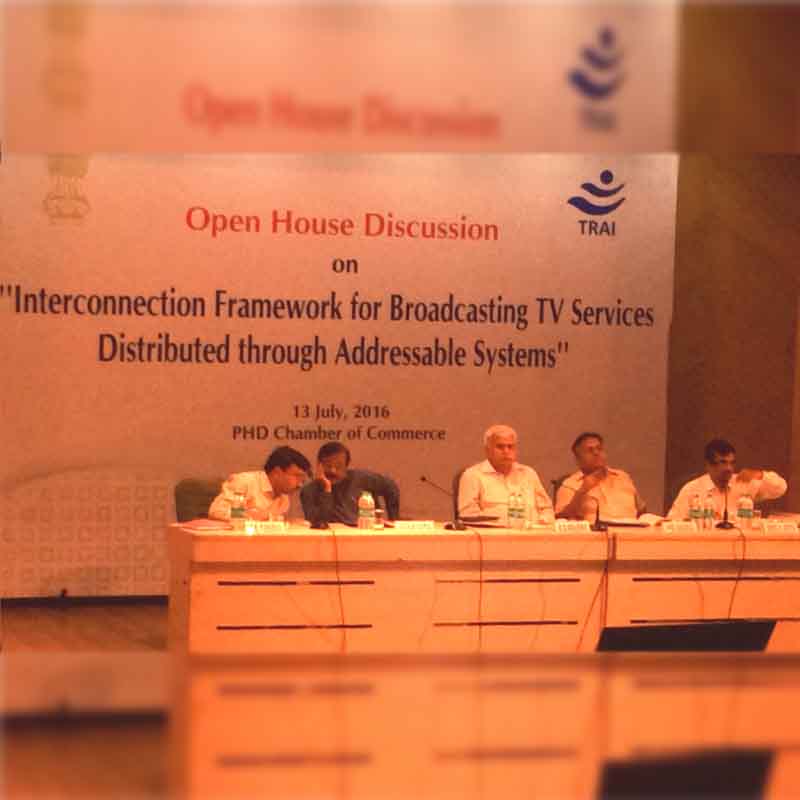
NEW DELHI: An Open House Discussion (OHD), organised by regulator TRAI on inter-connection framework for broadcasting TV services distributed through addressable systems (DAS), brought out the fact that yawning gaps still exist between broadcasters and distribution platforms.
The OHD, organised on Wednesday to garner final viewpoints of stakeholders after they have already submitted their stand on the issue, highlighted that the industry is still fighting for short to medium term gains instead of seeing the big picture.
While the broadcasting fraternity stood its ground saying, by and large, that interconnect agreements are private matters between two parties after mutually agreeing on certain terms, distribution platforms maintained that “more transparency is needed.”

“How can it be that a matter related to a broadcaster is private and nobody can ask about them, while those relating to us (distribution platforms) are supposed to be made public?” Jawahar Goel, managing director, Dish TV asked.
Goel’s probing query came after Star India, quoting various laws and regulations, said that the regulator should not encroach upon or erode broadcasters’ “right to freedom of contract in negotiating with distribution platform operators (DPOs).”
In its submission Star India had said, “The proposed regulations must allow freedom to negotiate to broadcasters so as to meet the peculiar demands of the market. Universal treatment to all seekers of signals— despite intelligible differences — is not an obligation imposed by law nor is it desirable.”
Issue like discounts offered by broadcasters, pay channels turning FTA, cloning of existing content to start another TV channel, regulation of OTT platforms managed and owned by broadcasters, cost of spectrum charges paid by consumers for accessing OTT services, the vagueness of interconnect agreements without geographical locations mentioned and the pitfalls of a proposed Interconnect Management System (IMS) whereby commercial data and information could be put in an encrypted form in limited public domain were amongst many issues brought up by stakeholders.
Pointing out broadcasters “impose stringent packaging restrictions” on DPOs, Videocon d2h, expressed its concerns on HD channels and their pricing, highlighting the fact that the difference in cost of the same content in standard definition and high-definition is hard to explain to price-sensitive consumers.
While TRAI chairman RS Sharma in the beginning observed that transparency, non-discrimination and consumer interests were paramount, amongst other things, when the regulator proposes a regulation, some MSOs and LCOs (led by a vocal Roop Sharma of Cable Operators’ Federation of India) vociferously said it’s transparency that’s lacking.
Dish TV also highlighted the discrimination between the licensing regime of DTH operators and cable ops — DTH licensee pays an annual fee, while a cable op doesn’t pay any licence fee on registration .
Bharti Telemedia, part of the telecoms-to-media giant Bharti group, reiterated Dish TV’s point on DTH ops being treated differently saying a “non-level playing field amongst the various types of service providers” exists.
In its submission to the TRAI earlier, Bharti had stated that DTH operators pay a higher tax of 34.5% and have a transparent business operation, while “digital cable operators, who have a similar nature of business, are not transparent and are also not liable to pay any licence fee.”
Though global trends indicate there’s convergence of services and service providers, in India there seems to be hardly any convergence of ideas or consensus amongst the various stakeholders and this would make any regulator’s job that much tougher. Unless one leaves market dynamics to take care of many issues that were raised at the OHD.






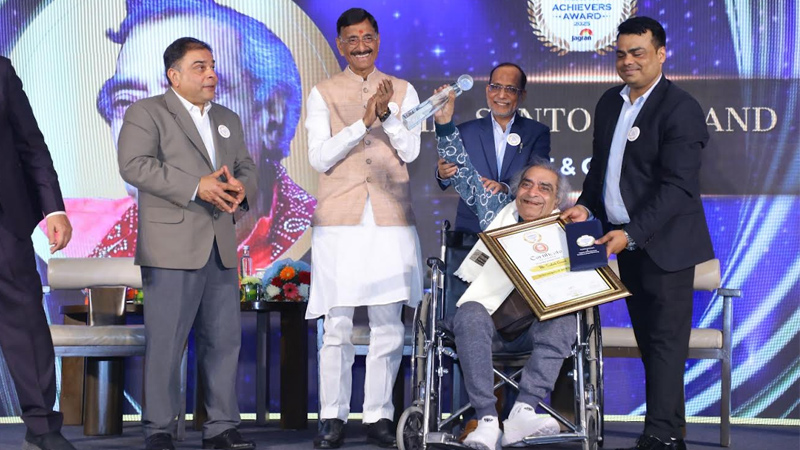
NEW DELHI: Hamdard Laboratories gathered a cross-section of India’s achievers in New Delhi on Friday, handing out the Hakeem Abdul Hameed Excellence Awards to figures who have left their mark across healthcare, education, sport, public service and the arts.
The ceremony, attended by minister of state for defence Sanjay Seth and senior officials from the ministry of Ayush, celebrated individuals whose work blends professional success with a sense of public purpose. It was as much a roll call of achievement as it was a reminder that influence is not measured only in profits or podiums, but in people reached and lives improved.
Among the headline awardees was Alakh Pandey, founder and chief executive of PhysicsWallah, recognised for turning affordable digital learning into a mass movement. On the sporting front, Arjuna Awardee and kabaddi player Sakshi Puniya was honoured for her contribution to the game and for pushing women’s participation onto bigger stages.
The cultural spotlight fell on veteran lyricist and poet Santosh Anand, whose songs have echoed across generations of Hindi cinema. At 97, Anand accepted the honour with characteristic humility, reflecting on a life shaped by perseverance and hope.
Healthcare honours spanned both modern and traditional systems. Manoj N. Nesari was recognised for strengthening Ayurveda’s place in national and global health frameworks. Padma shri Mohammed Abdul Waheed was honoured for his research-backed work in Unani medicine, while padma shri Mohsin Wali received recognition for his long-standing contribution to patient-centred care.
Education and social development also featured prominently. Padma shri Zahir Ishaq Kazi was honoured for decades of work in education, while former Meghalaya superintendent of Police T. C. Chacko was recognised for public service. Goonj founder Anshu Gupta received an award for his dignity-centred rural development initiatives, and the Hunar Shakti Foundation was honoured for empowering women and young girls through skill development.
The Lifetime Achievement Award went to former IAS officer Shailaja Chandra for her long career in public healthcare and governance, particularly in the traditional systems under Ayush.
Speaking at the event, Hamdard chairman Abdul Majeed said the awards were a tribute to those who combine excellence with empathy. “These awardees reflect Hakeem Sahib’s belief that healthcare, education and public service must ultimately serve humanity,” he said.
Minister Seth struck a forward-looking note, saying India’s young population gives the country a unique opportunity to become a global destination for learning, health and wellness by 2047.
The ceremony also featured the trailer launch of Unani Ki Kahaani, an upcoming documentary starring actor Jim Sarbh, set to premiere on Discovery on 11 February.
Instituted in memory of Unani scholar and educationist Hakeem Abdul Hameed, the awards have grown into a national platform that celebrates those building a more inclusive and resilient India. For one evening at least, the spotlight was not just on success, but on service with substance.