News Headline
Trai looks at telcos, cable ops for funding

NEW DELHI: In a bid to break the government’s financial hold over it, telecom and broadcast & cable regulator, Telecom Regulatory Authority of India (Trai), has suggested that it be allowed to keep a certain percentage of the annual license fee paid by the telecom service providers and cable operators to the government.
This would help the organisation, Trai has argued, to fund its various activities and also give it financial autonomy, the likes of which are enjoyed by other regulatory bodies like the Insurance Regulatory and Development Agency (IRDA) and the Securities Exchange Board of India (SEBI).
At present, all expenditure of Trai is met through grants from the government, which are made available through the department of telecommunications.

Contacted by indiantelevision.com, a senior official of the I&B ministry expressed surprise that such a move has been made, but hastily added, “We’ll study the proposal and further concur with our counterparts in the telecom ministry before taking a view on the matter.”
In a statement put out on its website today, Trai has said that an annual share of 0.05 per cent on the revenue base of telecom service providers and cable operators would help it meet its recurring expenditure and also have a provision for capital expenditure.
The revenue base of the telecom service providers is about Rs.550,000 million and that of the cable service providers is about Rs.150,000 million.
Pointing out that Trai’s jurisdiction rides over sectors falling under two separate ministries — ministries of communication & IT and information and broadcasting — the regulator has said a new funding process would avoid any clash about one ministry funding the activities of another.
The Trai Act provides legal authority to the organisation to frame regulations for levying fees and charges as a source to generate its own fund and keep the proceeds in the Trai General Fund.
According to information available, in 72 countries, the revenue of the telecom regulatory bodies is derived from various types of fees and charges.
Though Trai officials refused to comment on the fact as to the delay in putting such a proposal for the government’s consideration, sources in the organisation said certain developments in the finance ministry, relating to financial prudence, may have acted as a catalyst.
According to the Guidelines on Expenditure Management Fiscal Prudence and Austerity, issued by the ministry of finance on 24 September 2004, most autonomous bodies (like Trai and Prasar Bharati) are given 100 per cent deficit grants, which shall be reduced in a graded manner by 5 per cent in successive years.
This means 95 per cent in the first year, 90 per cent in the second year and so on, in respect of such bodies which have the potential of raising resources.
At present, the annual expenditure of Trai is approximately Rs.100 million and this is likely to increase this year because of additional functions of television and broadcasting regulation assigned to Trai some time back, it
has been contended.






NEW DELHI: Hamdard Laboratories gathered a cross-section of India’s achievers in New Delhi on Friday, handing out the Hakeem Abdul Hameed Excellence Awards to figures who have left their mark across healthcare, education, sport, public service and the arts.
The ceremony, attended by minister of state for defence Sanjay Seth and senior officials from the ministry of Ayush, celebrated individuals whose work blends professional success with a sense of public purpose. It was as much a roll call of achievement as it was a reminder that influence is not measured only in profits or podiums, but in people reached and lives improved.
Among the headline awardees was Alakh Pandey, founder and chief executive of PhysicsWallah, recognised for turning affordable digital learning into a mass movement. On the sporting front, Arjuna Awardee and kabaddi player Sakshi Puniya was honoured for her contribution to the game and for pushing women’s participation onto bigger stages.
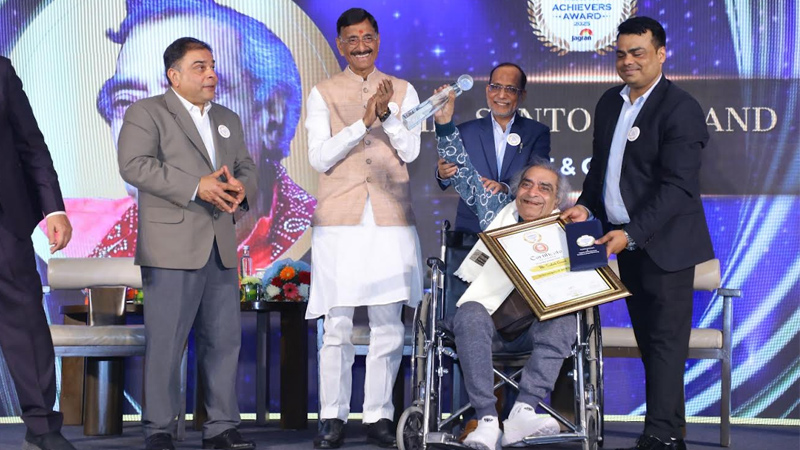
The cultural spotlight fell on veteran lyricist and poet Santosh Anand, whose songs have echoed across generations of Hindi cinema. At 97, Anand accepted the honour with characteristic humility, reflecting on a life shaped by perseverance and hope.
Healthcare honours spanned both modern and traditional systems. Manoj N. Nesari was recognised for strengthening Ayurveda’s place in national and global health frameworks. Padma shri Mohammed Abdul Waheed was honoured for his research-backed work in Unani medicine, while padma shri Mohsin Wali received recognition for his long-standing contribution to patient-centred care.
Education and social development also featured prominently. Padma shri Zahir Ishaq Kazi was honoured for decades of work in education, while former Meghalaya superintendent of Police T. C. Chacko was recognised for public service. Goonj founder Anshu Gupta received an award for his dignity-centred rural development initiatives, and the Hunar Shakti Foundation was honoured for empowering women and young girls through skill development.
The Lifetime Achievement Award went to former IAS officer Shailaja Chandra for her long career in public healthcare and governance, particularly in the traditional systems under Ayush.
Speaking at the event, Hamdard chairman Abdul Majeed said the awards were a tribute to those who combine excellence with empathy. “These awardees reflect Hakeem Sahib’s belief that healthcare, education and public service must ultimately serve humanity,” he said.
Minister Seth struck a forward-looking note, saying India’s young population gives the country a unique opportunity to become a global destination for learning, health and wellness by 2047.
The ceremony also featured the trailer launch of Unani Ki Kahaani, an upcoming documentary starring actor Jim Sarbh, set to premiere on Discovery on 11 February.
Instituted in memory of Unani scholar and educationist Hakeem Abdul Hameed, the awards have grown into a national platform that celebrates those building a more inclusive and resilient India. For one evening at least, the spotlight was not just on success, but on service with substance.








