News Headline
TRAI issues paper aimed at resolving controversial AGR for broadcast, telecom

NEW DELHI: Following a multitude of cases by both telecom and broadcast operators, the Telecom Regulatory Authority of India (TRAI) has initiated a review of the definition of Gross Revenue (GR) and the permissible deductions to arrive at Adjusted Gross Revenue (AGR) in the context of the National Telecom Policy 2012.
In a Consultation Paper on the subject, the Authority has examined the components of GR, AGR and minimum presumptive AGR, rates of Licence Fee and Spectrum Usage Charges, formats of statements of revenue and licence fee and audit and verifiability of revenue and licence fee.

Stakeholders are expected to respond to the 24 questions raised in the Consultation Paper by 1 September and counter-comments by 8 September. TRAI has made it clear that there will be no extension to these dates.
The paper on Definition of Revenue Base (AGR) for the Reckoning of Licence Fee and Spectrum Usage Charges will also examine the changes made in the licensing regime, the transition from the administrative allocation regime towards market-determined prices for spectrum, and the conclusion of tenure of many licences. The paper provides the relevant background information on the subject covering various issues involved.
On the definition of AGR specifically, the Authority had in 2012 recommended that only the revenue from the wireless services shall count towards AGR calculation for the limited purpose of calculation of Spectrum Usage Charges (SUC) that would continue to be determined on service area basis, and should be levied only in respect of those service areas where the Licensee holds any access spectrum.
TRAI wants to know whether there is a need to review/revise the definition of GR and AGR in the different licences at this stage; the guiding principles for designing the framework of the revenue sharing regime; and whether the rate of licence fee (LF) be reviewed instead of changing the definitions of GR and AGR, especially with regard to the component of USO levy, in the interest of simplicity, verifiability, and ease of administration.
The paper also wants to know whether the revenue base for levy of licence fee and spectrum usage charges include the entire income of the licensee or only income accruing from licenced activities if the definitions are to be reviewed/revised.
It has asked whether LF be levied as a percentage of GR in place of AGR in the interest of simplicity and ease of application, and should the revenue base for calculating LF and SUC include ‘other operating revenue’ and ‘other income’.
The Government prepared a draft licence agreement for International Long Distance (ILD) services in September, 2000 containing a provision that LF was payable as a percentage of revenue. For the Public Mobile Radio Trunk Service (PMRTS) too, the revenue share regime was made applicable from 1 November 2001.
The definition of AGR has been litigated since 2003. TSPs questioned the inclusion of various components of revenue in the reckoning of AGR as well as the legality of the definition before TDSAT. In 2006, TDSAT, after noting that revenue from non-licensed activities needed to be excluded from the reckonable revenue, asked TRAI to make recommendations on the inclusion or exclusion of the disputed items in the AGR. TRAI made its recommendations on 13 September 2006 and the Tribunal gave its final order in the matter on 30 August 2007 after accepting most (but modifying some) of TRAI’s recommendations.
In the course of finalising the recommendations of the Authority on the reference from TDSAT, the views of DoT were obtained by the Authority through its representative and incorporated in the “Recommendations on components of Adjusted Gross Revenue” dated 13 September 2006. The Authority was informed that the basic rationale adopted by the Government while formulating the definition of AGR was that it should be easy to interpret – so as to pose fewer problems in application and less disputes and litigations, and to make it less prone to reduction in LF liability by way of accounting jugglery; and it should be easy to verify.
The TDSAT’s judgment of 30 August 2007 was taken in appeal by DoT to the Supreme Court and was set aside by its judgment on 11 October 2011 on the grounds, among others, that TDSAT had no jurisdiction to decide the validity of the terms and conditions of the licence including the definition of AGR incorporated in the licence agreement. It was for DoT – and not TRAI and TDSAT – to take a final decision on the definition of AGR. The Supreme Court also held that a licensee can raise a dispute about the computation of AGR relating to a particular demand and that TDSAT can then examine whether the demand was in accordance with the licence agreement and the definition of AGR.
The judgment of the Supreme Court settled important points of law and has clarified the nature of the contractual relationship between the Government as licensor and the TSPs. The judgment also laid down the parameters of institutional responsibility in arriving at the contractual terms and conditions; it held that: litigation regarding the computation of LF continues before the TDSAT in the case of individual demands made on TSPs. It has also been reported that writ petitions re-agitating the revenue share definition have been filed by TSPs in different High Courts.





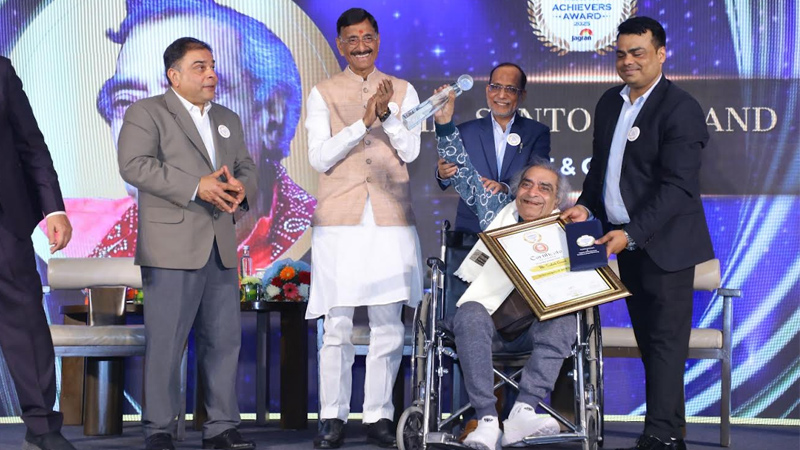
NEW DELHI: Hamdard Laboratories gathered a cross-section of India’s achievers in New Delhi on Friday, handing out the Hakeem Abdul Hameed Excellence Awards to figures who have left their mark across healthcare, education, sport, public service and the arts.
The ceremony, attended by minister of state for defence Sanjay Seth and senior officials from the ministry of Ayush, celebrated individuals whose work blends professional success with a sense of public purpose. It was as much a roll call of achievement as it was a reminder that influence is not measured only in profits or podiums, but in people reached and lives improved.
Among the headline awardees was Alakh Pandey, founder and chief executive of PhysicsWallah, recognised for turning affordable digital learning into a mass movement. On the sporting front, Arjuna Awardee and kabaddi player Sakshi Puniya was honoured for her contribution to the game and for pushing women’s participation onto bigger stages.
The cultural spotlight fell on veteran lyricist and poet Santosh Anand, whose songs have echoed across generations of Hindi cinema. At 97, Anand accepted the honour with characteristic humility, reflecting on a life shaped by perseverance and hope.
Healthcare honours spanned both modern and traditional systems. Manoj N. Nesari was recognised for strengthening Ayurveda’s place in national and global health frameworks. Padma shri Mohammed Abdul Waheed was honoured for his research-backed work in Unani medicine, while padma shri Mohsin Wali received recognition for his long-standing contribution to patient-centred care.
Education and social development also featured prominently. Padma shri Zahir Ishaq Kazi was honoured for decades of work in education, while former Meghalaya superintendent of Police T. C. Chacko was recognised for public service. Goonj founder Anshu Gupta received an award for his dignity-centred rural development initiatives, and the Hunar Shakti Foundation was honoured for empowering women and young girls through skill development.
The Lifetime Achievement Award went to former IAS officer Shailaja Chandra for her long career in public healthcare and governance, particularly in the traditional systems under Ayush.
Speaking at the event, Hamdard chairman Abdul Majeed said the awards were a tribute to those who combine excellence with empathy. “These awardees reflect Hakeem Sahib’s belief that healthcare, education and public service must ultimately serve humanity,” he said.
Minister Seth struck a forward-looking note, saying India’s young population gives the country a unique opportunity to become a global destination for learning, health and wellness by 2047.
The ceremony also featured the trailer launch of Unani Ki Kahaani, an upcoming documentary starring actor Jim Sarbh, set to premiere on Discovery on 11 February.
Instituted in memory of Unani scholar and educationist Hakeem Abdul Hameed, the awards have grown into a national platform that celebrates those building a more inclusive and resilient India. For one evening at least, the spotlight was not just on success, but on service with substance.






