News Broadcasting
Trai happy with Cas rollout, needs to look into customer choice

NEW DELHI: With 178,000 STBs seeded in the South Delhi Cas area, and an overall of just a little under 450,000 STBs seeded in the three metros as of date (Mumbai 210,000 and Kolkata 48,000-plus), the Telecom Regulatory Authority of India is happy with the physical roll out of Cas, Trai Advisor Rakesh Kacker tells indiantelevision.com.
However, there still remains the issue of implementation of the consumer choices, which has not been done so far, he informed.
Explaining the surprisingly small number of STBs that south-Kolkatans have opted for, Kacker said: “I am told that the area chosen is the problem. That (Behala and other places) is not typically the area where people would opt for the boxes.”
He explained that though people there could afford the boxes, since the initial deposit is as little as Rs 250, “I believe that people in these areas have a monthly billing of as low as Rs 70 or 80 at the most, so they feel that the FTAs is good enough for them.”

But why has the “pay-for-watching” system not been implemented so far?
“The main problem, of course, is human resources available with the cable operators to give the connections as per choice expressed by the customer. That being limited, it is taking time because of bunching of applications,” he explained.
In fact, it is a complex problem, he admitted.
“In some cases, the operators tell us that the customers have yet not filled up the form because they cannot decide. In other cases, there is the lack of manpower.”
Interestingly, one of the practices that MSOs resorted to during the transition period has further caused delay in the implementation of customer choice, or what is usually termed as “watch what you pay for”.
In the beginning, whoever paid for either renting or buying an STB had been given access by MSOs to all the available channels, and the latter had said that once the customers filed their choices – a la carte or bouquets – the bill for the first month would reflect that alone and not the entire package being shown initially.
“But customers may have started feeling that they are getting everything for the same amount of money, so why should they fill forms for specific choice? So they too are not submitting their forms,” Kacker explained.
Wasn’t there a cut off date for implementation. Some of the MSOs had told indiantelevision.com that the system of receiving all the channels would stop from January 20. Kacker, however, differed: “I am not aware of any such order by us at Trai.”
“Actually, seeding the boxes was the first priority, so now that has stabilised and now we have to implement the customer choice. I am more than happy with the number of boxes seeded, which goes a little beyond my original calculations. There was a shortage in the beginning of January because of the sudden spurt in demand, but the situation has stabilised,” Kacker added.
But what about the problem of frequent signal loss? And the fact that when there is signal box, there are no helpline numbers available on the TV screen, where it should be? Isn’t that an issue of ‘quality of service’?
Kacker dismissed the issue of signal loss and pixelisation of images, saying that the number of complaints are insignificant, and they could occur for a variety of reasons. And in any case, the helpline is always available with the customer. “Don’t tell me the customers do not know the telephone numbers of their cable operators!” he said.
Is there a decision to extend Cas to other areas in the three metros? It is too premature to say, he opined. Instead, he wants the system to stabilise.
There is no way of knowing the actual number of sets seeded by the DTH operators. But as far as controlling tariff for DTH is concerned, Kacker said Trai’s position has been expressed in an affidavit placed with TDSAT and he could not further comment on that.
Earlier last month, during a hearing of TDSAT, it was read out in the court by a lawyer for a DTH player that Trai had said it has been considering the issue of DTH tariff fixation and a consultation paper would be distributed. Trai counsels present at the hearing, but had not objected to the lawyer’s statement.
A news agency had reported that Tra has said it is too premature to consider tariff fixation for DTH, but Kacker dismissed the issue: “The agency can say what it wants to, how does it make a difference to me. We have told TDSAT what we had to.”
However, today Kacker still refused to comment, saying that the matter was in the court.
And would Trai – futuristically speaking – have any role to play in regulating Mobile TV?
“It is not clear. People speak of mobile TV as if it is one system, but this can happen through telecom through Internet, through terrestrial lines and so forth. Maybe there could be issues of quality of service or tariff fixing, but it all depends on who is providing the service and through which platform,” Kacker concluded.






News Broadcasting
News18 India launches Command Centre war explainer with Arya
New show shifts from debates to decoding global conflicts and impacts
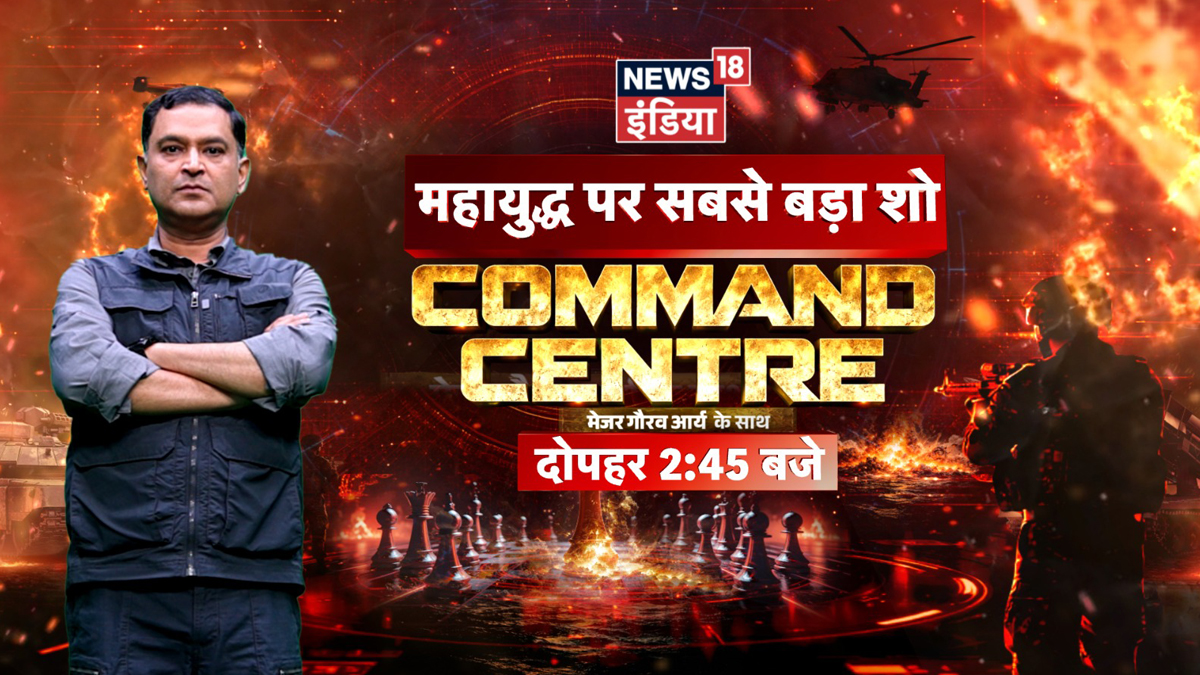
MUMBAI: News18 India has rolled out a new war-focused programme, Command Centre, featuring Gaurav Arya, as it looks to offer viewers a sharper, more grounded take on global conflicts amid rising tensions in West Asia.
Positioned as an “insider war room”, the show moves away from conventional panel debates and instead focuses on explaining military developments, decoding strategy and connecting global events to their everyday impact, from fuel prices to economic shifts.
The format leans heavily on visuals and data. The studio has been designed like a command hub, complete with large LED war maps, real-time graphics and an alert system to track developments as they unfold.
At the centre of it all is Arya, who brings his military background to simplify complex war strategies for viewers. His signature line, “Seedhi baat samjhiye”, anchors the show’s promise of clarity over noise.
News18 India managing editor Jyoti Kamal said, “Command Centre, featuring Major Gaurav Arya is designed to deliver accurate insights and a clear perspective on how evolving conflicts impact everyday life, from household budgets to national security. With expert voices analysing every development in real time, the show goes beyond headlines to decode what’s happening now, what it means, and what could come next.”
Echoing the intent, Gaurav Arya added, “In times of war, confusion is the biggest threat. With News18 India’s Command Centre, we are bringing viewers inside the war room, decoding strategies, tracking every escalation, and explaining, in the simplest terms, what it means for India and for every household. Seedhi baat samjhiye, this is where you understand not just what is happening, but what happens next.”
The weekday show will air in the afternoon slot and will also feature Gaurav Shukla, adding to its editorial depth.
With its mix of analysis, visuals and a clear focus on impact, the show reflects a broader shift in news consumption. Viewers are no longer just watching events unfold, they are looking to understand what those events mean for them.







