News Headline
TRAI for pvt players in DTT, suggests capping of transmitters


NEW DELHI: The telecom regulator TRAI has made it clear that it was in favour of private players being permitted to provide digital terrestrial transmission (DTT) services along with the public service broadcaster (Doordarshan) to ensure plurality and competition in the market.
Private participation is expected to bring in investment and speed up the digitisation process, thereby benefiting the consumers by providing variety of TV channels and value added services, it said. TRAI said the maximum number of DTT providers may be capped at five (one public broadcaster and four private broadcasters) at a particular place as per availability of spectrum.
DTT has been recommended to be introduced in three phases by 31 December 2023, beginning with metro cities by 31 December 2019. Seven months after it suo moto released a consultation paper on the subject on 24 June last year, the Telecom Regulatory Authority of India today said in its recommendations that a total of seven DTT transmitters may be allowed in a particular service area for making DTT as a competitive platform for providing rich bouquet of services including SDTV, HDTV channels, Mobile TV services and value added services.

Stressing that DTT services ‘may be introduced throughout the country in a time-bound manner to provide alternate affordable platform to consumers in accessing TV channels, Mobile TV services and other value added services’, the regulator said that after the first phase, the second phase will cover (cities having more than 10 lakh population as per Census 2011) by 31 December 2021.
The Information and Broadcasting Ministry in consultation with Wireless Planning and Coordination Wing of Department of Telecommunications and other technical agency such as Broadcast Engineering Consultants India Limited (BECIL) may carry out comprehensive frequency planning for roll out of DTT services in a time bound manner.
A maximum overlap of three month must be provided as simulcast period for migration from Analog to digital platform before analog switch off, the recommendations on “Issues related to Digital Terrestrial Broadcasting in India” said.
A Coordination Committee may be set up by the I and B Ministry to steer implementation of DTT as a mission mode project to ensure creation of a facilitating environment and timely completion for digitisation of terrestrial broadcasting.
It said terrestrial television broadcasting is the preferred method for providing free-to-air TV services to the people in most of the countries.
At present, Terrestrial TV broadcasting in India is under the exclusive domain of pubcaster Doordarshan (Prasar Bharati) and it is predominantly analogue.
Indiantelevision.com had earlier reported then Prasar Bharati Chief Executive Officer Jawhar Sircar as saying that the pubcaster had given the idea of DTT going private about two years before TRAI came out with its paper.
While a large number of TV channels are available to the consumers through various delivery platforms such as DTH, Cable TV, IPTV, HITS etc, the existing terrestrial TV platform provides only a few channels which do not offer a value proposition to the viewers.
But in the digital era, consumers prefer to have access to number of TV channels on various devices such as mobile phone and other handheld devices. However, terrestrial viewers are deprived of such benefits due to non availability of digital terrestrial broadcasting services.
Analogue terrestrial broadcasting is being phased out world over due to poor quality of service, inefficient use of spectrum and obsolescence of analog technologies.
In order to exploit benefits of digitization several countries have already switched off analog terrestrial TV broadcasting while many others are in the process of digitization as per the roadmaps laid down by them.
In India, although the work for digitization of analog terrestrial transmission has already begun, a clear roadmap is yet to be formulated to ensure an early migration to digital.
The regulator also listed the advantages of DTT over existing analogue TV services apart from better quality of TV reception – with enhanced quality of picture and sound.
This will also provide for more efficient use of frequency spectrum – one DTT transmitter can broadcast multiple TV channels (20 to 30 SD TV Channels in a given slot of 7 to 8 Mhz by using latest compression technologies). In analog , one transmitter broadcast only one TV channel.
There can be more efficient reception of TV channels in portable environment such as on moving vehicles and TV channels can also be received on mobile phones and handheld devices without requiring internet and broadband connection.
A combination of multiple DTT transmitters at a location can provide a rich bouquet of SDTV, HDTV, UHTV, mobile TV channels, radio service and other value added services. The recommendations follow an open house discussion after various stakeholders had sent in their comments.

NEW DELHI: Hamdard Laboratories gathered a cross-section of India’s achievers in New Delhi on Friday, handing out the Hakeem Abdul Hameed Excellence Awards to figures who have left their mark across healthcare, education, sport, public service and the arts.
The ceremony, attended by minister of state for defence Sanjay Seth and senior officials from the ministry of Ayush, celebrated individuals whose work blends professional success with a sense of public purpose. It was as much a roll call of achievement as it was a reminder that influence is not measured only in profits or podiums, but in people reached and lives improved.
Among the headline awardees was Alakh Pandey, founder and chief executive of PhysicsWallah, recognised for turning affordable digital learning into a mass movement. On the sporting front, Arjuna Awardee and kabaddi player Sakshi Puniya was honoured for her contribution to the game and for pushing women’s participation onto bigger stages.
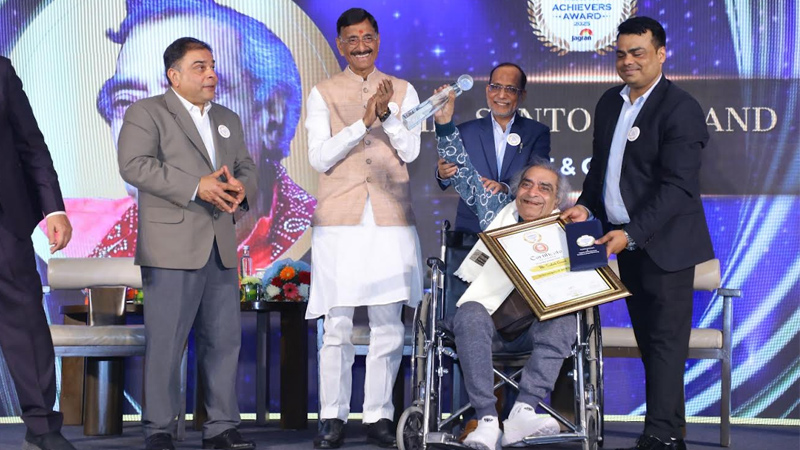
The cultural spotlight fell on veteran lyricist and poet Santosh Anand, whose songs have echoed across generations of Hindi cinema. At 97, Anand accepted the honour with characteristic humility, reflecting on a life shaped by perseverance and hope.
Healthcare honours spanned both modern and traditional systems. Manoj N. Nesari was recognised for strengthening Ayurveda’s place in national and global health frameworks. Padma shri Mohammed Abdul Waheed was honoured for his research-backed work in Unani medicine, while padma shri Mohsin Wali received recognition for his long-standing contribution to patient-centred care.
Education and social development also featured prominently. Padma shri Zahir Ishaq Kazi was honoured for decades of work in education, while former Meghalaya superintendent of Police T. C. Chacko was recognised for public service. Goonj founder Anshu Gupta received an award for his dignity-centred rural development initiatives, and the Hunar Shakti Foundation was honoured for empowering women and young girls through skill development.
The Lifetime Achievement Award went to former IAS officer Shailaja Chandra for her long career in public healthcare and governance, particularly in the traditional systems under Ayush.
Speaking at the event, Hamdard chairman Abdul Majeed said the awards were a tribute to those who combine excellence with empathy. “These awardees reflect Hakeem Sahib’s belief that healthcare, education and public service must ultimately serve humanity,” he said.
Minister Seth struck a forward-looking note, saying India’s young population gives the country a unique opportunity to become a global destination for learning, health and wellness by 2047.
The ceremony also featured the trailer launch of Unani Ki Kahaani, an upcoming documentary starring actor Jim Sarbh, set to premiere on Discovery on 11 February.
Instituted in memory of Unani scholar and educationist Hakeem Abdul Hameed, the awards have grown into a national platform that celebrates those building a more inclusive and resilient India. For one evening at least, the spotlight was not just on success, but on service with substance.






