News Headline
TRAI commences exercise at inter-operaability of STBs, isses pre-Consultation Paper


New Delhi: Noting the need for inter-operability of set top boxes as the country races towards completion of the final phase of digital addressable systems, the Telecom Regulatory Authority asked stakeholders for their opinion on the best methods for such inter-operability.
In a scenario where the government itself admits that Indian-made STBs are a mere ten per cent, it is even more imperative to find ways of smoother inter-operability since most of the STBs will be of foreign make.
In a pre-consultation paper on set top box interoperability issued today, TRAI has related the methods of inter-operability followed in Europe, Asia and the United States and asked the stakeholders to give their views by 29 April. Views have been invited from various organizations, industry bodies, standardization bodies,
STB manufacturers, chip vendors, conditional access system providers, software providers, stakeholders, experts, individuals etc

Answers have been sought to just three questions: what are the concerns that should be takencare of at the time of development of framework of interoperable of STBs; what are the techno-commercial reasons for non-interoperability of STBs; and the plausible solutions for technical interoperability of STBs and their impact on the sector’s growth.
After giving examples from around the world, the paper said there can be various possible solutions. But the views of stakeholders are necessary before starting any discussion on the possible solutions and to arrive at a common minimum agreement ofadoption of any specific standards and the way forward.
The paper also says stakeholders are free to give any relevant feedback for thedevelopment of technical inter-operability both within specific segment (cable TV and DTH) and across the segments (among cable TV and DTH operators).
The paper also lists the steps already taken by TRAI.
Based on the recommendations of TRAI for technical interoperability of STBs, theGovernment has mandated the provision of CI slot in the STBs deployed by DTH serviceproviders. The CI slot exists in the already deployed DTH STBs.
However TRAI said this effort has not been fruitful in meeting the objective of interoperabilityin India due to various reasons. These are: the availability of CI slot alone is not sufficient toachieve effective technical interoperability as other modules of STB like tuner, middleware, operating system; EPG etc. also require updation on change of service provider; DTHoperators are following different versions of standards for compression, and transmission; most of the DTH operators have not offered to customers the option of CAM card in place ofSTB; and the cost of CAM card is more or less equal to the new STB. It may be due to non-availability of economies of scale.
TRAI said it has notified tariff order prescribing standard tariff package for STBs, which provide an easy exit option to the consumers, who want to change their service providers due to one reason or the other. But the tariff order applicable for DTH is sub-judice as it is pending adjudication.
The paper says broadcasting of TV signals over distribution networks involves various steps like compression, encryption, transmission etc. For each purpose, different technologies andtheir versions have evolved over a period of time. The rules and regulations prescribed bythe government and the regulator provide freedom of choosing technology to serviceproviders. Accordingly, according to their business plans, individual service provider havechosen and implemented different technologies and their versions. The adoption of different versions of technical standards by service providers is one of the reasons for non–interoperability of STBs.
The issue relating to technical interoperability mainly hover around the question ofinteroperability of STBs, between two platforms viz DTH and cable; and question of inter-operability of STBs within the same platform i.e. with in cable or DTH systems. Further, withina platform, there could be a question of inter-operability of STBs across the different serviceproviders using the same make of CAS. Presently, STB inter-operability is not functional atany level.
The main technical reasons of STB non inter-operability are: different methods of EMM andECM encryption: ECM and EMM messages are carried in an encrypted form. Whereas DVBhas standardized the scrambling algorithm for scrambling of a channel (DVB-CSA), algorithms used for ECM/ EMM encryption are not standardized.
Different Modulation standards: using DVB-C standard whereas the signal is modulatedusing DVB-S standard in DTH. For a STB to be able to receive signal both from DTH andcable, there will be a requirement of switchable demodulator unit. Further, efficient versions namely DVB-C2 and DVB-S2 have been deployed by the operators. While the later versionsare backward compatible, earlier versions are not forward compatible. Therefore, it restrictsthe STB interoperability across the platforms as well as within the same platform using differentversions of standards.
In digital TV transmission, compression plays a very important role. There are two prominent compression standards in use today. In India, most of the operators have used, either MPEG2or MPEG4 standard for compression. In cable TV sector, due to cost advantage andavailability of sufficient bandwidth in the network, most of the STBs deployed till now are ofMPEG2 standard. While the MPEG4 standard is backward compatible, MPEG2 standard is not forward compatible. Therefore, MPEG2 compliant STBs cannot work in the MPEG4 networks.
Operating system/ middleware and EPG (Electronic Program Guide) boot loaders are specificto chip vendors and it allows the updating of STB software by specific operators afterproper verification. There is no standard operating system for STBs. DVB hasdeveloped multimedia home platform (MHP) as a standard for middleware. However the sameis not popular. Proprietary middleware, with non-standard APIs, are in use. It ensures that, theapplication software can be updated by specific operators only. Special end user applicationslike EPG installed over middleware are also unique for each operator.
The pay TV service providers are concerned about the piracy of content. They have expressedtheir apprehension about fake STBs that may be used to capture information from a validsmart card and that information may be misused to produce fake/clone smart cards. Further,the stakeholders have raised their concern about the common scrambling algorithm (DVB-CSA) which is a 48 bit scrambling mechanism, and can be broken with the help of highcapacity processors.
Therefore, the service providers are reluctant to use DVB-CSA. Operators due to theconcerns of piracy make the STB tightly coupled by integrating the Conditional Access Sub System into the chip.
All these become an impediment when a subscriber wishes to migrate to a different serviceprovider while attempting to use the same STB, and leads to concerns relating to technical inter operability.





NEW DELHI: Hamdard Laboratories gathered a cross-section of India’s achievers in New Delhi on Friday, handing out the Hakeem Abdul Hameed Excellence Awards to figures who have left their mark across healthcare, education, sport, public service and the arts.
The ceremony, attended by minister of state for defence Sanjay Seth and senior officials from the ministry of Ayush, celebrated individuals whose work blends professional success with a sense of public purpose. It was as much a roll call of achievement as it was a reminder that influence is not measured only in profits or podiums, but in people reached and lives improved.
Among the headline awardees was Alakh Pandey, founder and chief executive of PhysicsWallah, recognised for turning affordable digital learning into a mass movement. On the sporting front, Arjuna Awardee and kabaddi player Sakshi Puniya was honoured for her contribution to the game and for pushing women’s participation onto bigger stages.
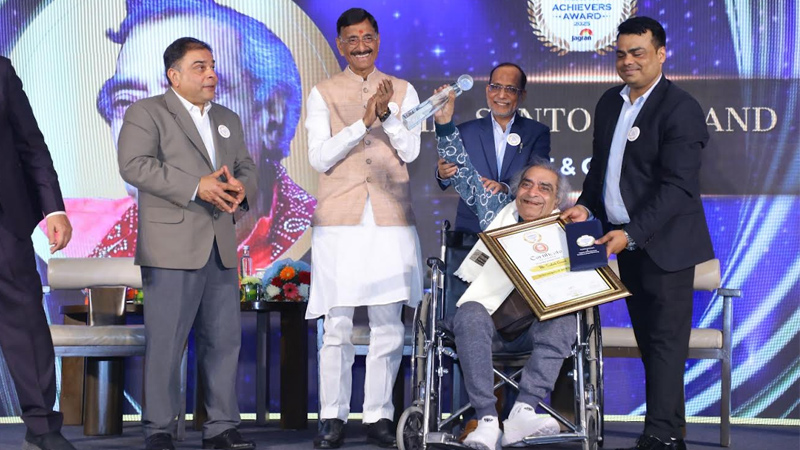
The cultural spotlight fell on veteran lyricist and poet Santosh Anand, whose songs have echoed across generations of Hindi cinema. At 97, Anand accepted the honour with characteristic humility, reflecting on a life shaped by perseverance and hope.
Healthcare honours spanned both modern and traditional systems. Manoj N. Nesari was recognised for strengthening Ayurveda’s place in national and global health frameworks. Padma shri Mohammed Abdul Waheed was honoured for his research-backed work in Unani medicine, while padma shri Mohsin Wali received recognition for his long-standing contribution to patient-centred care.
Education and social development also featured prominently. Padma shri Zahir Ishaq Kazi was honoured for decades of work in education, while former Meghalaya superintendent of Police T. C. Chacko was recognised for public service. Goonj founder Anshu Gupta received an award for his dignity-centred rural development initiatives, and the Hunar Shakti Foundation was honoured for empowering women and young girls through skill development.
The Lifetime Achievement Award went to former IAS officer Shailaja Chandra for her long career in public healthcare and governance, particularly in the traditional systems under Ayush.
Speaking at the event, Hamdard chairman Abdul Majeed said the awards were a tribute to those who combine excellence with empathy. “These awardees reflect Hakeem Sahib’s belief that healthcare, education and public service must ultimately serve humanity,” he said.
Minister Seth struck a forward-looking note, saying India’s young population gives the country a unique opportunity to become a global destination for learning, health and wellness by 2047.
The ceremony also featured the trailer launch of Unani Ki Kahaani, an upcoming documentary starring actor Jim Sarbh, set to premiere on Discovery on 11 February.
Instituted in memory of Unani scholar and educationist Hakeem Abdul Hameed, the awards have grown into a national platform that celebrates those building a more inclusive and resilient India. For one evening at least, the spotlight was not just on success, but on service with substance.






