News Headline
TRAI chief Lahoti charts bright future as India’s media waves hit full stream

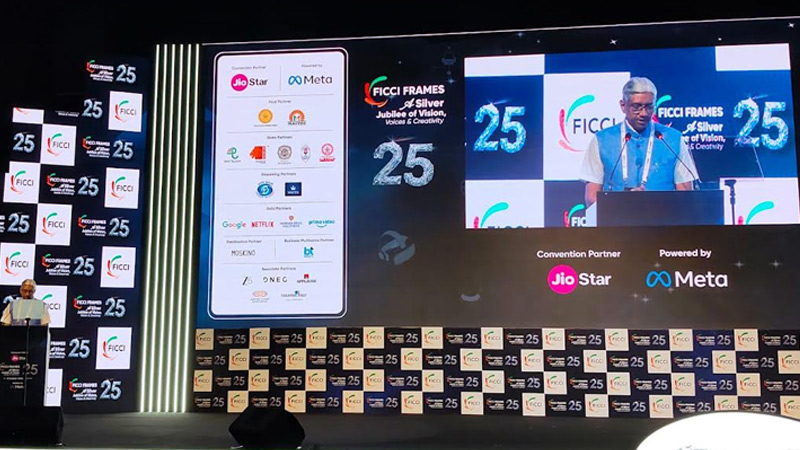
MUMBAI: When it comes to India’s media and entertainment sector, the waves are getting bigger and TRAI Chairman Anil Kumar Lahoti is steering them with both vision and precision. Addressing the 25th Ficci Frames 2025, Lahoti delved into the vibrant evolution of broadcasting, distribution, and regulation in India.
Lahoti highlighted that the media and entertainment (M&E) sector contributed Rs 2.5 trillion to the Indian economy in 2024 and is projected to grow at a CAGR of 7 per cent, crossing Rs 3 trillion by 2027. Within this, television and broadcasting alone generated nearly Rs 680 billion last year. He reflected on how the past 25 years have seen phenomenal transformation from analogue to digital transmission, standard definition to high definition, and now 4K video. Advances in audio quality and the proliferation of smart TVs have multiplied consumer choice, making content more accessible than ever.
Yet while home screens have expanded to 40–50 inches and beyond, smartphones and 4G/5G broadband are opening new frontiers. OTT users now exceed 600 million, around 41 per cent of India’s population, yet linear TV remains central, with roughly 190 million TV households, 160 million linear subscriptions, and over 100 million households yet to enter the ecosystem many of whom will start with linear TV.

The broadcast ecosystem is vast: 300 plus broadcasters, 900 plus TV channels, 388 private FM radio stations, and numerous national and international streaming platforms. Distribution involves 800 plus MSOs, 4 DTH operators, 1 HIDS operator, and a rapidly growing IPTV network, alongside 80,000 plus local cable operators. Public broadcasters Doordarshan and All India Radio operate 35 TV channels and 591 radio stations, respectively. While TRAI regulates linear TV and radio, digital content over the internet falls under the IT Intermediary Guidelines and Digital Media Ethics Code Rules 2021.
Lahoti emphasised the complexities of linear TV’s multi-player ecosystem. “Our challenge is to ensure fair, non-discriminatory deals for all players, large or small, across geographies, while balancing innovation and regulation,” he said. TRAI has been proactive, recommending policy reforms, simplified licensing under the Telecommunication Act 2023, and a regulatory framework for ground-based broadcasters, enabling transmission through non-satellite means, a significant shift from the existing satellite-only mandate.
Financial stress in FM radio has also been addressed, with TRAI recommending the rollout of digital radio services in 13 A-plus and A-category cities. Lahoti noted that rapid technological advancement from wired and wireless broadband to AI and cloud computing is reshaping content creation, distribution, and consumption. With India’s linguistic diversity 22 major languages and hundreds of dialects the opportunities for content creators are immense.
He also referenced the prime minister’s recent Waves Summit speech, highlighting the Orange Economy, powered by creativity, culture, and content. “Dream big, tell India’s untold stories, and invest not just in platforms but in people,” Lahoti quoted. The message was clear: the screen may be getting smaller, but the content’s impact is enormous.
As India’s M&E sector continues its remarkable growth, Lahoti stressed collaboration among stakeholders as essential to realising this vision. TRAI, he said, is committed to enabling orderly growth, simplifying compliance, and fostering innovation, ensuring a competitive and inclusive broadcasting ecosystem.
Wrapping up, he wished Ficci Frames continued success, expressing hope that the debates and discussions at the forum will guide the industry toward a brighter, smarter, and more connected media landscape.
In a sector worth Rs 2.5 trillion today and poised for Rs 3 trillion tomorrow, with 600 million OTT users, 190 million TV households, and a dynamic mix of technology and creativity, India’s media waves are indeed at full stream and TRAI is firmly at the helm.







NEW DELHI: Hamdard Laboratories gathered a cross-section of India’s achievers in New Delhi on Friday, handing out the Hakeem Abdul Hameed Excellence Awards to figures who have left their mark across healthcare, education, sport, public service and the arts.
The ceremony, attended by minister of state for defence Sanjay Seth and senior officials from the ministry of Ayush, celebrated individuals whose work blends professional success with a sense of public purpose. It was as much a roll call of achievement as it was a reminder that influence is not measured only in profits or podiums, but in people reached and lives improved.
Among the headline awardees was Alakh Pandey, founder and chief executive of PhysicsWallah, recognised for turning affordable digital learning into a mass movement. On the sporting front, Arjuna Awardee and kabaddi player Sakshi Puniya was honoured for her contribution to the game and for pushing women’s participation onto bigger stages.
The cultural spotlight fell on veteran lyricist and poet Santosh Anand, whose songs have echoed across generations of Hindi cinema. At 97, Anand accepted the honour with characteristic humility, reflecting on a life shaped by perseverance and hope.
Healthcare honours spanned both modern and traditional systems. Manoj N. Nesari was recognised for strengthening Ayurveda’s place in national and global health frameworks. Padma shri Mohammed Abdul Waheed was honoured for his research-backed work in Unani medicine, while padma shri Mohsin Wali received recognition for his long-standing contribution to patient-centred care.
Education and social development also featured prominently. Padma shri Zahir Ishaq Kazi was honoured for decades of work in education, while former Meghalaya superintendent of Police T. C. Chacko was recognised for public service. Goonj founder Anshu Gupta received an award for his dignity-centred rural development initiatives, and the Hunar Shakti Foundation was honoured for empowering women and young girls through skill development.
The Lifetime Achievement Award went to former IAS officer Shailaja Chandra for her long career in public healthcare and governance, particularly in the traditional systems under Ayush.
Speaking at the event, Hamdard chairman Abdul Majeed said the awards were a tribute to those who combine excellence with empathy. “These awardees reflect Hakeem Sahib’s belief that healthcare, education and public service must ultimately serve humanity,” he said.
Minister Seth struck a forward-looking note, saying India’s young population gives the country a unique opportunity to become a global destination for learning, health and wellness by 2047.
The ceremony also featured the trailer launch of Unani Ki Kahaani, an upcoming documentary starring actor Jim Sarbh, set to premiere on Discovery on 11 February.
Instituted in memory of Unani scholar and educationist Hakeem Abdul Hameed, the awards have grown into a national platform that celebrates those building a more inclusive and resilient India. For one evening at least, the spotlight was not just on success, but on service with substance.







