News Headline
TRAI brings out detailed paper on spectrum auctions


NEW DELHI: The government should immediately take back the unused 900 MHz from the Bharatiya Sanchar Nigam Limited (BSNL) and from the Defence Ministry the unused spectrum in the 1800 MHz band, the Telecom Regulatory Authority of India (TRAI) has said.
In its recommendations on “Valuation and Reserve Price of Spectrum: Licences expiring in 2015-16”, TRAI has also asked the Department of Telecom (DoT) to have a fresh look at the implementation of E-GSM band.
The entire 2×60 MHz in the 2100 MHz band should be made available for commercial use.
The government should announce the roadmap for the auction of spectrum in 700 MHz band. This should be done before the conduct of the upcoming auctions in 900/1800 MHz band.
The MHz spectrum in 900 MHz band should be taken back from BSNL from all the Licence Service Area (LSAs), where licences expire in 2015-16 except in Punjab. In lieu, BSNL should be assigned 1.2 MHz in the 1800 MHz band only in those LSAs where its spectrum holding in that band is less than 3.8 MHz in this band that is, in Gujarat, Rajasthan and West Bengal.
Unused spectrum in the Defence band should not be kept idle. In the LSAs, where spectrum assigned to Defence in the 1800 MHz band is more than 20 MHz, DoT should coordinate with Defence for the vacation of spectrum held by Defence in excess of 20 MHz.
A dialogue needs to be held at the level of the Finance Minister, the Minister of Communications and IT and the Defence Minister to ensure the availability of additional spectrum for commercial use.
At the outset, TRAI said the DoT had in April 2014 communicated that some of the Telecom Service Providers’ (TSPs) licences are due to expire during December 2015 and early 2016 and sought TRAI’s recommendations on the applicable reserve price for all the service areas for auction of spectrum in 900 MHz and 1800 MHz bands. After getting further information from DoT on certain points, TRAI had issued a consultation paper and received responses apart from an Open House Discussion.
The Authority has highlighted that the upcoming auction is critical for the Telecom Service Providers (TSPs) whose licences are due to expire in 2015-16. In the 900 MHz band, only the spectrum held by them is av ailable for the auction.
These licensees will have to win back this spectrum to ensure business continuity in a LSA; if they don’t, it places the large investment made in the LSAs in jeopardy. The continuity of services to millions of customers is also at stake. In this backdrop, the authority has emphasised the need to make available additional spectrum before conducting the auction.
TRAI now wants that the auction should be carried only after a clear roadmap is available for vacating spectrum in 2100 MHz band from Defence and in 900 MHz band from BSNL.
The forthcoming auction should be scheduled after the issues related to supply constraints are resolved. Auctions in the 800 MHz, 900 MHz, 1800 MHz and 2100 MHz band conducted simultaneously.
Auctions should not be held in Maharashtra and West Bengal for 1800 MHz spectrum at this stage as spectrum is available in very few districts in these LSAs.
The authority has reiterated its recommendation that the frequency rearrangement in the same band, from within the assignments made to the licensees, should be permitted amongst all licensees irrespective of whether the spectrum is liberalised or not. However, the use of spectrum shall be liberalised only if the entire spectrum holding of a licensee in a particular band is liberalised.
All efforts should be made to make available spectrum in contiguous form. In its recommendations, the authority demonstrated how such contiguity can be achieved in 7 LSAs in the 900 MHz band. Nevertheless, the entire available spectrum should be put to auction.

Spectrum should be put to auction in a block size of 2×200 KHz in both the 900 and 1800 MHz bands.
In the 900 MHz band, the bidders should be required to bid for a minimum of
2×3.6 MHz in those LSAs where spectrum being put to auction is 10 MHz or more and 2×2.4 MHz in the remaining LSAs.
Fresh valuation of 1800 MHz spectrum for all LSAs is the preferred way to determine value and reserve price of 1800 MHz spectrum (and for 900 MHz spectrum also) for the forthcoming auction.
The average expected valuation of 1800 MHz spectrum of each LSA should not be lower than the price realized in February 2014 auction in that LSA.
The value of 900 MHz spectrum in each LSA is subject to condition that average expected value in LSA should not be more than twice the value of
1800 MHz spectrum in that LSA.
The reserve price for 1800 MHz spectrum in Rajasthan LSA should be fixed at a discount of 30% on the reserve price calculated due to availability of partial spectrum (as was done in the February 2014 auctions).
The forthcoming auction should be scheduled after the issues related to supply constraints are resolved. Auctions in the 800 MHz, 900 MHz, 1800 MHz and 2100 MHz band conducted simultaneously.
Spectrum should be put to auction in a block sjze of 2×200 KHz in both the
900 and 1800 MHz bands.
In the 900 MHz band, the bidders should be required to bid for a minimum of 2×3.6 MHz in those LSAs where spectrum being put to auction is 10 MHz or more and 2×2.4 MHz in the remaining LSAs.
Fresh valuation of 1800 MHz spectrum for all LSAs is the preferred way to determine value and reserve price of 1800 MHz spectrum (and for 900 MHz spectrum also) for the forthcoming auction.
The average expected valuation of 1800 MHz spectrum of each LSA should not be lower than the price realized in February 2014 auction in that LSA.
The value of 900 MHz spectrum in each LSA is subject to condition that average expected value in LSA should not be more than twice the value of 1800 MHz spectrum in that LSA.
The reserve price for 1800 MHz spectrum in Rajasthan LSA should be fixed at a discount of 30% on the reserve price calculated due to availability of partial spectrum (as was done in the February 2014 auctions)
To accelerate the pace of investment, and to give a fillip to the penetration of telecom services, the reserve price for North East LSA has been fixed at a discount of 50% on the reserve price calculated.
The Recommended reserve prices for 1800 MHz and 900 MHz spectrum are as tabulated below.
RECOMMENDED RESERVE PRICE (PER MHz)
(Rs in crore)


Orissa c 23 47
*Reserve Price not recommended as spectrum is available in very few districts of LSA.
@ 900 MHz spectrum is not available j not likely to be available in Delhi, Mumbai, Kolkata and J&K LSAs. Hence, the reserve price has not been g1ven.




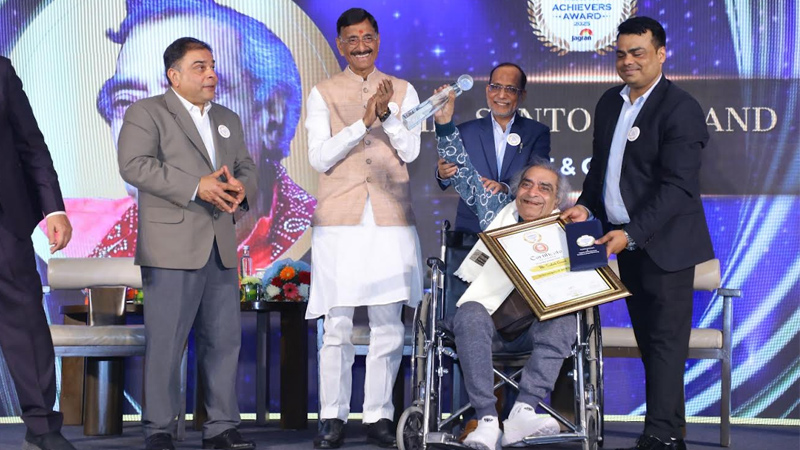
NEW DELHI: Hamdard Laboratories gathered a cross-section of India’s achievers in New Delhi on Friday, handing out the Hakeem Abdul Hameed Excellence Awards to figures who have left their mark across healthcare, education, sport, public service and the arts.
The ceremony, attended by minister of state for defence Sanjay Seth and senior officials from the ministry of Ayush, celebrated individuals whose work blends professional success with a sense of public purpose. It was as much a roll call of achievement as it was a reminder that influence is not measured only in profits or podiums, but in people reached and lives improved.
Among the headline awardees was Alakh Pandey, founder and chief executive of PhysicsWallah, recognised for turning affordable digital learning into a mass movement. On the sporting front, Arjuna Awardee and kabaddi player Sakshi Puniya was honoured for her contribution to the game and for pushing women’s participation onto bigger stages.
The cultural spotlight fell on veteran lyricist and poet Santosh Anand, whose songs have echoed across generations of Hindi cinema. At 97, Anand accepted the honour with characteristic humility, reflecting on a life shaped by perseverance and hope.
Healthcare honours spanned both modern and traditional systems. Manoj N. Nesari was recognised for strengthening Ayurveda’s place in national and global health frameworks. Padma shri Mohammed Abdul Waheed was honoured for his research-backed work in Unani medicine, while padma shri Mohsin Wali received recognition for his long-standing contribution to patient-centred care.
Education and social development also featured prominently. Padma shri Zahir Ishaq Kazi was honoured for decades of work in education, while former Meghalaya superintendent of Police T. C. Chacko was recognised for public service. Goonj founder Anshu Gupta received an award for his dignity-centred rural development initiatives, and the Hunar Shakti Foundation was honoured for empowering women and young girls through skill development.
The Lifetime Achievement Award went to former IAS officer Shailaja Chandra for her long career in public healthcare and governance, particularly in the traditional systems under Ayush.
Speaking at the event, Hamdard chairman Abdul Majeed said the awards were a tribute to those who combine excellence with empathy. “These awardees reflect Hakeem Sahib’s belief that healthcare, education and public service must ultimately serve humanity,” he said.
Minister Seth struck a forward-looking note, saying India’s young population gives the country a unique opportunity to become a global destination for learning, health and wellness by 2047.
The ceremony also featured the trailer launch of Unani Ki Kahaani, an upcoming documentary starring actor Jim Sarbh, set to premiere on Discovery on 11 February.
Instituted in memory of Unani scholar and educationist Hakeem Abdul Hameed, the awards have grown into a national platform that celebrates those building a more inclusive and resilient India. For one evening at least, the spotlight was not just on success, but on service with substance.






