News Headline
TRAI blames MSOs and LCOs for delay in DAS implementation

MUMBAI: The Telecom Regulatory Authority of India (TRAI) has come up with certain amendments to the Standards of Quality of Service (digital addressable cable TV systems) (amendment) regulation 2012 (12 of 2012). The regulation has laid down norms for billing of subscribers in digital addressable system (DAS) areas.
It says that even after coming up with the QoS regulation, it kept receiving several complaints from subscribers about not getting proper bill and receipt. Subsequently, the regulator issued a direction in December 2013 directing MSOs to offer prepaid and postpaid payment options, generate bills and issue receipts.

It also made a team consisting of representatives from TRAI and the Broadcast Engineers Consultant India Limited (BECIL) to inspect the head-end and subscriber management system (SMS) of MSOs in Delhi. During the inspection it noticed non-compliance by cable operators. Some cable ops are not offering prepaid option of payment while those who did offer, didn’t give an option of electronic payment.
It again issued a direction on 27 May 2014 to ensure bill delivery either by hand, post or e-mail, within 45 days of the direction to provide online payment option in its SMS, electronic acknowledgement to subscribers on payment. MSOs and LCOs are still delaying implementation of the same.
Since no details are being inserted in the SMS, it is hampering the transparency of financial transactions between MSOs and LCOs thereby affecting smooth implementation of DAS.
TRAI states that ‘in the absence of proper billing and accounting of receipts, there is a distinct possibility of loss of revenue accruable to government’.
Due to all these reasons, the regulator feels that financial disincentives should be levied on non-compliant MSOs and LCOS, similar to how it happens in the telecom field where this action has yielded result.
For non-compliance of issuing bills, a disincentive of not exceeding Rs 20 per subscriber will be levied on the MSO and/or its linked cable operator and for the second time, penalty would be Rs 50. For non-compliance of regulations, Rs 100 will be penalised on each MSO for each contravention. If the MSO and LCO have entered into an agreement, both of them will be penalised for faults while in the case of no deal being signed, only the MSO is liable to pay.
The regulator says that the MSO may offer multiple denomination schemes for recharging, with an expectation that monthly recharge schemes would be one of the options.
Another amendment that has been suggested is to ensure that bills have service tax registration number and entertainment tax registration number of either the MSO or the linked cable operator.
However, before imposing penalties, TRAI will give opportunities to the concerned MSO or LCO to represent its case.
The amendment, when approved, will come into effect 30 days from the date of publication and will be called Standards of Quality of Service (digital addressable cable TV systems) (amendment) Regulations 2014.
Stakeholders can provide comments before 8 September.
Click here for the press release






NEW DELHI: Hamdard Laboratories gathered a cross-section of India’s achievers in New Delhi on Friday, handing out the Hakeem Abdul Hameed Excellence Awards to figures who have left their mark across healthcare, education, sport, public service and the arts.
The ceremony, attended by minister of state for defence Sanjay Seth and senior officials from the ministry of Ayush, celebrated individuals whose work blends professional success with a sense of public purpose. It was as much a roll call of achievement as it was a reminder that influence is not measured only in profits or podiums, but in people reached and lives improved.
Among the headline awardees was Alakh Pandey, founder and chief executive of PhysicsWallah, recognised for turning affordable digital learning into a mass movement. On the sporting front, Arjuna Awardee and kabaddi player Sakshi Puniya was honoured for her contribution to the game and for pushing women’s participation onto bigger stages.
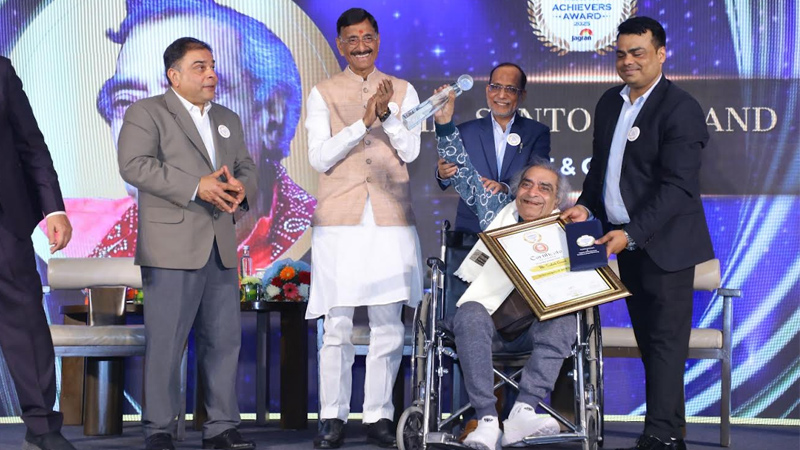
The cultural spotlight fell on veteran lyricist and poet Santosh Anand, whose songs have echoed across generations of Hindi cinema. At 97, Anand accepted the honour with characteristic humility, reflecting on a life shaped by perseverance and hope.
Healthcare honours spanned both modern and traditional systems. Manoj N. Nesari was recognised for strengthening Ayurveda’s place in national and global health frameworks. Padma shri Mohammed Abdul Waheed was honoured for his research-backed work in Unani medicine, while padma shri Mohsin Wali received recognition for his long-standing contribution to patient-centred care.
Education and social development also featured prominently. Padma shri Zahir Ishaq Kazi was honoured for decades of work in education, while former Meghalaya superintendent of Police T. C. Chacko was recognised for public service. Goonj founder Anshu Gupta received an award for his dignity-centred rural development initiatives, and the Hunar Shakti Foundation was honoured for empowering women and young girls through skill development.
The Lifetime Achievement Award went to former IAS officer Shailaja Chandra for her long career in public healthcare and governance, particularly in the traditional systems under Ayush.
Speaking at the event, Hamdard chairman Abdul Majeed said the awards were a tribute to those who combine excellence with empathy. “These awardees reflect Hakeem Sahib’s belief that healthcare, education and public service must ultimately serve humanity,” he said.
Minister Seth struck a forward-looking note, saying India’s young population gives the country a unique opportunity to become a global destination for learning, health and wellness by 2047.
The ceremony also featured the trailer launch of Unani Ki Kahaani, an upcoming documentary starring actor Jim Sarbh, set to premiere on Discovery on 11 February.
Instituted in memory of Unani scholar and educationist Hakeem Abdul Hameed, the awards have grown into a national platform that celebrates those building a more inclusive and resilient India. For one evening at least, the spotlight was not just on success, but on service with substance.






