News Headline
TRAI begins exercise on common mobile banking for all sectors

NEW DELHI: With consumers gradually getting attuned to it and the growth of Mobile Apps and OTT requiring mobile banking, the Telecom Regulatory Authority of India has started an exercise to find the best way of making or receiving payments through the mobile.
As a first step, it has issued a Consultation paper on regulatory framework for the use of USSD for mobile financial services. Stakeholders have been sent a set of ten questions and have to respond by 31 August with counter-comments by 14 September 2016.
Keeping in view the success achieved by many countries in delivering financial servicesthrough mobile telephone, the Government of India, in November, 2009, constituted an Inter-Ministerial Group (IMG) to submit a report and recommendations on the framework fordelivery of basic financial services using mobile phones. The framework proposed in the IMGreport has been accepted as the basis for delivery of basic financial services using mobile technology by a Committee of Secretaries under the chairmanship of the Cabinet Secretary in April 2010. The IMG framework envisages opening of mobile linked ‘no- frills’accounts, which would be operated using mobile phones. These accounts would be held bybanks and the money would be stored in the banks and not in the users’ mobile phones; thecustomer would be able to perform five basic transactions cash deposit, cash withdrawal,balance enquiry, transfer of money from one mobile-linked account to another, and transferof money to a mobile-linked account from a regular bank account. The IMG framework alsoenvisaged compensation to the key players after taking into account the actual costs incurred bythem. In the IMG framework, TRAI was expected to provide the required regulatory framework governing the quality of service, provisioning and pricing of mobile services for delivery of basicfinancial services.

Mobile financial services can be delivered using any of the following communication modes:
(i) Interactive Voice Response (IVR)
(ii) Short Messaging Service (SMS)
(iii) Wireless Access Protocol (WAP)
(iv) Stand-alone Mobile Application Clients (Mobile Apps)
(v) Unstructured Supplementary Service Data (USSD)
(vi) Using SIM tool Kit (STK)
With about 22.5 crore Jan-dhan accounts in the country, more than 100 crore Aadhar cardissued to the citizens and more than 100 crore mobile connections in the country (of whichabout 45 crore are in rural areas), it was expected that the USSD-based mobile banking servicewould gain popularity amongst the unbanked/ under-banked population (the target masses of financial inclusion) with passage of time and would soon achieve a critical mass. However, evenafter two years since August 2014, when it became available to all GSM subscribers in thecountry, the progress of USSD-based mobile banking is below expectations. In May 2016,only about 37 lakh mobile banking transaction attempts (over USSD channel) reached NPCI’splatform (*99#). Clearly, something is amiss. The situation demands a comprehensive review toensure that the service which has successfully deliver.





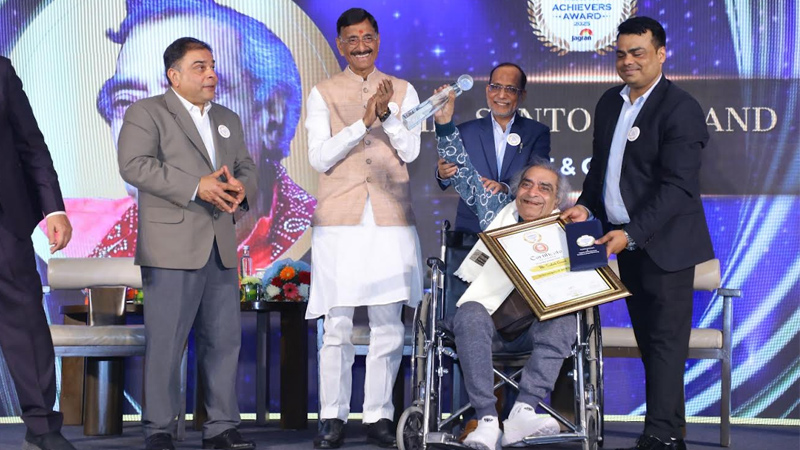
NEW DELHI: Hamdard Laboratories gathered a cross-section of India’s achievers in New Delhi on Friday, handing out the Hakeem Abdul Hameed Excellence Awards to figures who have left their mark across healthcare, education, sport, public service and the arts.
The ceremony, attended by minister of state for defence Sanjay Seth and senior officials from the ministry of Ayush, celebrated individuals whose work blends professional success with a sense of public purpose. It was as much a roll call of achievement as it was a reminder that influence is not measured only in profits or podiums, but in people reached and lives improved.
Among the headline awardees was Alakh Pandey, founder and chief executive of PhysicsWallah, recognised for turning affordable digital learning into a mass movement. On the sporting front, Arjuna Awardee and kabaddi player Sakshi Puniya was honoured for her contribution to the game and for pushing women’s participation onto bigger stages.
The cultural spotlight fell on veteran lyricist and poet Santosh Anand, whose songs have echoed across generations of Hindi cinema. At 97, Anand accepted the honour with characteristic humility, reflecting on a life shaped by perseverance and hope.
Healthcare honours spanned both modern and traditional systems. Manoj N. Nesari was recognised for strengthening Ayurveda’s place in national and global health frameworks. Padma shri Mohammed Abdul Waheed was honoured for his research-backed work in Unani medicine, while padma shri Mohsin Wali received recognition for his long-standing contribution to patient-centred care.
Education and social development also featured prominently. Padma shri Zahir Ishaq Kazi was honoured for decades of work in education, while former Meghalaya superintendent of Police T. C. Chacko was recognised for public service. Goonj founder Anshu Gupta received an award for his dignity-centred rural development initiatives, and the Hunar Shakti Foundation was honoured for empowering women and young girls through skill development.
The Lifetime Achievement Award went to former IAS officer Shailaja Chandra for her long career in public healthcare and governance, particularly in the traditional systems under Ayush.
Speaking at the event, Hamdard chairman Abdul Majeed said the awards were a tribute to those who combine excellence with empathy. “These awardees reflect Hakeem Sahib’s belief that healthcare, education and public service must ultimately serve humanity,” he said.
Minister Seth struck a forward-looking note, saying India’s young population gives the country a unique opportunity to become a global destination for learning, health and wellness by 2047.
The ceremony also featured the trailer launch of Unani Ki Kahaani, an upcoming documentary starring actor Jim Sarbh, set to premiere on Discovery on 11 February.
Instituted in memory of Unani scholar and educationist Hakeem Abdul Hameed, the awards have grown into a national platform that celebrates those building a more inclusive and resilient India. For one evening at least, the spotlight was not just on success, but on service with substance.