News Broadcasting
Times Now preps for Bihar election battle with 3 new data analytics salvos


MUMBAI: At a time when all national news channels are going in full throttle to win the ratings race as the high octane drama unfolds for the upcoming Bihar Assembly election day, Times Now has armed itself with technical innovations and three proprietary live analytic data tools namely Cluster, Firewall and Spectrum.
Starting at 7 pm on 7 November, the news channel will launch 36 hours of discontinuous live reporting led by editor-in-chief Arnab Goswami. Along with a team of experts, Goswami will analyse the news, exit poll indications and results through exclusives and hard hitting interviews.

Joining Goswami on the panel will be experts such as Sunil Alagh, Saba Naqvi, Sankarshan Thakur, R Rajagopalan, Kumar Ketkar, Hartosh Singh Bal, Ajoy Bose, Arati Jerath, Shahid Siddiqui and Neerja Chowdhury.
Goswami decodes the three proprietary live analytic data tools one at a time. Speaking about them he says, “Cluster is a graphical tool, which analyses results on the basis of social, demographic or political similarities and the profile of a constituency. The second tool Firewall, gives live data analysis that tells you whether any individual constituencies are bucking the overall trend,” informs Goswami.
“For example,” Goswami explains, “if there is a constituency that, say, the Janata Dal has won three times in a row, it is a ‘firewall’ constituency — because for anyone to breach that constituency from the other side will be doubly difficult. So if the exit polls indicate that trend is being bucked, Firewall throws it up, with details of the candidate or party challenging the favourite, and the others in the constituency. While people do this kind of an analysis 10 to 12 hours after the results, on Times Now, it will be done live.”
The third tool in Times Now’s inventory is Spectrum, which has been designed to emulate the concept of a spectrum, putting the result out literally on a band and colour-coding it.
“For example, saffron for the NDA and green for JDU. So the band is colour coded, and as the results come in, the band gets filled with colour. So you can compare the band of this election to the band of last elections and visually a viewer can understand if colour-wise this election is looking like the last election or otherwise,” explains Goswami, adding that the info-graphic will simplify the exit poll analysis for the viewers.
Also keeping the channel on top of its game is its recently announced exclusive partnership with social media giant Twitter to launch a global video service. Understanding the need of the hour, Goswami has no qualms in even dumping full shows on the Twitter owned video curation service Periscope.
“In India, the PMO site and Times Now alone were chosen partners for global video launch of Twitter. In fact, I will be doing the first ever exclusive news show on Periscope, that will go live before the TV coverage commences this Saturday (7 November, 2015) evening,” Goswami reveals in parting.






News Broadcasting
News18 India launches Command Centre war explainer with Arya
New show shifts from debates to decoding global conflicts and impacts
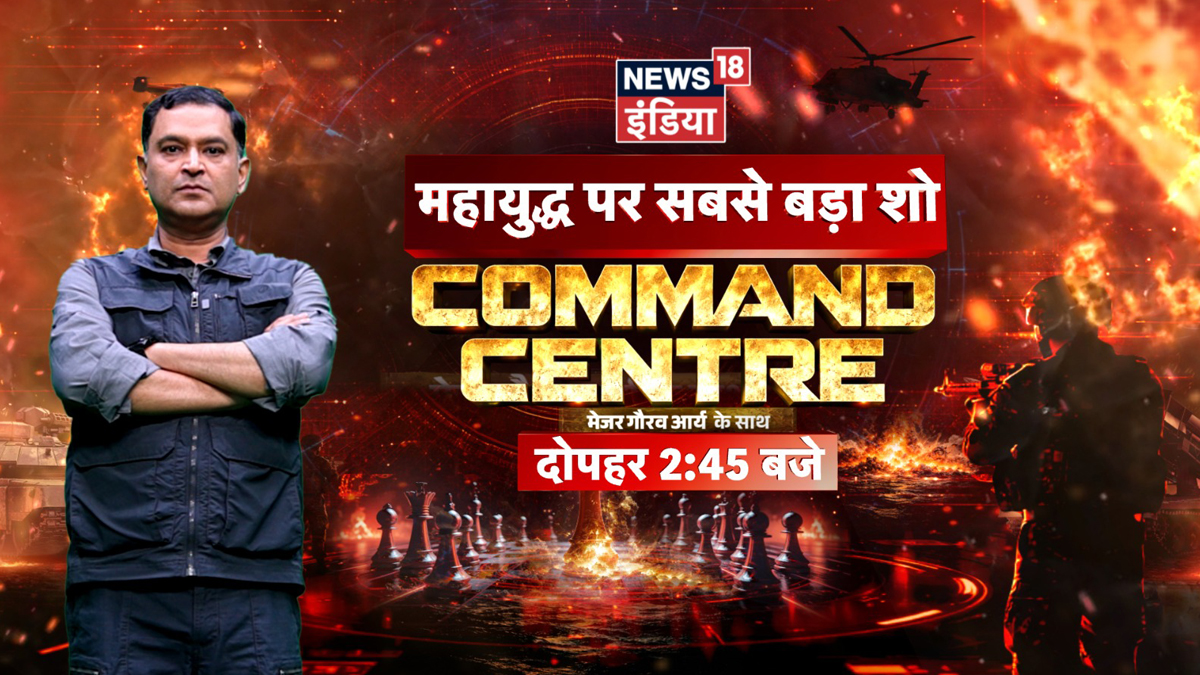
MUMBAI: News18 India has rolled out a new war-focused programme, Command Centre, featuring Gaurav Arya, as it looks to offer viewers a sharper, more grounded take on global conflicts amid rising tensions in West Asia.
Positioned as an “insider war room”, the show moves away from conventional panel debates and instead focuses on explaining military developments, decoding strategy and connecting global events to their everyday impact, from fuel prices to economic shifts.
The format leans heavily on visuals and data. The studio has been designed like a command hub, complete with large LED war maps, real-time graphics and an alert system to track developments as they unfold.
At the centre of it all is Arya, who brings his military background to simplify complex war strategies for viewers. His signature line, “Seedhi baat samjhiye”, anchors the show’s promise of clarity over noise.
News18 India managing editor Jyoti Kamal said, “Command Centre, featuring Major Gaurav Arya is designed to deliver accurate insights and a clear perspective on how evolving conflicts impact everyday life, from household budgets to national security. With expert voices analysing every development in real time, the show goes beyond headlines to decode what’s happening now, what it means, and what could come next.”
Echoing the intent, Gaurav Arya added, “In times of war, confusion is the biggest threat. With News18 India’s Command Centre, we are bringing viewers inside the war room, decoding strategies, tracking every escalation, and explaining, in the simplest terms, what it means for India and for every household. Seedhi baat samjhiye, this is where you understand not just what is happening, but what happens next.”
The weekday show will air in the afternoon slot and will also feature Gaurav Shukla, adding to its editorial depth.
With its mix of analysis, visuals and a clear focus on impact, the show reflects a broader shift in news consumption. Viewers are no longer just watching events unfold, they are looking to understand what those events mean for them.






