News Broadcasting
Thursday World Television Day


NEW DELHI: The first television telecast may have actually happened sometime early last century, but it is 21 November which is celebrated as World Television Day as proclaimed by the UN General Assembly in 1996.
This day commemorates the date on which, in 1996, the first World Television Forum was held at the United Nations. Member states were invited to observe the day by encouraging global exchanges of television programmes focusing on issues such as peace, security, economic and social development, and the enhancement of cultural exchanges.
Though the real spirit of the resolution through which this day is celebrated throughout the world may be yet to be realised fully, the UN thinks that some progress has been made, especially by public service and national broadcasters.

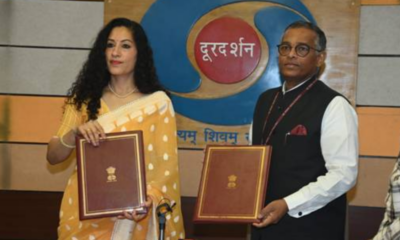
India’s information and broadcasting minister Sushma Swaraj recently said that the government is aware of the role of TV in mass education and spreading awareness. And keeping that in mind Prasar Bharati, which oversees the functioning of pubcasters Doordarshan and AIR, has undertaken several projects, including cable services, in those areas of north-east India where DD’s signals weak and narrowcasting envisaging airing locally relevant programmes (such as on agriculture and culture) in 13-odd centres round the country through low-powered transmitters.
Indiantelevision.com looks back into the recent past to see what UN has to say. UN secretary-general Kofi Annan, addressing World Television Forum 1999, held from 18 to 19 November at UN Headquarters, stressed the role of television in furthering peace and development.
Kofi Annan said that by giving attention to victims of crises in faraway and seemingly insignificant countries, television could help them receive more aid and assistance. The Secretary-General reiterated his call to previous Forums for “preventive journalism.” By drawing attention to abuses or potential conflicts in good time, journalists can give the international community the chance to do something about them before they explode in all-out warfare, he told the participants.
Annan had also stressed the importance of “staying with the story.” Once a country in crisis is no longer on prime time news “we find that the funding, and the political support from governments, tends to dry up,” he had said.
Get a feeling of djvu? More often than not what Annan said should not happen is increasingly happening. Be commercially viable or perish. This seems to be the mantra that is driving broadcasting in most cases these days.
What is the UN resolution which makes 21 November such a historic day in the history of broadcasting? We reproduce here the text of the 88th plenary meeting of the UN held in 1996 and the resolution 51/205 the proclamation of which saw 21 November as being commemorated as the World Television Day.
“Recalling its resolution 13 (I) of 13 February 1946, in which it stated, inter alia, that the United Nations cannot achieve its purposes unless the peoples of the world are fully informed of its aims and activities,
“Recalling also its resolutions concerning information in service of humanity and United Nations public information policies and activities,
“Reaffirming its commitment to the principles of the Charter of the United Nations and to the principles of freedom of information, as well as to those of the independence, pluralism and diversity of the media,
“Underlining that communications have become one of today’s central international issues, not only for their relevance for the world economy, but also for their implications for social and cultural development,
“Recognizing the increasing impact that television has on decision-making by alerting world attention to conflicts and threats to peace and security and its potential role in sharpening the focus on other major issues, including economic and social issues,
“Underlining that the United Nations faces ever-increasing demands to address the major issues facing humankind and that television, as one of today’s most powerful communications media, could play a role in presenting these issues to the world,
“Noting with satisfaction the holding at Headquarters, on 21 and 22 November 1996, of the first World Television Forum, where leading media figures met under the auspices of the United Nations to discuss the growing significance of television in today’s changing world and to consider how they might enhance their mutual cooperation,
“1. Decides to proclaim 21 November World Television Day, commemorating the date on which the first World Television Forum was held;
“2. Invites all Member States to observe World Television Day by encouraging global exchanges of television programmes focusing, among other things, on such issues as peace, security, economic and social development and the enhancement of cultural exchange;
“3. Requests the Secretary-General to bring the present resolution to the attention of all Governments and appropriate non-governmental organizations.”
In India it has by and large been left to pubcaster Doordarshan to hold aloft the spirit of 21 November.
As former BBC correspondents, David Page and William Crawley wrote in a recent book (Satellites Over South Asia:Broadcasting Culture And The Public Interest), “National broadcasters have not only acted as custodians of national culture; they have also seen it as their job to provide a universal service.”
Further they also observed that when Indian TV began in 1959 on an experimental basis in the Delhi region, the programmes reflected India’s development priorities. The first systematic TV service (in India) funded by Unesco, was principally aimed at the rural areas around Delhi. Later there were experiments in educational TV.
These early ventures were subject of much analysis and the government did not increase its investment. It was not until 1972 – 13 years after the opening of the Delhi station – That India got its second TV station in Mumbai.
Things certainly have changed a whole lot since then, but the government’s approach to Prasar Bharati, which oversees the functioning of AIR and DD, still leaves much to be desired.
Speaking on the pubcaster’s social responsibility, chief executive KS Sarma said: “Public Broadcasting no longer enjoys a monopoly status. It will always remain an important reminder of the social and cultural responsibilities of the media in an age when the thrust is overwhelmingly oriented towards consumerism. The more commercial the television market becomes, the role of a public broadcaster correspondingly becomes that much more necessary.”
On plurality of voice, Sarma said, “The public service broadcast media helps us celebrate the rich diversity of our country. Regional strengths are part of our diversity. Nurturing regional talent and offering a platform to regional voices is of great importance, if we want to realise the full creative potential of the country. Doordarshan’s foray into ‘narrowcasting’ is a right step in this direction. It would be almost axiomatic to say that the enlightened public of the world will never let the information superhighway function without a distinct public lane.”
DD’s USP — its massive reach covering almost 95 per cent of all TV households in the country — still remains to be tapped effectively. An indicator to this is the usage of the facilities with DD countrywide, which is 30 per cent less than the optimum.
Doordarshan is the national television service of India and also one of the largest broadcasting organisations in the world. DD originates about 1,300 hours of programmes every week on its various channels through 40 programme production centres all over India. From a humble beginning of a single transmitter of 500 W power, which could carry signals up to 25 kms, and an operational time of just one hour per day Doordarshan today has in place 800 transmitters and a multitude of satellite transponders.
The flagship of Doordarshan — DD1 or National — operates through a network of 1,308 terrestrial transmitters of varying powers.
Doordarshan has a three-tier primary programme service – the national, the regional and the local. In the national programmes the focus is on the national culture and the programmes include news, current affairs, science, cultural magazines, serials, music, dance, drama and feature films. The regional programmes carried on all the transmitters in the different states of India also deal with similar programmes but in the language and idiom of the particular region. The local programmes are area specific and cover local issues featuring local people.
Doordarshan has an estimated viewership of 415 million people, including both viewers having home TV sets and otherwise (like TV sets with village panchayats where community viewing takes place).




News Broadcasting
News18 India launches Command Centre war explainer with Arya
New show shifts from debates to decoding global conflicts and impacts
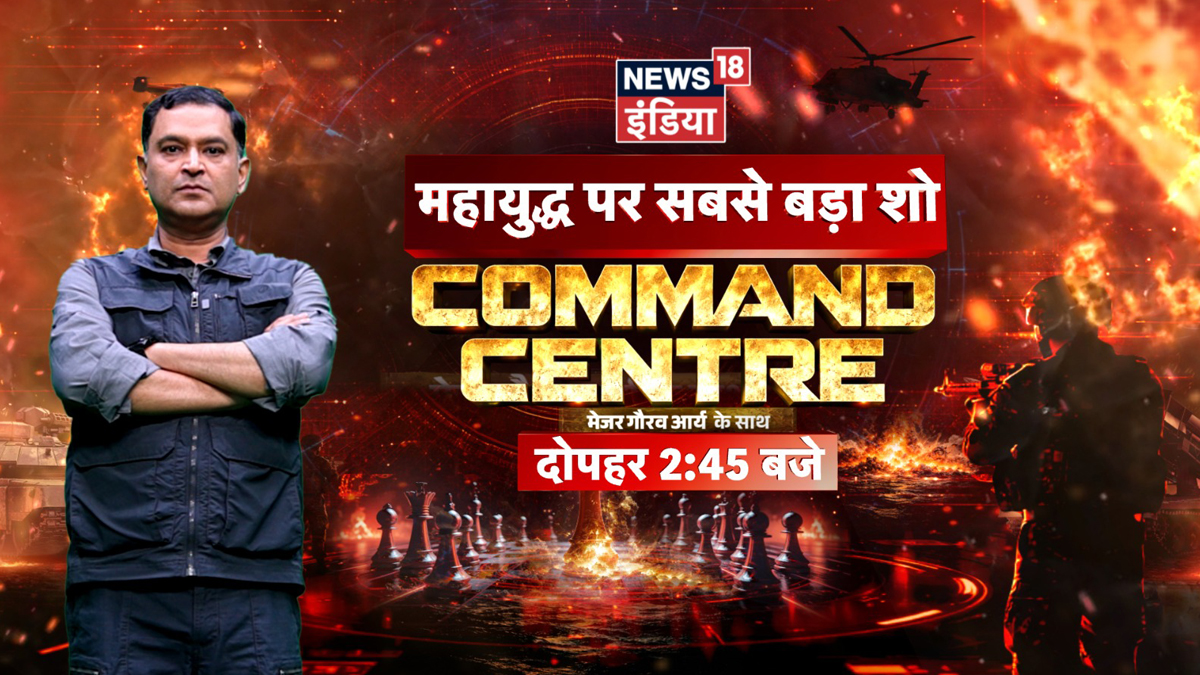
MUMBAI: News18 India has rolled out a new war-focused programme, Command Centre, featuring Gaurav Arya, as it looks to offer viewers a sharper, more grounded take on global conflicts amid rising tensions in West Asia.
Positioned as an “insider war room”, the show moves away from conventional panel debates and instead focuses on explaining military developments, decoding strategy and connecting global events to their everyday impact, from fuel prices to economic shifts.
The format leans heavily on visuals and data. The studio has been designed like a command hub, complete with large LED war maps, real-time graphics and an alert system to track developments as they unfold.
At the centre of it all is Arya, who brings his military background to simplify complex war strategies for viewers. His signature line, “Seedhi baat samjhiye”, anchors the show’s promise of clarity over noise.
News18 India managing editor Jyoti Kamal said, “Command Centre, featuring Major Gaurav Arya is designed to deliver accurate insights and a clear perspective on how evolving conflicts impact everyday life, from household budgets to national security. With expert voices analysing every development in real time, the show goes beyond headlines to decode what’s happening now, what it means, and what could come next.”
Echoing the intent, Gaurav Arya added, “In times of war, confusion is the biggest threat. With News18 India’s Command Centre, we are bringing viewers inside the war room, decoding strategies, tracking every escalation, and explaining, in the simplest terms, what it means for India and for every household. Seedhi baat samjhiye, this is where you understand not just what is happening, but what happens next.”
The weekday show will air in the afternoon slot and will also feature Gaurav Shukla, adding to its editorial depth.
With its mix of analysis, visuals and a clear focus on impact, the show reflects a broader shift in news consumption. Viewers are no longer just watching events unfold, they are looking to understand what those events mean for them.







