I&B Ministry
Three-tier committees set up by Election Commission to monitor paid news


NEW DELHI: Following the announcement of elections to the state assemblies of Jharkhand and Jammu and Kashmir next month, the Election Commission of India on 23 October said that it had put into force a mechanism to deal with the issue of ‘paid news’.
The mechanism provides for three-tier Media Certification and Monitoring Committees (MCMC) at district, state and ECI level.

It has also placed on its website eci.gov.in revised comprehensive instructions on paid news.
Necessary instructions have been issued to the CEOs of the poll going states to ensure briefing of political parties and media in the districts about ‘Paid News’ and the mechanism to check paid news. The MCMCs of all states have been trained to do their job.
With the model code of conduct coming into effect immediately, the Commission has made elaborate arrangements for ensuring their effective implementation and any violation of these guidelines would be strictly dealt with. The Commission re-emphasises that the instructions issued in this regard from time to time should be read and understood by all political parties, contesting candidates and their agents/representatives, to avoid any misgivings or lack of information or understanding/interpretation.
The commission attaches great importance to preparation and implementation of a perfect communication plan at the district/constituency level for the smooth conduct of elections and to enable concurrent intervention and mid-course correction on the poll day.
It has directed the chief electoral officers of the polling going states to coordinate with the officers of the Telecommunication Department in the state headquarters, BSNL authorities, the representatives of other leading service providers in the states so that network status in the states is assessed and communication shadow areas be identified. The CEOs have also been advised to ensure best communication plan in their states.
All critical events will be video-graphed. District election officers will arrange sufficient number of video and digital cameras and camera teams for the purpose. The events for videography will include filing of nominations, scrutiny thereof and allotment of symbols, first level checking, preparations and storage of electronic voting machines, important public meetings, processions etc. during campaign, process of dispatching of postal ballot papers, polling process in identified vulnerable polling stations, storage of polled EVMs, counting of votes etc.
Webcasting, videography and digital cameras will also be deployed inside polling booths wherever needed.
CDs of video recordings will be available on payment to anyone who wishes to obtain a copy of the same.
The elections will take place in five phases in both states from 25 November onwards and the counting will be done simultaneously on 23 December.



I&B Ministry
Doordarshan, ICCR sign MoU to boost global reach of Indian culture
Pact taps TV, radio and digital platforms to take cultural content worldwide
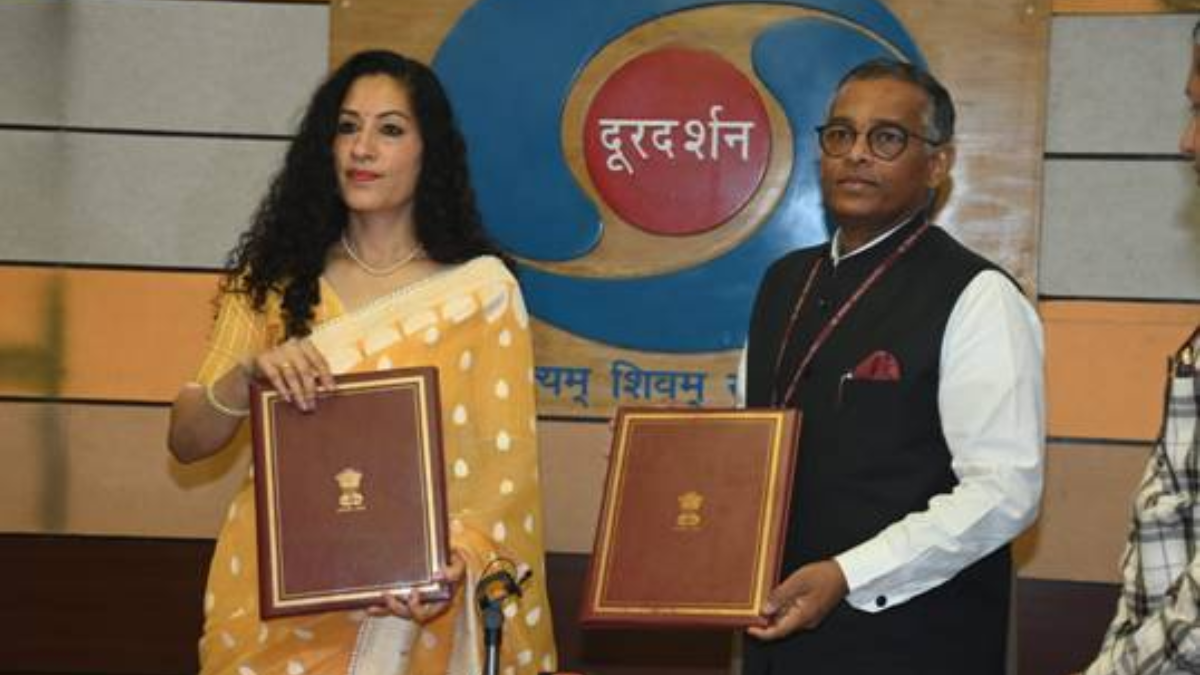
NEW DELHI: In a move aimed at taking India’s cultural story further across borders, Doordarshan under Prasar Bharati has signed a memorandum of understanding with the Indian Council for Cultural Relations to expand the global reach of Indian cultural content.
The agreement, signed on April 7 at Doordarshan Bhawan, brings together the content strength of ICCR and the wide broadcast network of Doordarshan, spanning television, radio and digital platforms.
Under the partnership, ICCR will provide a steady stream of cultural programming, including performances and events organised by Indian missions abroad such as embassies, consulates and cultural centres. Doordarshan will handle production, coverage and distribution, ensuring that these programmes find audiences not just in India but across the world.
The collaboration also opens the door for recorded cultural content from overseas missions to be aired across multiple platforms, including OTT and social media, making Indian art, music and heritage more accessible to global viewers.
A notable feature of the MoU is joint ownership of content rights in perpetuity, including digital rights. This allows both organisations to archive and reuse material over time, building a long-term cultural repository while maximising reach. Doordarshan will also support pre-event promotion and cross-platform visibility to drive engagement.
Speaking at the signing, Doordarshan director general K. Satish Nambudiripad and Indian Council for Cultural Relations director general K. Nandini Singla highlighted the potential of the partnership to strengthen India’s cultural diplomacy through modern media channels.
The agreement, initially valid for three years, also allows Doordarshan to explore monetisation opportunities from the content generated, adding a commercial layer to cultural broadcasting.
As India looks to blend tradition with technology, this partnership signals a clear intent to make its cultural voice not just heard, but seen and streamed across the globe.






