News Headline
The SC court judgement & TDSAT’s powers

MUMBAI: The broadcasting industry that has been fiercely fighting the ad cap regulation by the Telecom Regulatory Authority of India (TRAI) got a jolt last Friday when the news emerged that the Supreme Court, in a separate case, had declared that the Telecom Disputes Settlement Appellate Tribunal (TDSAT) does not have power to deal with appeals over regulations framed by the authority.
The judgment in BSNL vs TRAI and others case came out on the Supreme Court web site today. It had some crucial points regarding what can be termed as ‘regulations’ and whether TDSAT has the authority to hear appeals against them.
According to the judgment, the powers under Section 36 of the TRAI act are legislative and not administrative and by virtue of Section 37 of the Act, they are at par with rules framed by the Central Government thereby mandating them to be laid before both houses of Parliament. Thereafter, Parliament has the power to annul or modify the same. But there is ambiguity on what happens if it is not laid in parliament. Does it stand void? Or can it still be taken as a regulation?

The bench stated that ‘the Tribunals are competent to hear matters where the vires (read: powers) of statutory provisions are questioned. However, in discharging this duty, they cannot act as substitutes for the High Courts and the Supreme Court’ meaning that they cannot hear cases which go into legislative laws. Although the Tribunal will have the power to test the vire of subordinate legislation the exception would be questions regarding the vires of its parent statute. ‘A Tribunal which is a creature of an Act cannot declare that very Act to be unconstitutional’ reads the judgment.
This makes the Tribunal incapable of deciding the fate of the ad cap case as it is a challenge to the validity of one of its parent statute.
The TRAI Act, amended in the year 2000 brought judicial functions under the TDSAT and kept the legislative and administrative powers under the regulator.
The BSNL vs TRAI and others case verdict states: ‘In exercise of the power vested in it under Section 14(b) of the Act, TDSAT does not have the jurisdiction to entertain the challenge to the regulations framed by the Authority under Section 36 of the Act.”
Now, if anyone wants to challenge the validity of the regulation framed under section 36, such as the ad cap regulation, the party has to file a petition before the High Court and not TDSAT. However, cases regarding the application of a regulation can still be taken to the TDSAT.
The ad cap regulation that has been challenged by the News Broadcasters Association (NBA) and others has now come under a cloud. The contention of the broadcasters is that regulation is not valid and TRAI does not have the authority to regulate content, let alone prosecute it. However, the TRAI claims that advertisements form a part of content and by the contract between licensor and licensee; it had come out with the Standards of Quality of service (Duration of advertisements in TV channels) (amendment) regulation 2013 under section 36 and section 11 of the TRAI act.
The judgement in the case has been reserved and according to lawyers from both sides, TDSAT will have to take into consideration this SC verdict and then give its final verdict on the case. Legally speaking, TRAI says it came out with an ad cap ‘regulation’ but the NBA says that TRAI has not fulfilled the laying requirement.
If the TDSAT’s verdict says that the case is dismissed then the next step for the NBA would be to challenge TRAI in the High Court, which seems to be most likely one.
But it could also lead to some furrowed brows amongst the TV channel executives as the stay order on TRAI not to take any coercive actions against channels that are not following the ad cap would be annulled and from then till the time the HC does not give a stay, TRAI could go back to taking its aggressive stance against broadcasters







NEW DELHI: Hamdard Laboratories gathered a cross-section of India’s achievers in New Delhi on Friday, handing out the Hakeem Abdul Hameed Excellence Awards to figures who have left their mark across healthcare, education, sport, public service and the arts.
The ceremony, attended by minister of state for defence Sanjay Seth and senior officials from the ministry of Ayush, celebrated individuals whose work blends professional success with a sense of public purpose. It was as much a roll call of achievement as it was a reminder that influence is not measured only in profits or podiums, but in people reached and lives improved.
Among the headline awardees was Alakh Pandey, founder and chief executive of PhysicsWallah, recognised for turning affordable digital learning into a mass movement. On the sporting front, Arjuna Awardee and kabaddi player Sakshi Puniya was honoured for her contribution to the game and for pushing women’s participation onto bigger stages.
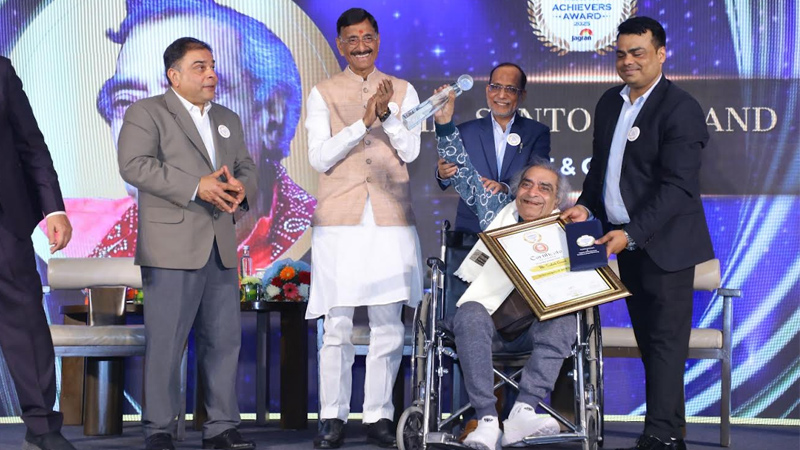
The cultural spotlight fell on veteran lyricist and poet Santosh Anand, whose songs have echoed across generations of Hindi cinema. At 97, Anand accepted the honour with characteristic humility, reflecting on a life shaped by perseverance and hope.
Healthcare honours spanned both modern and traditional systems. Manoj N. Nesari was recognised for strengthening Ayurveda’s place in national and global health frameworks. Padma shri Mohammed Abdul Waheed was honoured for his research-backed work in Unani medicine, while padma shri Mohsin Wali received recognition for his long-standing contribution to patient-centred care.
Education and social development also featured prominently. Padma shri Zahir Ishaq Kazi was honoured for decades of work in education, while former Meghalaya superintendent of Police T. C. Chacko was recognised for public service. Goonj founder Anshu Gupta received an award for his dignity-centred rural development initiatives, and the Hunar Shakti Foundation was honoured for empowering women and young girls through skill development.
The Lifetime Achievement Award went to former IAS officer Shailaja Chandra for her long career in public healthcare and governance, particularly in the traditional systems under Ayush.
Speaking at the event, Hamdard chairman Abdul Majeed said the awards were a tribute to those who combine excellence with empathy. “These awardees reflect Hakeem Sahib’s belief that healthcare, education and public service must ultimately serve humanity,” he said.
Minister Seth struck a forward-looking note, saying India’s young population gives the country a unique opportunity to become a global destination for learning, health and wellness by 2047.
The ceremony also featured the trailer launch of Unani Ki Kahaani, an upcoming documentary starring actor Jim Sarbh, set to premiere on Discovery on 11 February.
Instituted in memory of Unani scholar and educationist Hakeem Abdul Hameed, the awards have grown into a national platform that celebrates those building a more inclusive and resilient India. For one evening at least, the spotlight was not just on success, but on service with substance.






