GECs
The parallels between Rupert Murdoch and Essel group’s Subhash Chandra

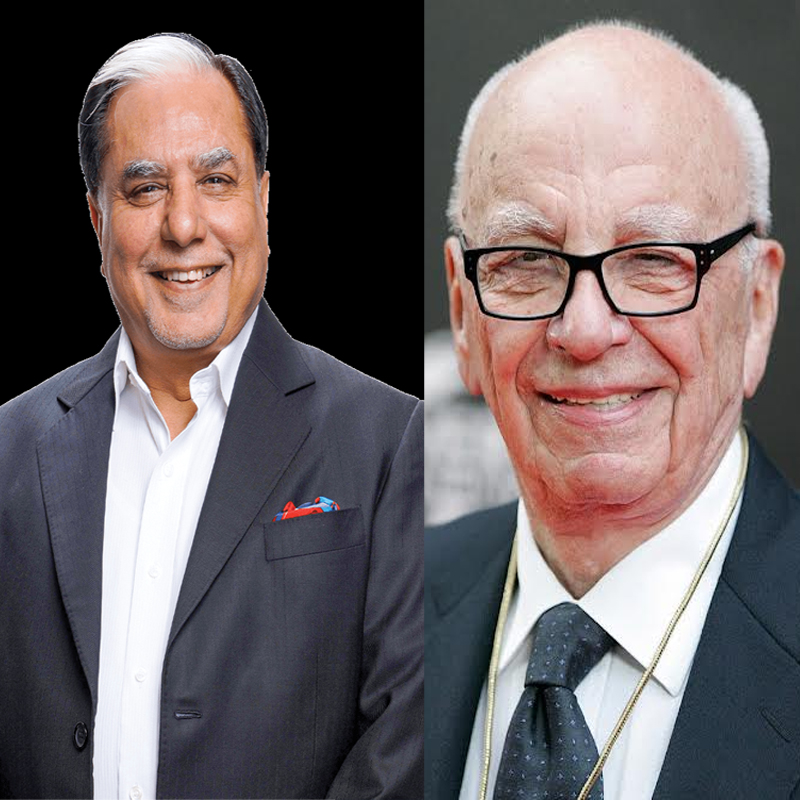
Mumbai: Rupert Murdoch and Subhash Chandra. Two media barons, who are gutsy and un-put-downable. Each is a pioneer in his own way. Chandra for flagging off the Indian cable and satellite TV revolution in India with Zee TV, and later for drawing the path for many others who followed. Murdoch for building a global print media behemoth, fighting the newspaper unions in the UK, and winning, And then for setting up a television and movie empire which he finally hawked to Disney.
But both have another thing in common. Murdoch nearly lost control over News Corp in 1990 when his urge to splurge meant he over-leveraged his company and had to convince more than 146 bankers all over the world not to call in the loans and agree to his plan on restructuring the debt. Even then, a small outfit, the Pittsburgh National Bank, which had lent a $10 million loan to News Corp, held out and threatened to stymie the plan, which could have triggered the collapse of the whole plan. Murdoch and one of the main lenders Citibank’s Ann Lane flew down and managed to get the bank’s favour and Murdoch’s baby survived. And later of course it thrived, making good on all the debt.
Chandra shares quite a few parallels with Murdoch. He and his family have lost majority holding in Zee Entertainment Enterprises Ltd (Zeel) And his plan to save his empire by merging with Sony in India looks to be in trouble with the Securities Exchange Board of India (Sebi) ordering him and his son Punit Goenka to hold no executive positions in Zeel. The allegation is that he misappropriated funds to the tune of Rs 200 crore by taking a circuitous route through various companies to repay Yes Bank. Something unpardonable according to corporate governance norms. This could spell trouble for the Sony merger as conditions require Punit to be at the helm of the merged entity.

In Murdoch’s case, he had asked the lending consortium to include $800 million in loans in the debt restructuring package. That had been used for a private company, Queensland Press, controlled by him and his family. Some bankers were not in favour, but Murdoch finally prevailed.
Moving on to Zeel, observers are questioning if there are any machinations behind Sebi’s announcement regarding the divestiture of executive power from Chandra and Punit.
“Why was this announced just days before the NCLT hearing to finalise the merger,” asks an investment analyst. “Isn’t there something fishy? Obviously, bigger and stronger forces are at play here. The group seems to be under attack from vested interests.”
On his part, the goateed entrepreneur, says he has repaid more than Rs 40,000 crore in loans to various banks and institutions over the past three to four years.
Speaking to Zee Business recently, he said that he has sold the Essel group’s crown jewels to square off a large part of the borrowings. “I know I have to clear my debts and I have no problems selling assets to pay back. We expected to be in the clear by 31 March 2023, but the sale of some assets did not happen or it is in process. I will fold my hands and pay those three or four parties to whom we still owe money.”
According to Chandra, many other industrialists have huge loans and have at times found it a challenge to repay them but they don’t come into the limelight like his group has. “Everyone faces challenges. Some run away. Only the courageous stand up and fight them. I belong to the latter and I will overcome the situation.”
Chandra told the channel that he has given personal guarantees after January 2019 and he has gone so far as to even mortgage his own home to repay some of the debt.
“95 per cent of the lenders have supported us. It’s all about business. We have given them interest over the years, and they have gained quite a lot. Now, we have some losses. And most have stood by us. One or two lenders are insisting on us making good the losses. I am willing to do so up to a limit. But not all of it. When I have money in the future, I will even do that. I am a virtuous businessman and over the decades the Essel group has repaid debt amounting to Rs 50,000 crore, so why are we talking about smaller amounts?” he asked putting on a brave face.
He also said that he was no longer involved in the day-to-day running of Zeel and that both Amit and Punit were in charge there.” Hence, I cannot answer when the merger will happen or where it is at currently,” he said. “I know it’s been delayed and it should have happened sometime back.”
Will Chandra and his fighting spirit see the Essel group, Zeel, the merger with Sony and his sons Punit and Amit through? And will he be able to repeat what Murdoch managed in 1990 and beyond?
It will require more than a magician’s wand to do so, but going by his and his sons’ track record and the confidence that the Sony management has shown in the group, he well might. Watch this space.

GECs
Sahara One reports financial results, notes director exit and business realignment
Muted revenues, steady expenses and strategic adjustments shape company’s current phase

MUMBAI: In a tale where the sands seem to be slipping faster than they can be gathered, Sahara One Media and Entertainment Limited has reported another quarter of wafer-thin income and widening losses, even as a boardroom exit adds to the unease.
The company informed the Bombay Stock Exchange that its board, in a meeting held on April 4, approved its unaudited financial results for the quarter ended September 30, 2025. The numbers paint a stark picture. Total income for the quarter stood at just Rs 0.13 lakh, unchanged sequentially and sharply down from Rs 0.26 lakh a year earlier.
Losses, meanwhile, deepened. The company posted a net loss of Rs 24.16 lakh for the quarter, compared to Rs 18.81 lakh in the June quarter and Rs 39.69 lakh in the same period last year. For the six months ended September 2025, the cumulative loss stood at Rs 39.69 lakh, while the full-year loss for FY25 was reported at Rs 60.72 lakh.
Expenses continued to outweigh income by a wide margin. Total expenses for the quarter came in at Rs 24.30 lakh, led by employee benefit costs of Rs 6.51 lakh and other expenses of Rs 17.78 lakh. Earnings per share remained in the red at Rs (0.11) for the quarter.
The balance sheet reflects a company with significant assets on paper but limited operational momentum. Total assets stood at Rs 23,065.57 lakh as of September 30, 2025, broadly unchanged from March 2025. Equity share capital remained steady at Rs 2,152.50 lakh, while total equity was reported at Rs 18,004.85 lakh.
Cash and cash equivalents saw a modest uptick to Rs 6.75 lakh from Rs 4.68 lakh earlier, supported by a positive operating cash flow of Rs 180.01 lakh for the period.
Yet, beneath these numbers lies a more complex narrative. The company’s auditors flagged their inability to obtain sufficient evidence to form a conclusion on the financial statements, citing lack of access to records. They also raised concerns over the company’s ability to continue as a going concern, pointing to insufficient funds, delayed recoveries, and stalled content investments.
Adding to the governance overhang, the company disclosed that Rana Zia has resigned as whole-time director, effective October 16, 2025, citing other professional commitments. The resignation, noted and accepted by the board, also brings an end to her role across company committees.
Regulatory pressures continue to loom large. The Securities and Exchange Board of India has already initiated penal actions for non-compliance with listing norms, with trading in the company’s shares remaining suspended. There is also a risk of promoter demat accounts being frozen.
Legacy legal issues remain unresolved. A substantial deposit of Rs 694,027.88 thousand linked to the long-running OFCD dispute involving Sahara group entities is still under the purview of the Supreme Court of India. Restrictions on asset disposal continue to weigh on the company’s financial flexibility.
Operationally, challenges persist across multiple fronts. Advances worth Rs 1,92,916 thousand given for film content remain stuck, with delays in project completion and uncertain recoverability. The company’s YouTube channel, despite being operational, has generated no revenue for over three years due to compliance lapses. In a further twist, management has indicated that revenues may have been fraudulently diverted through unauthorised changes to its AdSense account, with a police complaint in the works.
There are also missed revenue opportunities. Television content rights continue to be used by a related party despite the expiry of the licence agreement, with fresh negotiations still underway.
For now, Sahara One Media and Entertainment Limited appears caught between legacy disputes and present-day operational hurdles. As losses linger and governance questions mount, the road to recovery looks less like a sprint and more like a slow trudge through shifting sands.






