News Broadcasting
The Content Hub: “In News9 Plus, news transitions to content,” says TV9 Network’s Barun Das

Mumbai: In a fireside chat – Can Content be the Light House for News? – with TV9 Network MD & CEO Barun Das – Indiantelevision.com Group founder, CEO and editor-in-chief Anil NM Wanvari deliberated over the nuances of news and content at The Content Hub which was held on 25 April at The Lalit, Mumbai.
Wanvari questioned, “With News9 Plus, when it comes to news and content, how do you place news within the content space?”
“What OTT gives you is the power of choice. I can watch what I want when I want. Therefore, that is the transition that news will have to make. I take immense pride in coming out with the concept of News9 Plus, which we will formally launch soon is the OTT version of news,” Das said.

“In News9 Plus, news is being converted into content. Everything is exclusive but not as news broke. The news breaking would continue to happen on social media. So everything is content which is treatment, perspective, analysis which is our own. There the news makes the transition to content and by doing that I hope we would be able to overcome the challenge that we have unsuccessfully faced so far as TV industry,” he elaborated.
“And what makes you think that the people will pay for news?” asks Wanvari. Das explained the business model that will drive News9 Plus, the world’s first news OTT. “At present, we are not interacting with them (the middle class) directly. We’re not charging subscription fees from them. The consumers are paying but by advertising. So that is a lost opportunity for the news industry. I think that’s what can be addressed through this. News9 Plus eventually would be a paid app. Unless and until people find the content worthwhile to pay for, it won’t stand a chance. So therefore, finally news can actually become content, can evolve into content and in such a compelling content that consumers would not mind paying substantial amount which will make the business viable.”
Ultimately people will be willing to pay for news in which they perceive value and utility, added Das. “People will pay for that news, which they can use. It has to live up to this utility value. Feel good news? Not much interested. Feel good entertainment? Not interested. News has to live up to the utility value. It has to provide utility, and usage to people. Some professions are very numbers driven, like finance professionals, like research professionals, like an IT professional. So if you have to talk, you need to be good enough to participate in any conversation. That’s what we’ll make the cut for you. So, therefore, the utility value is very important. And when we talk about utility value, we’ll have a lot of focus on business content going forward. So when we actually turn to pay, you would say that significant amount of content would be business and economy-related, which people will pay for,” he explained.
Wanvari questioned about the success of the series Duologue with Barun Das, to which Das replied, “I’m not a journalist. I’m not fishing for a headline. I’m there for a cerebral conversation. But sometimes people have expressed things which they haven’t expressed it elsewhere. But one of the latest ones (with Infosys founder NR Narayana Murthy and philanthropist and academician Sudha Murthy), I think, everybody must watch it, the second episode, that I raised a very pertinent question: I said that India is not leveraging 50 per cent of its strength, which are the women and good womanhood will always have to be preceded by good wifehood. So I said why didn’t you take the corner office 40 years back then: possibly chairwoman would have become a legitimate term at Oxford or Cambridge.”

News Broadcasting
WITT Summit 2026 concludes in New Delhi
Babar Azam’s comical diving attempt goes viral as league introduces anti-dew measures.
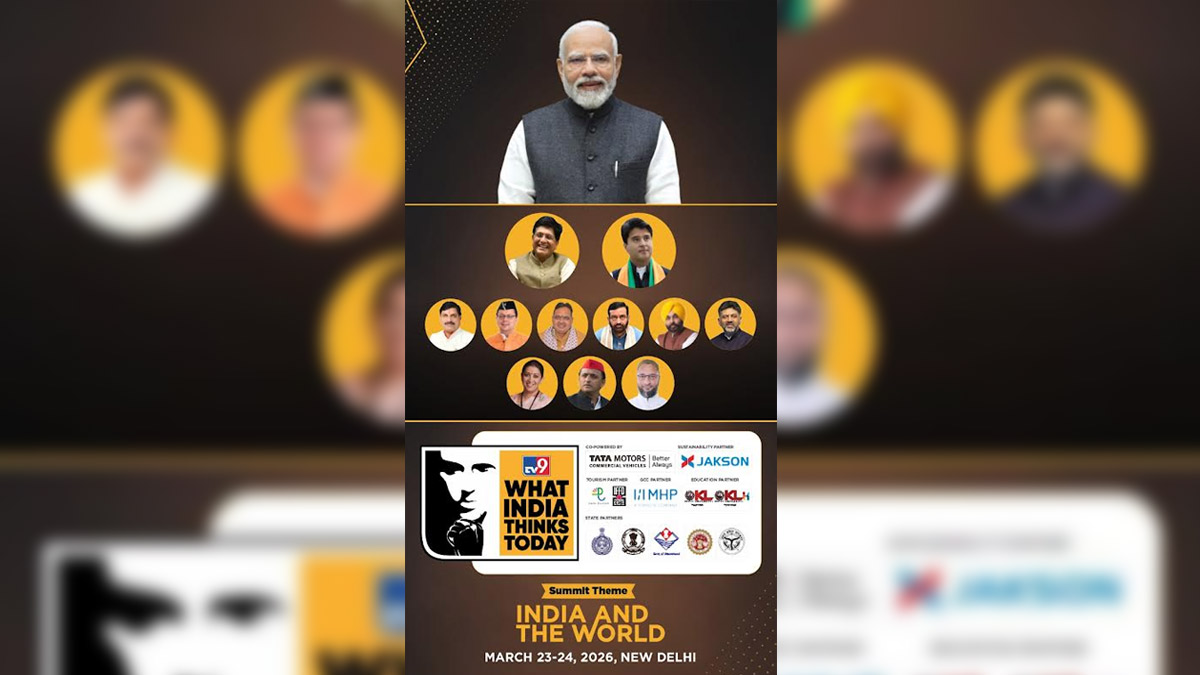
MUMBAI: The WITT Summit just wrapped up with enough big ideas to fill a policy playbook because when India’s leaders, thinkers and icons gather under one roof, even the conversations hit sixes. The eighth edition of TV9 Network’s flagship What India Thinks Today (WITT) Summit 2026 concluded on Saturday after two days of dynamic discussions at its New Delhi venue. India’s largest multi-domain public policy and culture summit brought together political leaders, policymakers, sports icons, artists and technology innovators to examine the forces shaping contemporary India and its global standing.
Prime minister Narendra Modi delivered the keynote address on the theme “India and the World” for the third consecutive year. In a wide-ranging speech, he addressed the ongoing conflict in West Asia, calling for restraint and compassion while highlighting India’s continued development trajectory despite global turmoil.
The summit featured candid conversations with state leaders. Telangana Chief Minister A. Revanth Reddy articulated a people-first governance model and contrasted it with other development approaches. Madhya Pradesh Chief Minister Mohan Yadav declared that Left-wing extremism had been effectively eliminated in his state and highlighted preparations for the upcoming Kumbh Mela. Punjab Chief Minister Bhagwant Mann defended his government’s record, citing the closure of 19 toll plazas and creation of the Sadak Suraksha Force. Karnataka Deputy Chief Minister D.K. Shivakumar expressed confidence in Congress prospects in Assam and addressed recent allegations against him.
On geopolitics and national security, Union Minister Jyotiraditya Scindia outlined India’s ambition to become a builder of trusted digital infrastructure for the world, citing the rapid 5G rollout and village-level 4G connectivity.
Cricket received significant attention. Former India captain Sourav Ganguly praised player freedom and trust as hallmarks of great leadership and named MS Dhoni as the greatest captain due to his World Cup successes. India women’s team bowling coach Aavishkar Salvi credited the BCCI and Women’s Premier League for building a pipeline of world-class talent behind the team’s recent ODI World Cup triumph.
The summit also hosted the inaugural AI² Awards 2026, celebrating the convergence of human creativity and machine intelligence in storytelling and content creation. Poet and kathavachak Kumar Vishwas delivered a nuanced take on India’s concept of Dharma and criticised the recent arrest of an 80-year-old Shankaracharya. Veteran lyricist Sameer Anjaan and storyteller Neelesh Misra reflected on changing music trends and artistic responsibility in the wake of a recent controversy involving Nora Fatehi.
In a country where conversations often run as deep as the Ganges, the WITT Summit proved once again that when leaders, thinkers and storytellers come together, the real winner is public discourse lively, layered and refreshingly unafraid to tackle the big questions shaping India’s tomorrow.








