News Headline
The Content Hub: Content Creation – No More Formulas

Mumbai: On a bright sunny day of 25 April, Indiantelevision.com’s event, The Content Hub, which took place at The Lalit, Mumbai saw the presence of many experts in the content space.
The first panel which was moderated by Bodhitree Multimedia managing director Mautik Tolia was on the topic – Content Creation: No More Formulas. The panelists comprised of Locomotive Global Inc. co-founder & managing partner Sunder Aaron, Sony SAB, PAL and Sony MAX Movies Cluster business head Neeraj Vyas, Phantom Studios CEO Srishti Behl Arya, Jio Studios head – content alliances Shobha Sant, Contiloe Pictures Founder & CEO Abhimanyu Singh, and Fremantle managing director Aradhana Bhola.
The panel kicked off with a discussion about the India story being one of the most exciting when it comes to content creation. We’re the only industry where we have the OTT business growing – apparently, it is supposed to double in the next couple of years. And at the same time, the television industry is growing as well. That represents an interesting content challenge, in terms of audiences, in terms of pace, in terms of where the industry is going over the last few years.

Tolia questioned Singh, “You have seen the entire spectrum from television to OTT, one of the biggest shows in the industry, a great edition just came out. So what I wanted to understand from you is over the last five years since the way that the OTT industry has evolved, from the time you started making and conceiving the first slot of the shows, how has the thinking changed? So where is the evolution happening from OTT content 1.0 to the next part of content 2.0 right now in terms of evolution, and how are you looking at that as a shift as a content creator?”
To which Singh mentioned that in the last five years, we’ve seen largely when OTT came and when we started creating content OTT for the first time that we’ll see even content being produced. “Audiences have, I wouldn’t say changed – they have evolved. They are used to a lot more content. In the good old days, when there was only one channel, which was DD, then given one satellite, then we had VCRs so we consumed films. But now with web 2.0, when you are going digital on the internet, you have a huge amount of user-generated content as well as streaming. And I think that’s evolved the consumer. And that consumer now wants content, which is changing rapidly. And their attention spans are reducing.”
Arya added, “I think the good thing that’s happening now is with streaming the kind of access to what you want to watch without having to be necessarily mass. The scary thing that’s happening is that people come into India, especially looking for numbers. I think we just need to keep making the best version of content.”
Bhola definitely thinks that there is something to captive reality. “I think captive reality works really well in the OTT space, and you’re going to see more of that from us too in that particular genre.”
Sant mentioned about the 100 pieces plan – it’s not 100 movies, it’s 100 content pieces, which include films, shows, mini-shows, all of that. “There was a very definite plan, we have a mix of genres that cater to most audiences. The idea was that we are reaching out to the length and breadth of this country, which is very diverse. So to cater to the diversity was the challenge that we didn’t put across, so stories have been chosen according to that. But the idea was never to look at just one set of audience. So it’s what it’s all still growing, still evolving, is still learning, it’s all there.”
Aaron brings out that they are not just a format company. “I think what’s interesting is what we are going to be doing to take India to the rest of the world because we naturally get very focused on our own market as we should. And we are all evolving as the audience – Korea has had its moment. And it’s absolutely true that in the next year or two, India will also have its moment, without a doubt. And you see the capital, again, flying around the world looking for emerging market opportunities. India is going to be where that money comes to, and that capital comes – may not be this year, but it’s definitely going to be next year, or maybe 2025. And we’re going to have a huge boom here. And we have to be ready to take advantage of that.”
Vyas pointed out that fortunately, despite all the noise about cricket going digital and TV sinking, that hasn’t happened. Ratings have been very good at Star Sports. But TV is probably not growing at the speed that it used to. But it’s definitely here to stay.
“There is very little writing talent. And even lesser acting talent. And you’re very dependent on a few people, you know, in terms of content writers, creators, actors, to be able to sustain it. It’s also a choice that we have learned to work with only a few producers, who have a commitment towards that kind of content. So I think a reorientation is something that television will need. We need to tell our stories differently. We need to make our shows look good. The way we project shows, the way we market – we need to take care of that,” he says.

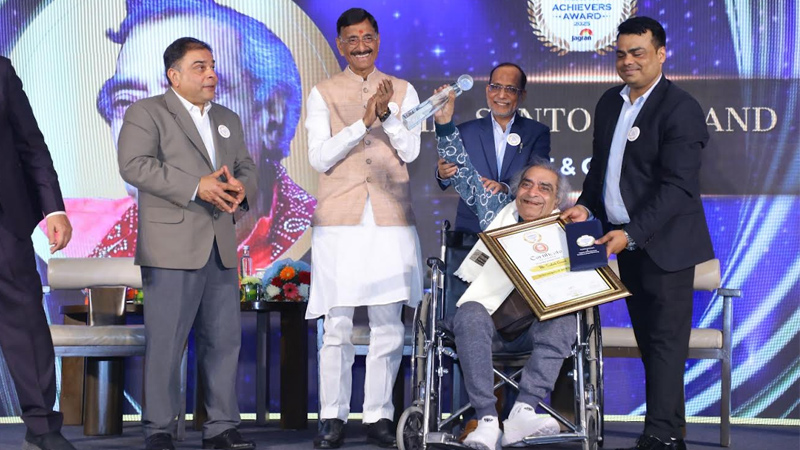
NEW DELHI: Hamdard Laboratories gathered a cross-section of India’s achievers in New Delhi on Friday, handing out the Hakeem Abdul Hameed Excellence Awards to figures who have left their mark across healthcare, education, sport, public service and the arts.
The ceremony, attended by minister of state for defence Sanjay Seth and senior officials from the ministry of Ayush, celebrated individuals whose work blends professional success with a sense of public purpose. It was as much a roll call of achievement as it was a reminder that influence is not measured only in profits or podiums, but in people reached and lives improved.
Among the headline awardees was Alakh Pandey, founder and chief executive of PhysicsWallah, recognised for turning affordable digital learning into a mass movement. On the sporting front, Arjuna Awardee and kabaddi player Sakshi Puniya was honoured for her contribution to the game and for pushing women’s participation onto bigger stages.
The cultural spotlight fell on veteran lyricist and poet Santosh Anand, whose songs have echoed across generations of Hindi cinema. At 97, Anand accepted the honour with characteristic humility, reflecting on a life shaped by perseverance and hope.
Healthcare honours spanned both modern and traditional systems. Manoj N. Nesari was recognised for strengthening Ayurveda’s place in national and global health frameworks. Padma shri Mohammed Abdul Waheed was honoured for his research-backed work in Unani medicine, while padma shri Mohsin Wali received recognition for his long-standing contribution to patient-centred care.
Education and social development also featured prominently. Padma shri Zahir Ishaq Kazi was honoured for decades of work in education, while former Meghalaya superintendent of Police T. C. Chacko was recognised for public service. Goonj founder Anshu Gupta received an award for his dignity-centred rural development initiatives, and the Hunar Shakti Foundation was honoured for empowering women and young girls through skill development.
The Lifetime Achievement Award went to former IAS officer Shailaja Chandra for her long career in public healthcare and governance, particularly in the traditional systems under Ayush.
Speaking at the event, Hamdard chairman Abdul Majeed said the awards were a tribute to those who combine excellence with empathy. “These awardees reflect Hakeem Sahib’s belief that healthcare, education and public service must ultimately serve humanity,” he said.
Minister Seth struck a forward-looking note, saying India’s young population gives the country a unique opportunity to become a global destination for learning, health and wellness by 2047.
The ceremony also featured the trailer launch of Unani Ki Kahaani, an upcoming documentary starring actor Jim Sarbh, set to premiere on Discovery on 11 February.
Instituted in memory of Unani scholar and educationist Hakeem Abdul Hameed, the awards have grown into a national platform that celebrates those building a more inclusive and resilient India. For one evening at least, the spotlight was not just on success, but on service with substance.







