News Broadcasting
The broadcasters’ viewpoint


The enabling provision giving the government powers to modify the The Cable TV Networks (Regulation) Act, 1995 to incorporate CAS raises questions which beg answers. Legislators and politicians will do well to take a closer look at some of these issues before moving on CAS. Many of these issues will affect broadcasters, some of them will have an impact on consumers, some on cable TV operators.
What will constitute the basic cable TV tier? Will set top boxes be acceptable to viewers?Who will pick up the tab for educating consumers about CAS? What should the price of the set top box (STB) be? Will they become available early within the set timeframe and in substantial quantity? What technology should be followed? Will CAS encourage or curtail piracy?
On the basic cable package, one view is that will finally end up consisting of Doordarshan channels (except DD Sports), MTV, Sahara TV, SABe TV, BBC, Aaj Tak and regional language channels like Sun TV and Enaadu TV. Mass entertainment channels will be left out of the basic tier because they have gone pay in recent times.

Points out Rakesh Dutta, an independent cable operator in Delhi and an office bearer of Cable Networks Association, The basic service will exclude the mass-based entertainment channels like Star Plus, Zee TV and Sony which are all pay channels.
Adds Vicky Choudhary, another independent cable operator and a vocal member of a newly-formed National Cable & Telecom Association, Either these channels like Star Plus will have to revert to being free-to-air or they will stand to lose a substantial chunk of their advertising revenues, where ad sales is done on the basis of the fact that they reach maximum number of (38 million-odd ) cable TV homes in he country.
Moreover, CAS will also mean that broadcasters will face problems bundling and selling comparatively weaker channels like Animal Planet, some Alpha channels and the National Geographic Channel to advertisers.
Who will pick up the tab for educating consumers about CAS and will broadcasters face an ad squeeze? While Choudhry feels that broadcasters and cable operators can still sit across the table and thrash out various issues like educating viewers on premium services through set-top boxes, a fellow player from the cable industry and a senior executive of the Rajan Raheja-controlled Hathaway says, It may not be so gloomy for broadcasters either. If the big broadcasters like Star, Zee-Turner and Sony (all overseeing pay channels) can digest the slight slump in ad revenues for a couple of months (subsequent to implementation of CAS), the viewing public will realise the importance of popular serials on mass-based channels and force the cable and broadcasting fraternity to come to a compromise which will benefit all.
One issue that could really impact the progress of CAS is the cash that will be needed by the cable TV trade and consumers to toe the government line on addressability. According to figures available, about 70 per cent of TV homes still have black & white sets which cost anywhere between Rs 2,500- 3,500. The remaining have colour TV sets which cost anywhere between Rs 8,000 and RS 21,000.
According to rough and ready estimates, the cost of an analogue STB is between Rs 3,500 and 4000 – though the government has been talking of a Rs 1,500 STB – while the cost of a digital STB is likely to be, even if subsidised, between Rs 9,000 and Rs 18,000.
According to estimates an affordable CAS will cost cable TV ops about Rs 10,00,000 (Rs 1 million) per headend, considering that decoding and encoding equipment and subscriber management systems will have to be installed. Some networks will also have to upgrade their distribution equipment. Additionally, cable TV ops will have to change in the way they manage their networks and subscribers. CATV will become more of a service business calling for retraining of employees.
The total amount that will have to be spent by consumers nationally to buy STBs at today’s CATV penetration levels of 38 million homes to comply with CAS is an obscene (Rs 15,200 crore or Rs 152 billion – 38 million x Rs 4,000 per box). The total investment that cable TV ops will have to pump into in their headends to provide addressability is estimated at around RS (Rs 1,500 crore or Rs 15 billion – considering that there are 15,000 headends which will have to be upgraded at Rs 10 lakh per headend).
But wait let’s get answers to a basic question: who will pay for the STBs? The Rakesh Mohan committee feels that a subscriber will pay for it. The cable industry is still not fully organized to mobilise such big investments needed for CAS and broadcasters will not jump in with the moolah as they do not have direct `relationships with cable households.
So, who will foot the bill for CAS? Certainly not the government, which is pushing for it.
Given such huge numbers it is quite a large part of the populace – a majority of the population has low purchasing power – will be deprived of quality entertainment and information if CAS is implemented.
Even more basic questions need to be answered on the availability of the STBs. Though Delhi-based HFCL has said it is negotiating with the government to manufacture cheaper STBs and the likes of Philips, the BPL group and Videocon have the capability to manufacture STBs, at present there is no or very little manufacturing capacity or indigeneous technology available in India.
Therefore it would be safe to conclude that the time span of six months (as per the Rakesh Mohan task force’s recommendations) is too short for manufacturing capacity to service the 38 million cable TV homes and it may take four years to supply STBs to each C&S home by which time it is quite likely the technology will have changed.
A problem that could arise if the government mandates and industry goes in for a low cost CAS system is that of security – even expensive systems have been hacked, rudimentary low cost systems will be broken into easily. This could lead to an increase in piracy as cable TV ops may chose to install STBs for each encrypted channel and make a mini control room to illegally transmit encrypted signals to those households which may find the STB sticker price too high.
It is also quite likely that cable TV ops will continue to fudge subscriber figures – despite SMS – to stay out of the tax and broadcasters nets. If this happens, it is quite likely that the government will lose out on revenue, as will broadcasters.





News Broadcasting
WITT Summit 2026 concludes in New Delhi
Babar Azam’s comical diving attempt goes viral as league introduces anti-dew measures.
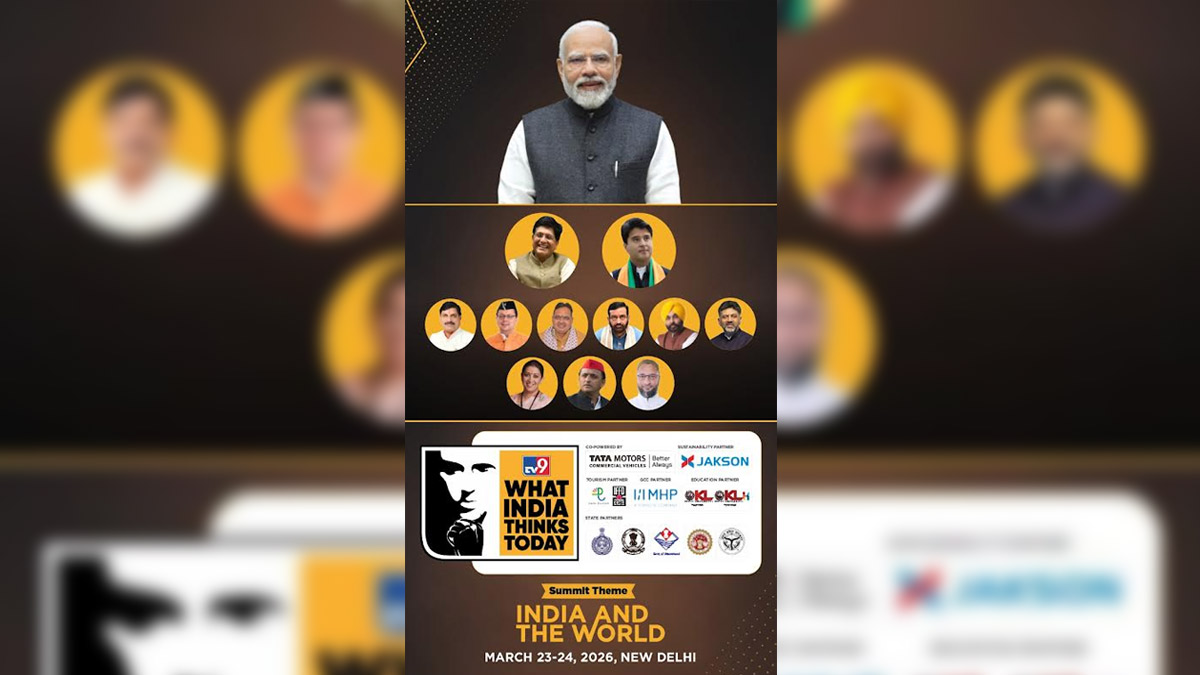
MUMBAI: The WITT Summit just wrapped up with enough big ideas to fill a policy playbook because when India’s leaders, thinkers and icons gather under one roof, even the conversations hit sixes. The eighth edition of TV9 Network’s flagship What India Thinks Today (WITT) Summit 2026 concluded on Saturday after two days of dynamic discussions at its New Delhi venue. India’s largest multi-domain public policy and culture summit brought together political leaders, policymakers, sports icons, artists and technology innovators to examine the forces shaping contemporary India and its global standing.
Prime minister Narendra Modi delivered the keynote address on the theme “India and the World” for the third consecutive year. In a wide-ranging speech, he addressed the ongoing conflict in West Asia, calling for restraint and compassion while highlighting India’s continued development trajectory despite global turmoil.
The summit featured candid conversations with state leaders. Telangana Chief Minister A. Revanth Reddy articulated a people-first governance model and contrasted it with other development approaches. Madhya Pradesh Chief Minister Mohan Yadav declared that Left-wing extremism had been effectively eliminated in his state and highlighted preparations for the upcoming Kumbh Mela. Punjab Chief Minister Bhagwant Mann defended his government’s record, citing the closure of 19 toll plazas and creation of the Sadak Suraksha Force. Karnataka Deputy Chief Minister D.K. Shivakumar expressed confidence in Congress prospects in Assam and addressed recent allegations against him.
On geopolitics and national security, Union Minister Jyotiraditya Scindia outlined India’s ambition to become a builder of trusted digital infrastructure for the world, citing the rapid 5G rollout and village-level 4G connectivity.
Cricket received significant attention. Former India captain Sourav Ganguly praised player freedom and trust as hallmarks of great leadership and named MS Dhoni as the greatest captain due to his World Cup successes. India women’s team bowling coach Aavishkar Salvi credited the BCCI and Women’s Premier League for building a pipeline of world-class talent behind the team’s recent ODI World Cup triumph.
The summit also hosted the inaugural AI² Awards 2026, celebrating the convergence of human creativity and machine intelligence in storytelling and content creation. Poet and kathavachak Kumar Vishwas delivered a nuanced take on India’s concept of Dharma and criticised the recent arrest of an 80-year-old Shankaracharya. Veteran lyricist Sameer Anjaan and storyteller Neelesh Misra reflected on changing music trends and artistic responsibility in the wake of a recent controversy involving Nora Fatehi.
In a country where conversations often run as deep as the Ganges, the WITT Summit proved once again that when leaders, thinkers and storytellers come together, the real winner is public discourse lively, layered and refreshingly unafraid to tackle the big questions shaping India’s tomorrow.








