News Headline
‘The best thing that has happened is the wake up call on content’

As I see it, I think what has happened is that the media game has become far more commoditised, and in a sense cluttered and competitive now than ever before. As for me, in the context of television content, there has been an increase in the volume of that content available this year, but paradoxically, whether quality has improved is a huge question mark.
That to me is the biggest worrying point in 2007. Just see, so many news channels coming together to work on a content code would not have happened 12 months ago. They are all recognising that we could be going down a very slippery slope. We at CNN IBN are considering having an ombudsman who would ensure that the highest standards of journalistic integrity are maintained.

It is also becoming a major question whether for the odd rating points here and there are we allowing standards to slip, and I think we shall not be forgiven beyond a point if we allow this to happen. That for me has been the defining aspect of 2007.
It has been like a wakeup call. It may have been driven in by the government, and they took the first step and that worried us, because the government is identified with censorship, but there is much that we have to look at very carefully.
We have to realise that our jobs as journalists is to provide credible information and I hope this debate does not end in 2007 and from being a government-led debate it should become an industry-led one.
I am glad that Indian Television Dot Com’s News Television (NT) Awards, which was launched from this year itself, started with a debate on content and the direction in which we are going: can we self regulate? Do we need a broadcasting council? These are all questions that came up this year and these have to be answered in 2008.
The other issue, though I confess that I am not an expert on it, is distribution, and I think it is going to be the next big challenge. As Cas rolled out, and digitilisation began, we realised that it is the future. How Cas can be spread across the country and not just to a few areas will be a big challenge. How regulation will ensure a level playing for all will be a challenge.
To my mind we have reached a stage where the entire distribution area will need a serious study, along with the issue of content.
| Media game has become far more commoditised, and in a sense cluttered and competitive _____****_____ |
The way the hidden camera was being used was a worrying thing. It was becoming an end in itself rather than a means to an end. These are serious issues and I think we need a far more rigorous code of content across our channels.
I hope we are moving in that direction, I really do.
The other big challenge is, how do you become multi-media? Mobile, television, Internet, possibly even print becoming a part of it. Localisation without a print partner does not work. We need to be spread across all the platforms, rather than just be television, the only platform we have. I think it is going to be the battle of the networks in the future, not just television channels alone.
I am positive that Hindi channels must also do the same. Who says Hindi channels should stay away from the web? It may not happen today, but it is going to happen five years from now.
I think the future will also see a greater emphasis on localisation and regionalisation of news. We will need to be much more conscious of a changing viewer, but without sacrificing quality… that is the key. The future battle will be of perceptions, of influence, or being thought leaders. In CNN IBN. That’s been our aim, to be thought leaders.
We are going into Marathi and we are taking these decisions consciously. We want to be India’s window to the world but to spread our influence, we also have to be in the regional space.



NEW DELHI: Hamdard Laboratories gathered a cross-section of India’s achievers in New Delhi on Friday, handing out the Hakeem Abdul Hameed Excellence Awards to figures who have left their mark across healthcare, education, sport, public service and the arts.
The ceremony, attended by minister of state for defence Sanjay Seth and senior officials from the ministry of Ayush, celebrated individuals whose work blends professional success with a sense of public purpose. It was as much a roll call of achievement as it was a reminder that influence is not measured only in profits or podiums, but in people reached and lives improved.
Among the headline awardees was Alakh Pandey, founder and chief executive of PhysicsWallah, recognised for turning affordable digital learning into a mass movement. On the sporting front, Arjuna Awardee and kabaddi player Sakshi Puniya was honoured for her contribution to the game and for pushing women’s participation onto bigger stages.
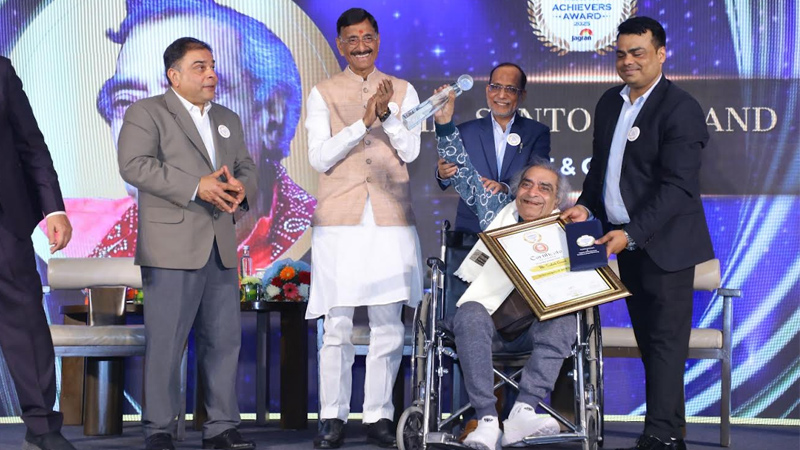
The cultural spotlight fell on veteran lyricist and poet Santosh Anand, whose songs have echoed across generations of Hindi cinema. At 97, Anand accepted the honour with characteristic humility, reflecting on a life shaped by perseverance and hope.
Healthcare honours spanned both modern and traditional systems. Manoj N. Nesari was recognised for strengthening Ayurveda’s place in national and global health frameworks. Padma shri Mohammed Abdul Waheed was honoured for his research-backed work in Unani medicine, while padma shri Mohsin Wali received recognition for his long-standing contribution to patient-centred care.
Education and social development also featured prominently. Padma shri Zahir Ishaq Kazi was honoured for decades of work in education, while former Meghalaya superintendent of Police T. C. Chacko was recognised for public service. Goonj founder Anshu Gupta received an award for his dignity-centred rural development initiatives, and the Hunar Shakti Foundation was honoured for empowering women and young girls through skill development.
The Lifetime Achievement Award went to former IAS officer Shailaja Chandra for her long career in public healthcare and governance, particularly in the traditional systems under Ayush.
Speaking at the event, Hamdard chairman Abdul Majeed said the awards were a tribute to those who combine excellence with empathy. “These awardees reflect Hakeem Sahib’s belief that healthcare, education and public service must ultimately serve humanity,” he said.
Minister Seth struck a forward-looking note, saying India’s young population gives the country a unique opportunity to become a global destination for learning, health and wellness by 2047.
The ceremony also featured the trailer launch of Unani Ki Kahaani, an upcoming documentary starring actor Jim Sarbh, set to premiere on Discovery on 11 February.
Instituted in memory of Unani scholar and educationist Hakeem Abdul Hameed, the awards have grown into a national platform that celebrates those building a more inclusive and resilient India. For one evening at least, the spotlight was not just on success, but on service with substance.