Hardware
TechSpan’s Content Management System uploaded on America’s PBS website


TechSpan, Inc. has managed to put into place a Content Management System (CMS) for the Public Broadcasting Service (PBS). TechSpan’s speciality is integrating the internet business’s of companies on the web by delivering end-2-end web ennoblement solutions. PBS is a large media organisation looking after the interests of American television. Its members include 349 of America’s leading public Television stations. PBS’s role is to look after their programming content be it buying, selling or distribution.
It also raises funds for media business’s and ventures that are in the process of taking off. Market data reveals that PBS’s content is enjoyed by nearly 100 million people every week. PBS also produces education services on non commercial television, the Internet and other media.
In a survey conducted in March by Voice & Data, TechSpan was numero uno among the pure-play e-business consulting companies in India. TechSpan has managed to streamline PBS’s process of content authoring and delivery across various departments. The new CMS will allow PBS to deal with administrative hassles in a more efficient manner. Viewers will increasingly get access to more local station content. Cross-platform content publication for multiple devices will also be enabled. PBS will now be able to tackle goals like improving and enhancing its site’s features while making sure that there is no delay in the functioning of its backend operations.

Five Techspan consultants worked tirelessly on the project, which lasted for seven months. The value of the project was Rs 20 million. The task was not easy as PBS’s website receives nearly 375,000 hits per day. PBS.org also claims to have over 135,000 pages of content as well as companion Web sites for more than 450 PBS programs and specials.
To develop the system of adding new content without ignoring existing content, TechSpan which boasted revenues in the region of 67 million dollars for the year 2000 sought the advice of various groups, which work within PBS like Red Bridge Interactive. TechSpan integrated Red Bridge’s engenda application with the ATG Dynamo personalization engine to meet PBS’s needs.
CMS also performs functions like instant e-mail notifications based on transition of business functions, automated sub-systems that perform content publishing, transformations and syndication.
A visibly happy Sandeep Sahai who is the Managing Partner, East Operations, TechSpan Inc. had this to say about the company’s latest accomplishment: “This implementation reinforces our systems integration expertise and project management values. Moreover, the success of the PBS implementation reinforces TechSpan’s collaborative approach to project management. It was in great part due to the collaborative processes established between TechSpan consultants and the PBS team.”

Hardware
India clears Rs 1.6 lakh crore semiconductor projects under Semicon India
Ten projects cleared as production begins and design ecosystem gathers pace
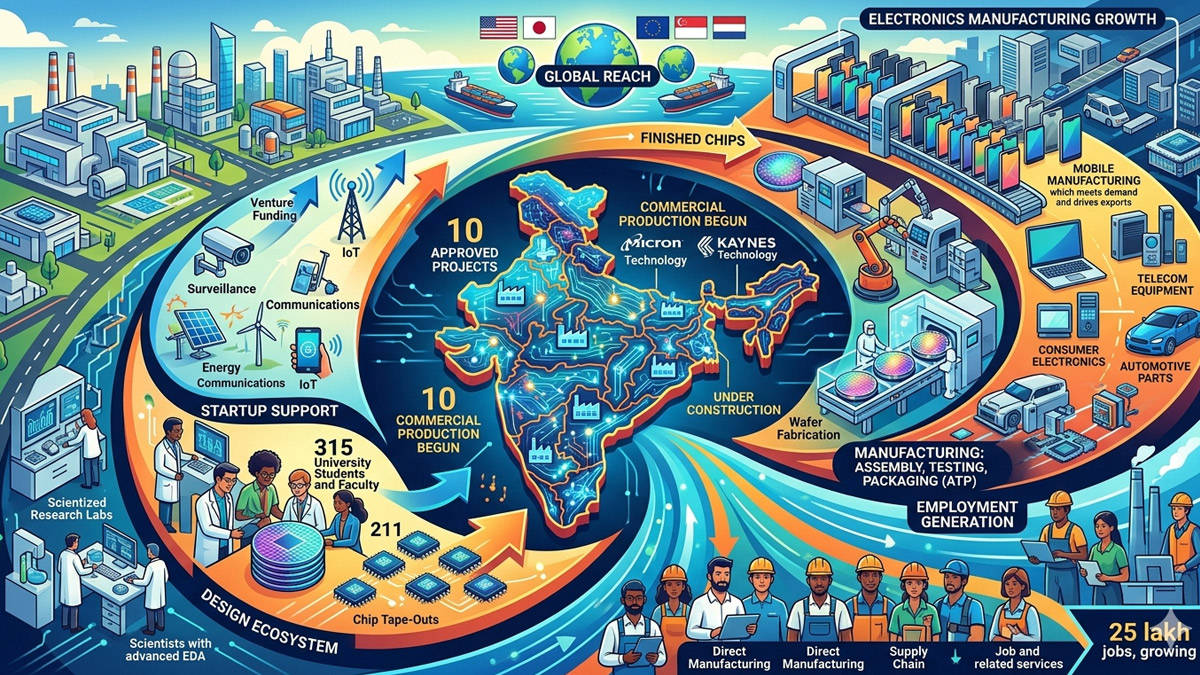
NEW DELHI: India’s push to become a global electronics powerhouse is gaining momentum, with the Semicon India Programme driving the creation of a full-fledged semiconductor ecosystem from design to manufacturing.
Launched in 2022, the programme aims to build capabilities across the entire value chain, including chip design, fabrication, assembly, testing and packaging. In just four years, the government has approved 10 semiconductor projects with a combined investment commitment of around Rs 1.6 lakh crore.
Two of these facilities have already begun commercial production, including units led by Micron Technology Inc. and Kaynes Technology India Limited. Two more plants are expected to go live later this year, signalling that India’s chip ambitions are moving from blueprint to factory floor.
The broader electronics manufacturing story has also seen sharp growth over the past decade. Production has jumped from roughly Rs 1.9 lakh crore in 2014-15 to about Rs 12 lakh crore in 2024-25, while exports have surged nearly eightfold. Mobile phone manufacturing, once heavily import-dependent, now meets almost all domestic demand and has become a major export driver.
Alongside manufacturing, the government is investing heavily in design capabilities. Through access to advanced chip design tools provided free to 315 universities, students and researchers have clocked over 200 lakh hours of usage. This effort has already resulted in 211 chip tape-outs from 75 institutions.
Support for startups is also picking up pace. Twenty-four chip design projects have been approved, targeting sectors such as surveillance, energy, communications and IoT. Of these, 14 companies have collectively raised over Rs 650 crore in venture funding, while several designs have progressed to fabrication, including at advanced nodes.
To strengthen supply chains, India has also signed semiconductor cooperation agreements with countries including the United States, Japan, the European Union, Singapore and the Netherlands. These partnerships aim to reduce global dependencies while boosting domestic capabilities.
The employment impact is equally significant. The electronics sector now supports an estimated 25 lakh jobs, with mobile manufacturing alone accounting for nearly half. As more semiconductor units come online under the India Semiconductor Mission, indirect job creation across supply chains is expected to rise further.
Sharing these updates in Parliament, Ministry of Electronics and Information Technology minister of state Jitin Prasada underscored the government’s focus on building a resilient, end-to-end semiconductor ecosystem.
With factories taking shape, designs moving to silicon and investments flowing in, India’s semiconductor story is steadily shifting gears from ambition to execution.






