Legal and Policies
Team Satyug advocates for stringent perjury law

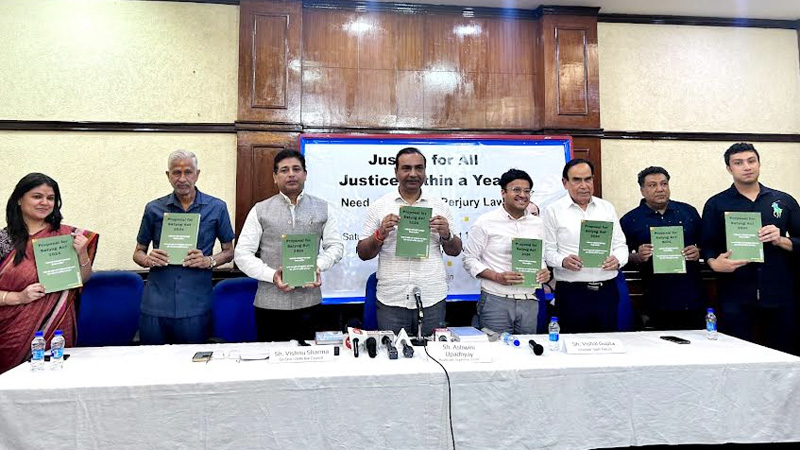
Mumbai: Team Satyug, a volunteer-driven organisation dedicated to eliminating the backlog of court cases in India and promoting justice within the judicial system, hosted a press conference titled “Justice for All, Justice Within a Year” which was themed around the need for stringent perjury law. The press conference took place at the Press Club of India, New Delhi, on 3 August 2024 at 11:30 am. The event was addressed by renowned Supreme Court advocate Ashwini Upadhyay and Delhi Bar Council co-chairman Vishnu Sharma.
Perjury, the act of lying under oath, is a grave offense that undermines the integrity of the judicial system. Despite repeated concerns raised by the High Courts and the Supreme Court, the issue of perjury has remained inadequately addressed and not given the seriousness it warrants. Team Satyug believes that addressing perjury is not a matter of technological limitation but one of political will. Team Satyug is committed to fostering a just society through collective volunteer efforts and innovative solutions.
The press conference garnered significant attention from the media and the public, bringing the urgent need for a stringent perjury law to the forefront of national discourse. The event successfully highlighted the critical issues within the judicial system and the necessity for political will to address perjury effectively. As a result, there was an increase in volunteer sign-ups, with many individuals committing their time to support Team Satyug’s mission. Furthermore, the conference sparked discussions among policymakers, leading to the consideration of legislative changes to strengthen laws against perjury.

Commenting on the same belief, Supreme Court lawyer Ashwini Upadhyay addressed the attendees stating, “Perjury is a significant threat to the sanctity of our judicial system. By not addressing it with the seriousness it deserves, we allow the integrity of our courts to be compromised. Team Satyug’s initiative to create a stringent perjury law is a crucial step towards ensuring justice for all. Our goal is to see justice delivered within a year, and with the collective efforts of our volunteers, we can make this vision a reality.”
Delhi Bar Council co-chairman Vishnu Sharma added, “Implementing a stringent perjury law is essential to restore the credibility of our judicial system. It is not just about punishment but about creating an environment where truth prevails. By tackling perjury head-on, we can ensure faster and fairer justice for everyone.”
Team Satyug’s initiative encourages individuals to come forward and rectify false testimonies without fear of punishment, thereby streamlining judicial processes. Team Satyug’s philosophy of “Absolute Satvik Karm” emphasized selfless actions performed for the greater good, without seeking personal or reputational gain.
“Our mission is to empower citizens to contribute to a fair and just society. The one-time amnesty program is a groundbreaking approach to dealing with perjury, which not only helps in reducing the backlog of cases but also restores faith in our legal system.” Team Satyug founding member Vishal Gupta stated. “We urge everyone to join us in this noble cause, dedicating just an hour a day to bring about a substantial change.”
The press conference hosted by Team Satyug on the need for a stringent perjury law marked a crucial step in addressing the integrity of India’s judicial system. With insights from Ashwini Upadhyay and Vishnu Sharma, the event emphasised the urgency of implementing the need for stringent laws, gaining widespread support for the cause.


Legal and Policies
India’s new income tax law and higher F&O levies take effect from 1st April
A sweeping overhaul of the tax code, stiffer securities transaction taxes and relief for travellers and tech firms all land at once

NEW DELHI: India’s tax landscape shifts gears on Tuesday. The Income-tax Act, 2025, which replaces the Income-tax Act, 1961, comes into force from April 1, 2026, alongside a clutch of budgetary measures that will be felt by traders, tourists, technology firms and ordinary taxpayers alike.
The new Act is not a reinvention of tax policy so much as a tidying up of it. Gone is the unwieldy distinction between the assessment year and the previous year; in its place comes a single “tax year” framework designed to be more logical and reader-friendly. Taxpayers will also, for the first time, be able to claim tax deducted at source refunds even when income tax returns are filed after the deadline, without incurring penal charges.
For those who trade derivatives, however, the news is less comfortable. Securities transaction tax on futures contracts rises to 0.05 per cent from 0.02 per cent, while STT on options premiums and the exercise of options is hiked to 0.15 per cent from 0.1 per cent and 0.125 per cent respectively. The government has made no secret of its intent: the higher levy is aimed squarely at curbing speculative bets in the futures and options segment and shielding retail investors from ruinous losses. The numbers tell a grim story. The number of individual investors active in the F&O segment fell from 1.06 crore in FY25 to about 75.43 lakh by December 2025. A Sebi study found that individual investors had racked up net losses of more than Rs 1.05 lakh crore in FY25 alone.
Overseas travellers and those remitting money abroad for medical and education purposes get some relief. Tax collected at source on overseas tour packages has been slashed to 2 per cent from 20 per cent, while TCS on Liberalised Remittance Scheme transfers for medical and educational purposes drops to 2 per cent from 5 per cent.
The data centre industry, too, has reason to cheer. Any foreign company procuring data centre services in India will enjoy a 20-year tax holiday stretching to 2047, shielding its global income from Indian tax authorities. Whether a global firm sets up its own facility or simply buys services from an Indian data centre, the tax treatment will be identical, ensuring a level playing field. India’s effective corporate tax rate stands at 25.17 per cent.
Software companies get a further fillip: the safe harbour threshold for IT services has been raised sharply from Rs 300 crore to Rs 2,000 crore, a move designed to reduce litigation and give the sector greater certainty.
On the transition, the income tax department has confirmed that its e-filing portal will handle compliance under both the old and new Acts during the switchover period. Taxpayers filing returns for assessment year 2026-27, which covers the period governed by the old Act, will do so in July 2026 using the old forms. Advance tax payments for tax year 2026-27, commencing from June 2026, will follow the new Act.
One sweeping law, several sharp edges, and a deadline that waits for no one.






