News Broadcasting
Tara Bangla initiates Bangladesh fashion week

MUMBAI: Regional channel Tara Bangla, the flagship of Broadcast Worldwide Limited, presented a Bangladesh fashion week in Dhaka on 3 and 4 of June. Aarong, an NGO which is into craft and fashion products marketing in Bangladesh, was the main sponsor of the event.
Tara Bangla will air the event on 11 July Sunday at 9:00 pm. India (9:30 Bangladesh).
Bangladeshi designers showed that their country was ready to take on the world in terms of Fashion Design. Not content to just manufacture some of the world’s biggest brands, the country is now all set to promote its original designers who can offer both pr?t-a-porter and couture designs to a rapidly expanding market, said an official release.

The Fashion week was a result of a chance meeting Bangladesh’s renowned model Bibi Russell had with Shobhaa De, who was so impressed with Bibi’s work that she felt it had to lead an effort to showcase the country’s vibrant and energized design initiative.
When Shobhaa mentioned the idea to Broadcast Worldwide chairman Rathikant Basu, he decided to take up the project immediately. To ensure that the Bangladesh Fashion Week became a regular annual feature on the Fashion calendar, he met the leading designers of Bangladesh and proposed the formation of an apex body on the lines of the Fashion Design Council of India. He also roped in Prasad Bidapa as Producer so that the event was organized professionally to the same international standards as other Fashion Weeks, said the release.
The leading designers of Bangladesh came together under the stewardship of Bibi Russell to form the Bangladesh Fashion Alliance, their equivalent of the FDCI. With dates set in early July, the eight designers would present their collection with five designers from India invited as well.
At a glittering function held at the Pan Pacific Sonargaon, one of Dhaka’s finest hotels, all of the city’s fashionistas attended in droves. Day One opened with Maheen Khan. One of Dhaka’s most directional designers, her combination of classic colours in black, white and red were translated into a chic retro collection pointed collars on fitted shirts were detailed with rows of buttons, creating a modern silhouette.
Anamika Khanna followed with a rich and texturised collection of very modern peasant inspired shapes that were layered and worn to great effect. Next, Aneela Haque, a trained graphic designer showed her mastery over the medium with her superbly printed collection of silk ensembles that floated down the ramp with great elegance and style. Here is a designer we think would make a huge impact in India.
India’s own Kiran Uttam Ghosh showed an eclectic mix of the styles she is well known for in India. Rina Lateef is a premier wedding trousseau designer there, and her collection reflected the tehzeeb and tradition of an impeccable sensibility.
On Day Two, Bibi Russell showed off a superbly detailed collection of separates and ensembles in cream and white – demonstrating just why she is the doyenne of international fashion. Satya Paul was up next, and his breezy, post modernistic sarees were a great hit, as were his vibrant colours and impeccable printed silks.
Kuhu, a painter and sculptor in Dhaka had recently made a foray into painting on textiles and fashion wear. Her unique viewpoint celebrated the Royal Bengal Tiger, the flora and fauna of her native country. Lita was the next traditionalist to show, and her Jamdhani sarees were like jewels, each one a rare and precious woven masterpiece that celebrated the colour and joy of the Bangladeshi people.
Sisters Mona and Pali departed from their signature look of ethnic formalwear to create a collection that Vivienne Westwood would have been proud to have designed, Her menswear celebrated the brash young male in cut offs and sleeveless shirts, beautifully printed and overprinted again, with a surface texture added on with embroidery. Abhishek Gupta’s funky, hip men’s wear and wife Nandita’s equally progressive women’s collection made the audience sit up in shock and awe.
The weekend however belonged to Aarong, who fielded four of their top design team headed by the attractive Tamara Abed, with a trousseaux collection of ensembles, saris and men’s formal looks that would make our designers sit up and take notice, and the buyers notice that these exquisite clothes sold for a fraction of the price of what Indian designers would have sold it for.
27 Bangladeshi Models headed by supermodels Tupa, Chaitee, Logono, Tumpa and Lisa walked the ramp with style and grace, and among the male models, the two Asifs, Xia. Abir, Alif and Abir would definitely give some of our boys a complex.
The guests present included the Bangladesh Foreign Secretary, Shamsher Chowdhury Shobhaa De and Dilip De, The Indian High Commissioner, Veena Sikri, The British and the French Ambassadors amongst others.
The event was managed by Momentum, a division of Unitrend Advertising and Prasad Bidapa Associates handled the creative.


News Broadcasting
Network18 channels lead YouTube news viewership in March 2026
CNN-News18, News18 India and CNBC channels top categories with record views
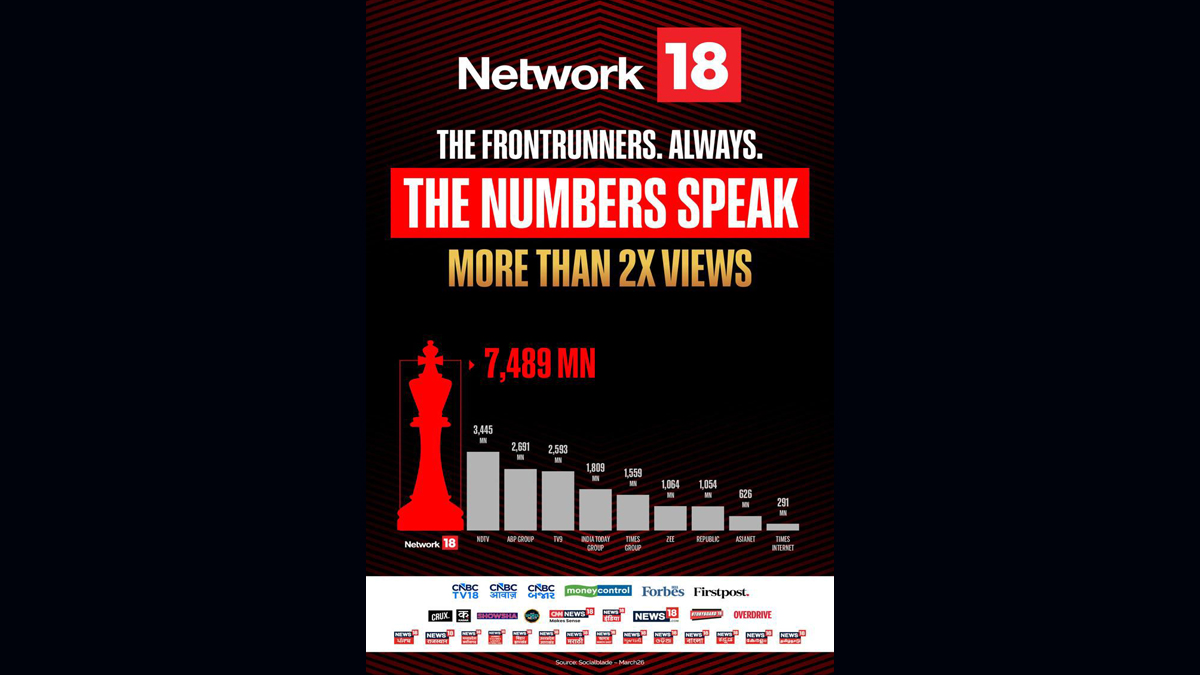
MUMBAI: When the world hit refresh on breaking news, Network18’s channels were already streaming ahead. As geopolitical tensions and war-driven headlines fuelled a surge in global news consumption, the network’s digital playbook delivered big clocking record Youtube viewership across English, Hindi and business news categories in March 2026.
At the forefront was CNN-News18, which emerged as the clear leader in the English news segment with 130 million live and video-on-demand views. The channel edged past competitors such as Times of India (126.5 million), Times Now (101.1 million), India Today (88.2 million) and NDTV (77.5 million), according to Databeings data for March.
In the Hindi news arena, News18 India delivered a commanding performance, racking up a staggering 3,297 million views on YouTube. The channel comfortably outpaced NDTV India, which recorded 3,119 million views, underlining its deep reach and consistent engagement with mass audiences, as per Playboard data.
The network’s dominance wasn’t confined to general news. In the Hindi business segment, CNBC Awaaz topped the charts with 92 million views, narrowly ahead of Zee Business (90 million) and well ahead of ET Now Swadesh (57 million). Meanwhile, its English counterpart CNBC-TV18 posted a strong 58 million views, reinforcing the network’s cross-category strength.
The spike in viewership reflects a broader shift in audience behaviour, with viewers increasingly turning to digital platforms particularly Youtube for real-time updates and in-depth coverage during high-intensity news cycles. For Network18, the numbers signal more than just scale; they underline the effectiveness of a multi-platform strategy that blends speed, credibility and continuous coverage.
In a month where the news never paused, it seems viewers chose to stay tuned where the stream never stopped.






