News Broadcasting
Swaraj pushes for Broadcasting Regulatory Authority

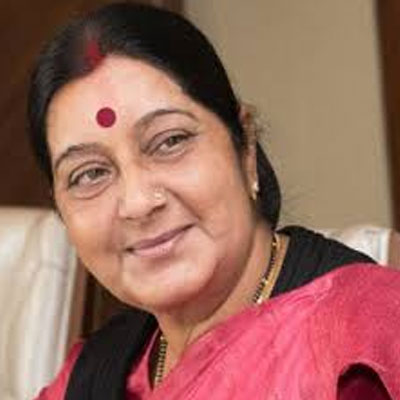
NEW DELHI: Trust India’s information and broadcasting minister Sushma Swaraj to drive to the hilt the advantage she has gained in recent times. Now she is pushing for a Broadcasting Regulatory Authority.
Egged on by her, the Parliamentary Consultative Committee, attached to India’s information and broadcasting ministry, in a meeting earlier today, came out strongly in favour of forming a regulatory body to monitor unregulated content on television channels in the country as soon as possible.
Members of Parliament, cutting across party lines, said that this was necessary in order to address the concerns of public order and decency, preservation of cultural diversity, prevention of excessive depiction of sex and violence, national security, integrity and sovereignty of the country and protection of children from undesirable programmes and advertisements, government sources told indiantelevision.com.

The issue is being seen as another step taken by I&B minister Sushma Swaraj in recent times to have in place a legislation to regulate the broadcasting and cable sectors in a piecemeal fashion, ahead of an omnibus legislation being proposed to govern the three sectors of media, information technology and telecommunications.
According to the sources, presiding over the meeting, Swaraj fully shared the concerns of the members and said that the ministry would consider setting up of an independent Broadcasting Regulatory Authority. According to Swaraj, the earlier Broadcasting Bill was not pursued in view of the introduction of the Communication Convergence Bill 2001 that had a provision for setting up of a panel for content regulation.
The members felt that in case of a delay in finalising the Convergence Bill, the government should move ahead towards regulating content since the programmes on various television channels were becoming increasingly unwholesome.
Merely waiting for the Convergence Act would not help, they are reported to have chorused —- something which Swaraj, on being criticised by the Communist Party of India (Marxist) for getting legislations passed in a piecemeal fashion, had reiterated in Parliament earlier.
IT, telecom and parliamentary minister Pramod Mahajan had some time earlier told indiantelevision.com that he does not foresee the Communications Convergence Bill, envisaging a super-regulator for IT, broadcasting and telecom, being discussed by policy-makers in Parliament before May 2003.
Meanwhile, arguing strongly for the immediate need of content regulation, Saroj Dubey, a BJP Member of Parliament during the meeting today said women are projected in a very bad light through some serials and advertisements on some channels.
Another MP, Vijay Darda, said that the proposed Authority must have adequate powers to punish the defaulters and should not be like the Press Council of India, which is unable to enforce its decisions. Kartar Singh Duggal said that the Authority be set up immediately without waiting for the Convergence Bill’s passage in Parliament and, at the same time, the script writers, artists, producers, broadcasters, advertisers and the viewers may be made aware of their obligations.
E. M. Sudarsana Natchiappan said the glorification of drinking, smoking, sex, violence and degraded values must not be allowed to be carried on. Abdul Rashid Shaheen shared the concerns but wanted detailed discussions both in and outside the Parliament.
Other MPs who wanted immediate action included C Narayana Reddy, G Sukhender Reddy, D Ramanaidu, Ram Naresh Tripathi, Lalhmingliana and Ajay Maroo.


News Broadcasting
Network18 channels lead YouTube news viewership in March 2026
CNN-News18, News18 India and CNBC channels top categories with record views
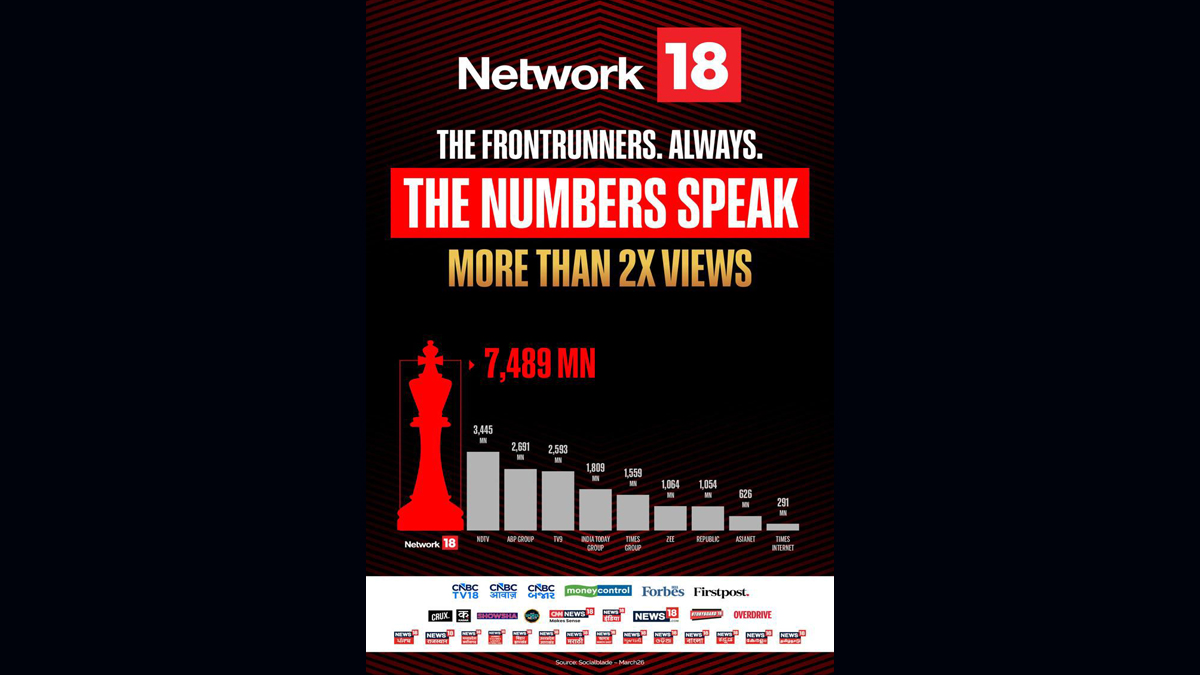
MUMBAI: When the world hit refresh on breaking news, Network18’s channels were already streaming ahead. As geopolitical tensions and war-driven headlines fuelled a surge in global news consumption, the network’s digital playbook delivered big clocking record Youtube viewership across English, Hindi and business news categories in March 2026.
At the forefront was CNN-News18, which emerged as the clear leader in the English news segment with 130 million live and video-on-demand views. The channel edged past competitors such as Times of India (126.5 million), Times Now (101.1 million), India Today (88.2 million) and NDTV (77.5 million), according to Databeings data for March.
In the Hindi news arena, News18 India delivered a commanding performance, racking up a staggering 3,297 million views on YouTube. The channel comfortably outpaced NDTV India, which recorded 3,119 million views, underlining its deep reach and consistent engagement with mass audiences, as per Playboard data.
The network’s dominance wasn’t confined to general news. In the Hindi business segment, CNBC Awaaz topped the charts with 92 million views, narrowly ahead of Zee Business (90 million) and well ahead of ET Now Swadesh (57 million). Meanwhile, its English counterpart CNBC-TV18 posted a strong 58 million views, reinforcing the network’s cross-category strength.
The spike in viewership reflects a broader shift in audience behaviour, with viewers increasingly turning to digital platforms particularly Youtube for real-time updates and in-depth coverage during high-intensity news cycles. For Network18, the numbers signal more than just scale; they underline the effectiveness of a multi-platform strategy that blends speed, credibility and continuous coverage.
In a month where the news never paused, it seems viewers chose to stay tuned where the stream never stopped.






