iWorld
Streaming strikes gold as India’s entertainment industry hits new highs


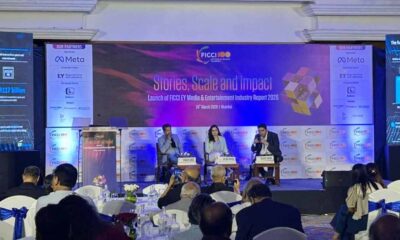
MUMBAI: If content is king, India’s entertainment industry is the kingdom where multiple rulers are emerging. At Content India 2025, industry stalwarts dissected the evolving media landscape in The State of the Indian Entertainment Nation panel discussion. From the meteoric rise of streaming to the power of regional narratives, the session brought to light the shifting dynamics of how Indians consume entertainment today.
India’s over-the-top (OTT) landscape is on an unstoppable growth trajectory, with over 500 million digital viewers making it one of the largest streaming markets globally. The paid subscription ecosystem grew 10 per cent in 2023, bringing in Rs 9,900 crore (1.2 billion dollars) in revenue, while the advertising-based video-on-demand (AVOD) model jumped 40 per cent to Rs 6,800 crore (850 million dollars).
Prime Video India director & head of SVOD business Shilangi Mukherji captured the moment by saying, “Streaming has democratised content. It’s no longer about big cities versus small towns. Today, the same audience that enjoys an international thriller can also binge-watch a hyperlocal drama from a remote region. The lines have blurred.”

Streambox Media founder and CEO Anuj Gandhi agreed, noting that AI-driven hyper-personalisation is further shaping the streaming experience. “The biggest challenge for any OTT platform is making sure that users find what they want before they get frustrated. AI is now solving that problem, ensuring people spend less time searching and more time watching.”
Despite streaming’s dominance, the theatrical experience refuses to fade into the background. While the OTT boom has led to a dip in mid-budget theatrical releases, big-ticket films continue to dominate. “Theatres aren’t dying, they’re just evolving,” said Applause Entertainment MD Sameer Nair. “The magic of a collective viewing experience is irreplaceable. Streaming has changed consumption habits, but cinema will always be a cultural event in India.”
The merger of PVR and INOX has strengthened multiplex chains, making them more resilient against digital competition. However, the industry has become more cautious with high-budget originals. Many OTT platforms are now focusing on regional acquisitions and dubbing successful content instead of creating big-budget originals from scratch.
If there’s one undeniable trend, it’s the explosion of regional content. Data shows that 48 per cent of all content produced in India in 2024 was in regional languages. Streaming platforms are doubling down on dubbed and subtitled content to bridge linguistic barriers and tap into non-Hindi-speaking markets. The industry is no longer bound by language, hyperlocal content is travelling far beyond its native state.
Hungama Digital Media CEO Siddhartha Roy noted, “We are witnessing a content explosion beyond Hindi. Regional is the new national. A Telugu film dubbed in Hindi or a Malayalam film finding audiences in Tamil Nadu, this cross-pollination of audiences is proof that language is no longer a barrier.”
Phantom Films CEOSrishti Behl added, “The best content is not necessarily being created in Mumbai. It’s coming from smaller production hubs in Chennai, Hyderabad, and even remote pockets of India. The industry is decentralising, and that’s exciting.”
Artificial intelligence (AI) is emerging as a game-changer for both content creation and consumption. AI-driven personalisation ensures that platforms serve users exactly what they want, while interactive content formats are gaining traction from AI-powered interactive storytelling to immersive live-streaming experiences.
Aniruddha Roy Chowdhury, an acclaimed director, shared his perspective on AI’s role in the creative process. “AI is not here to replace filmmakers, but to assist them. Whether it’s de-aging actors, enhancing visual effects, or even predicting audience preferences, AI is making storytelling smarter.”
The future of Indian entertainment is a melting pot of theatrical spectacles, streaming supremacy, regional dominance, and AI-driven innovations. As India’s internet penetration deepens and smartphone usage skyrockets, the next chapter in the industry’s evolution is being written in real-time.
“We’re in the business of storytelling,” said Shilangi Mukherji. “And in India, stories never run out. They only get better.”






iWorld
Bill Ackman’s Pershing Square makes $64 billion bid to acquire Universal Music Group
Ackman pitches NYSE relisting plan as UMG board weighs unsolicited offer

The hedge fund has proposed a business combination that values UMG at €30.40 per share, representing a hefty 78 per cent premium to its current trading price. The offer includes €9.4 billion in cash alongside stock in a newly formed entity, with shareholders set to receive €5.05 per share in cash and 0.77 shares in the new company for each UMG share they hold.
Under the proposal, UMG would merge with Pershing Square SPARC Holdings Ltd and re-emerge as a Nevada-based entity listed on the New York Stock Exchange. The move is designed to boost investor visibility and potentially secure inclusion in major indices such as the S&P 500.
Pershing Square Capital Management ceo Bill Ackman argued that while UMG’s operational performance remains strong, its market valuation has lagged due to external factors. “UMG’s stock price has languished due to a combination of issues that are unrelated to the performance of its music business,” Ackman said, pointing to concerns ranging from shareholder overhang to delayed US listing plans.
Ackman also flagged what he sees as untapped potential in UMG’s balance sheet and a lack of clear capital allocation strategy. He added that the market has not fully recognised the value of UMG’s €2.7 billion stake in Spotify, alongside gaps in investor communication.
The proposed transaction would also result in the cancellation of around 17 per cent of UMG’s outstanding shares, while maintaining its investment-grade balance sheet. Pershing Square has said it will fully backstop the equity financing, with debt commitments secured at signing. The deal is targeted for completion by the end of the year.
UMG, however, has struck a measured tone. The company confirmed that its board has received the non-binding proposal and will review it with advisers. It reiterated confidence in its current strategy and leadership under Lucian Grainge, signalling no immediate shift in stance.
The proposal comes at a time when global music companies are navigating evolving investor expectations, streaming economics and capital allocation pressures. For Pershing Square, the bet is clear: sharpen the financial story, relist in the US, and let the music play louder in the markets.
Whether UMG’s board is ready to change the tune remains to be seen, but the spotlight on its valuation just got a lot brighter.






