Components
Sterlite Tech’s shaky Q2 signals challenges ahead amid global demand contraction


Mumbai: Why, in a world ruled by the invisible hands of technology, do tech giants stumble through uneven financial terrain? Despite their omnipresence in our lives, tech companies often hit the rocks at least once each fiscal year—and Sterlite Technologies Limited (STL) is no exception. For STL, a powerhouse in optical and digital solutions, Q2 FY25 exposed more than just numbers. Faced with contracting demand, squeezed margins, and a fading grip on last year’s benchmarks, STL’s latest performance tells a tale of turbulence that reveals just how volatile the road to digital dominance can be.
STL reported consolidated revenues of Rs 1,413 crore for the quarter ending 30 September 2024, a 16 per cent increase from the previous quarter. This growth, however, fails to mask the underlying challenges. Compared to the same quarter last year, revenues have slid by 5.4 per cent, down from Rs 1,494 crore in Q2 FY24. This revenue dip reflects broader market contractions, especially in STL’s core optical fibre cable (OFC) and optical connectivity (OC) businesses, which have been grappling with supply chain constraints and price pressures globally.
In financial performance, STL’s EBITDA reached Rs 151 crore, marking a 63 per cent QoQ increase. However, this positive quarter-over-quarter rise sharply contrasts with the year-over-year trend, as EBITDA plummeted by 30 per cent from Rs 216 crore in Q2 FY24. STL’s EBITDA margin now stands at 10.7 per cent, a steep decline from 14.4 per cent last year, signalling weakened profitability across its core sectors.

The optical networking division, historically the backbone of STL’s business, continues to struggle. OFC volumes have decreased on an annual basis, underscoring the persistent demand softness that has plagued the company’s market segments. A more concerning aspect is the drop in Optical Connectivity attach rates from prior peaks, weakening STL’s market positioning. The segment generated Rs 1,027 crore in revenue this quarter, a reduction of 5.3 per cent YoY, despite modest QoQ growth. EBITDA margins within this segment also fell to 12.9 per cent, compared to 19.4 per cent in the same period last year, driven by higher operational costs and reduced OFC sales volumes.
Moreover, STL’s digital services division faced hurdles, with quarterly revenue declining to Rs 64 crore from Rs 78 crore YoY, reflecting a 17.9 per cent decrease. Losses within the digital business narrowed slightly, yet the unit continues to operate at a deficit, posting an EBITDA loss of Rs 15 crore.
Despite its revenue decline, STL achieved several key client acquisitions, securing projects in the US and UK, including a new partnership with Netomnia. However, these wins are tempered by STL’s broader market contraction and reduced OFC demand worldwide, as highlighted by a projected global market growth of only 4.3 per cent CAGR from 2022 to 2028. Although STL’s management expresses optimism for demand recovery, these short-term volume reductions underscore systemic weaknesses.
The company’s recent financials have cast doubt over its ability to maintain the growth trajectory seen in prior years. With H1 FY25 net losses mounting to Rs 60 crore, STL’s debt profile has also become a point of concern. Net debt stood at Rs 2,169 crore at the end of H1 FY25, accompanied by a debt-to-equity ratio of 0.74. This leverage, coupled with reduced earnings, limits STL’s flexibility to navigate the industry’s tightening margins and escalating global competition.
As STL embarks on its demerger of the Global Services business, the separation process itself may introduce further operational complexities and transitional costs. Scheduled for completion by Q3 FY25, this demerger aims to bolster STL’s core focus on optical and digital solutions, yet the timing appears precarious given the present fiscal constraints.
For now, STL’s path to stability appears fraught with challenges. A combination of cost restructuring and a recalibrated growth strategy may be crucial if STL is to weather the industry’s cyclical headwinds and regain investor confidence in the coming quarters.



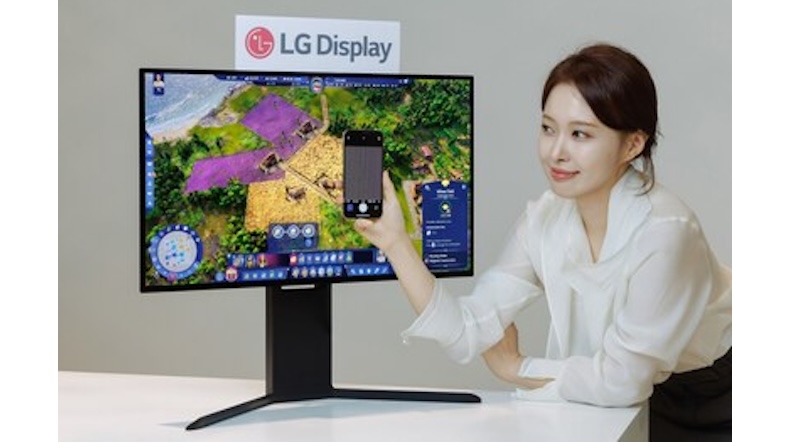
SEOUL: In the eternal battle between gamers demanding lightning-fast refresh rates and professionals craving pixel-perfect clarity, LG Display reckons it has found détente. The South Korean display titan is unveiling the world’s first 27-inch 4K OLED monitor panel that marries an RGB stripe structure with a blistering 240Hz refresh rate—a combination previously thought incompatible, like oil and water or fashion and function.
The breakthrough lies in how the pixels are arranged. RGB stripe structure lines up red, green and blue subpixels in neat rows, banishing the colour bleeding and fringing that plague lesser screens when you park your nose close to the display. It is the difference between reading crisp text and squinting at a rainbow-tinged mess. OLED panels using this method existed before, but they topped out at a sluggish 60Hz—fine for spreadsheets, useless for fragging opponents in first-person shooters.
LG Display’s engineering wizardry changes the game. By cranking the refresh rate to 240Hz whilst maintaining that pristine RGB stripe layout, the company has produced a panel that works equally well for colour-critical design work and twitchy gaming sessions. Better still, the panel incorporates Dynamic Frequency & Resolution technology, letting users toggle between ultra-high-definition at 240Hz and full-HD at a frankly ludicrous 480Hz. That is fast enough to make your eyeballs sweat.
The specs are suitably impressive: 160 pixels per inch for exceptional detail, optimised performance for Windows and font-rendering engines, and colour accuracy that should please the Photoshop brigade. LG Display achieved this by boosting the aperture ratio—the percentage of each pixel that actually emits light—and applying what it coyly describes as “various new technologies.” Translation: years of R&D and probably some sleepless nights.
Existing high-end gaming OLED monitors have relied on RGWB structures (which add a white subpixel) or triangular RGB arrangements. Both work, but neither delivers the sharpness that professionals demand. LG Display’s new stripe pattern is tailored specifically for monitor use, a recognition that staring at a screen from two feet away demands different engineering than watching telly from across the room.
The company is betting big on this technology, targeting the high-end monitor market where it already commands roughly 30 per cent of global OLED panel production. Among gaming OLED panels in mass production, LG Display claims world-leading specs across refresh rate, response time and resolution—a trifecta that sounds like marketing bluster until you check the numbers.
“Technology is the foundation of leadership in the rapidly growing OLED monitor market,” says LG Display head of the large display business unit Lee Hyun-woo. He promises to keep pushing “differentiated technologies compared to competitors”—corporate-speak for staying ahead of Chinese rivals snapping at LG’s heels.
The new panel will debut at CES 2026 in Las Vegas, where LG Display plans to woo customers and expand its lineup. Initial rollout targets high-end gaming and professional monitors, the sweet spot where people actually pay premiums for superior screens rather than settling for whatever came with their laptop.
Whether this technology reshapes the monitor market or remains a niche luxury depends on two things: pricing and production scale. But for now, LG Display has pulled off something rare—a genuine technical leap that solves a real problem. Gamers get their speed, designers get their clarity, and LG gets bragging rights. In the cutthroat world of display tech, that counts as a win.






