News Broadcasting
Star India joins global initiative to curb piracy

NEW DELHI: With the country losing around Rs 180 billion in revenue accompanied by a loss of 60,000 jobs every year because of film piracy, content producers and distribution platforms have been searching for various ways to fight this menace. As the FICCI-KPMG Report on Media and Entertainment said, movie piracy has over time shifted from CDs and DVDs to online platforms and the modus operandi involves use of sophisticated smartphones and camcorders to record films in theatres and then publish them on rogue websites.
Realising that this is a global menace, 30 leading content creators and on-demand entertainment companies from around the world have come together to protect the dynamic legal market for creative content and reducing online piracy.
The organizations launched a new global coalition Alliance for Creativity and Entertainment (ACE) for this purpose earlier this week.

The worldwide members of ACE are Amazon, AMC Networks, BBC Worldwide, Bell Canada and Bell Media, Canal+ Group, CBS Corporation, Constantin Film, Foxtel, Grupo Globo, HBO, Hulu, Lionsgate, Metro-Goldwyn-Mayer (MGM), Millennium Media, NBCUniversal, Netflix, Paramount Pictures, SF Studios, Sky, Sony Pictures Entertainment, Star India, Studio Babelsberg, STX Entertainment, Telemundo, Televisa, Twentieth Century Fox, Univision Communications Inc., Village Roadshow, The Walt Disney Company, and Warner Bros. Entertainment Inc.
The legal marketplace for creative content has grown exponentially over the last few years, as film and television companies have invested heavily in digital distribution models. There are more than 480 online services worldwide available for consumers to watch films and television programs legally on demand.
This tremendous growth of creativity also drives the economy. In the United States alone, the creative sector adds over $1.2 trillion to the economy and supports more than 5.5 million direct jobs each year.
However, as more creative content moves online, piracy poses a continuing threat to creators, consumers, and the economy. Films and television shows can often be found on pirate sites within days – and in many cases hours – of release. Last year, there were an estimated 5.4 billion downloads of pirated wide release films and primetime television and VoD shows using peer-to-peer protocols worldwide. There were also an estimated 21.4 billion total visits to streaming piracy sites worldwide across both desktops and mobile devices in 2016.
Piracy also puts consumers at risk. One in three pirate sites target consumers with malware that can lead to a range of problems including identify theft and financial loss, according to a December 2015 report by Digital Citizens Alliance.
ACE hopes to expand ongoing, cooperative efforts to reduce the prevalence of online piracy. ACE will draw upon the global antipiracy resources of the Motion Picture Association of America (MPAA) in concert with the internal antipiracy expertise of the ACE coalition members.ACE will conduct research, work closely with law enforcement to curtail illegal pirate enterprises, file civil litigation, forge cooperative relationships with existing national content protection organizations, and pursue voluntary agreements with responsible parties across the internet ecosystem.
MPAA Chairman and CEO Senator Chris Dodd said: “Global piracy is not just a concern for one studio or creator, it undermines the foundation of the entire global entertainment sector. Meeting the challenges ahead will require more voices, greater collaboration, new ideas, and increased resources. ACE, with its broad coalition of creators from around the world, is designed, specifically, to leverage the best possible resources to reduce piracy. For decades, the MPAA has been the gold standard for antipiracy enforcement. We are proud to provide the MPAA’s worldwide antipiracy resources and the deep expertise of our antipiracy unit to support ACE and all its initiatives.”
BBC Worldwide General Counsel Marlyn Freeman said: “BBC Worldwide invests in, commercializes, and showcases content from the BBC around the world and champions British creativity globally. It is the lifeblood of our business and we must ensure that we do all we can to secure and protect it from theft and illegal distribution. The ACE initiative is hugely important at a time when content consumption habits are rapidly shifting and methods of piracy are becoming more and more sophisticated.”
Sony Pictures Entertainment Senior EVP and General Counsel Leah Well said: “The theft and illegal distribution of copyrighted content impacts our business, the creative community, and the consumer viewing experience. As the landscape of the industry evolves, the range and threat of piracy expands with it. We look forward to working with our industry colleagues from around the globe to address this urgent issue.”
MGM Chief Legal Officer Lesley Freeman said : “As an industry, we collectively aim to maximize access to, and choices for, audiences to engage with our content. To be successful, we must also play an active role in raising awareness about the detrimental effects of online piracy, as it increasingly jeopardizes the rights of content creators and impedes the creation of the films and television programming that consumers want to watch. This partnership with ACE will allow us to combat the growing threat of online piracy and protect the work of those creators, while ensuring the highest level of safety and quality viewing experiences for our consumers worldwide.”
Netflix General Counsel David Hyman said: “While we’re focused on providing a great consumer experience that ultimately discourages piracy, there are still bad players around the world trying to profit off the hard work of others. By joining ACE, we will work together, share knowledge, and leverage the group’s combined anti-piracy resources to address the global online piracy problem.”
Sky Group COO Andrew Griffith saud: “Collaboration, through bodies such as ACE, is critical in tackling this issue because piracy is illegal, unreliable, and risky.”







News Broadcasting
Induction cooktop demand spikes 30× amid LPG supply concerns
Supply worries linked to West Asia tensions push households and restaurants to turn to electric cooking alternatives
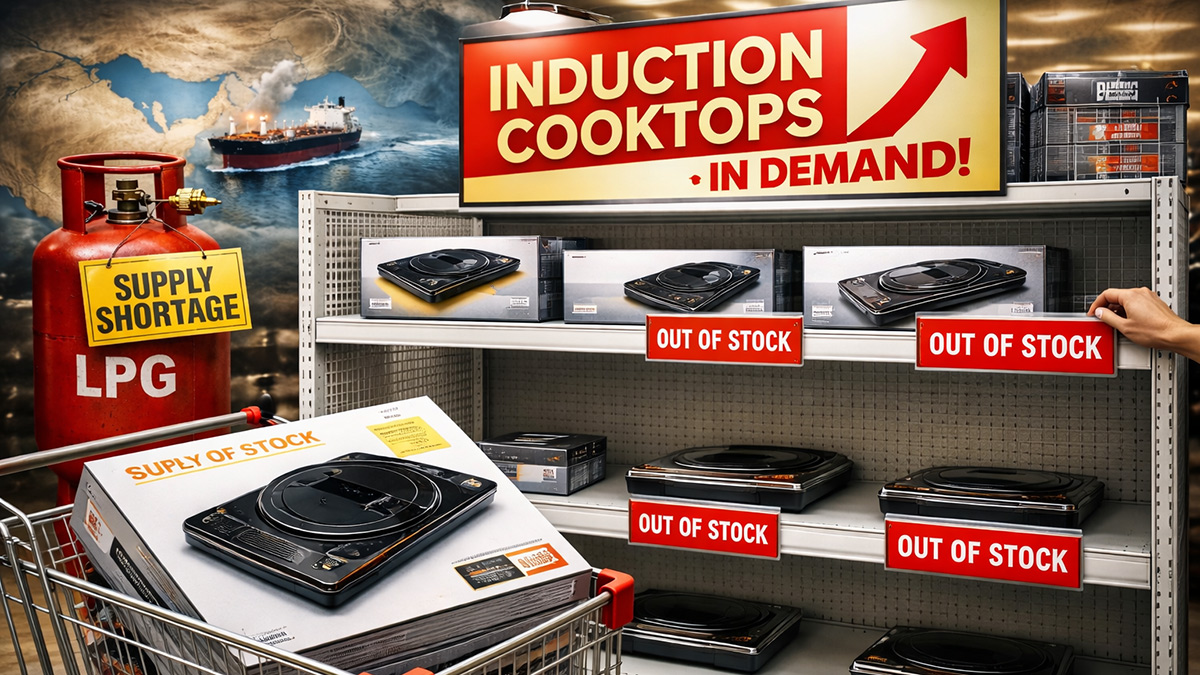
MUMBAI: As geopolitical tensions in West Asia ripple through global energy supply chains, the familiar blue flame in Indian kitchens is facing an unexpected challenger: electricity.
What began as concerns over the availability of liquefied petroleum gas (LPG) has quickly evolved into a technology-driven shift in cooking habits. Households across India are increasingly turning to induction cooktops and other electric appliances, initially as a backup but now, for many, a necessity.
A sudden surge in demand
Recent data from quick-commerce and grocery platform BigBasket highlights the scale of the shift. According to Seshu Kumar Tirumala, the company’s chief buying and merchandising officer, demand for induction cooktops has risen dramatically.
“Induction cooktops have seen a significant surge in demand, recording a fivefold jump on 10 March and a thirtyfold spike on 11 March,” Tirumala said.
The increase stands out sharply when compared with broader kitchen appliance trends. Most appliance categories are growing within 10 per cent of their typical demand levels, while induction cooktops have witnessed explosive growth as households rush to secure an alternative cooking option.
Major e-commerce platforms including Amazon and Flipkart have reported rising searches and orders for induction stoves. Quick-commerce apps such as Blinkit and Zepto have also witnessed stock shortages in major metropolitan areas including Delhi, Mumbai and Bengaluru.
What was once considered a convenient appliance for hostels, small kitchens or occasional use has suddenly become an essential addition in many homes.
A crisis thousands of miles away
The trigger for this shift lies far beyond India’s kitchens.
Escalating conflict in the Middle East has disrupted shipping routes through the Strait of Hormuz, one of the world’s most critical energy corridors. Nearly 85 to 90 per cent of India’s LPG imports pass through this narrow waterway, making the country particularly vulnerable to supply disruptions.
The ripple effects have been swift.
India currently meets roughly 60 per cent of its LPG demand through imports, and tightening global supply has already begun to affect domestic availability and prices.
Earlier this month, the price of domestic LPG cylinders increased by Rs 60, while commercial cylinders rose by more than Rs 114.
To discourage panic buying and hoarding, the government has also extended the mandatory waiting period between domestic refill bookings from 21 days to 25 days.
Restaurants feel the pressure
The strain is not limited to households. Restaurants, hotels and roadside eateries are also grappling with supply constraints as commercial LPG availability tightens under restrictions imposed through the Essential Commodities Act.
In cities such as Bengaluru and Chennai, restaurant associations report that commercial LPG availability has dropped by as much as 75 per cent, forcing many establishments to rethink their kitchen operations.
Some restaurants have reduced menu offerings, while others are rapidly installing high-efficiency induction systems, creating hybrid kitchens where electricity now shares the workload with gas.
For smaller eateries and roadside dhabas, the shift is less about sustainability and more about survival.
A potential structural shift
The government has maintained that there is no nationwide LPG crisis and has directed refineries to increase production to stabilise supply.
Nevertheless, the developments of March 2026 may already be triggering a longer-term behavioural shift.
For decades, LPG has been the backbone of cooking in Indian households. However, recent disruptions have highlighted the risks of relying on a single fuel source.
Increasingly, households appear to be hedging against uncertainty by adopting electric cooking options to guard against price volatility and delivery delays.
If the current trend continues, the induction cooktop, once viewed as a niche appliance, could emerge as a quiet symbol of India’s evolving kitchen economy.