News Broadcasting
Star Chinese Movies to launch in Singapore on StarHub CableTV


MUMBAI: The Star Group is expanding and how! It today announced that Star Chinese Movies will be launched in Singapore on StarHub CableTV Channel 62 on 21 January.
The new channel claims to have the most current movie line-up of any Chinese movie channel in the world. It will feature over 100 movies including at least 20 exclusive premieres a month. The movies aired will be in Mandarin and are commercial-free.
To celebrate the launch, the channel will showcase the exclusive premiere of The Lion Roars, starring Louis Koo and Cecilia Cheung. The channel has also lined up a series of blockbusters for the Chinese New Year, including Andy Lau and Gigi Leung’s Fat Choi Spirit, Anita Mui, Sammi Cheng starrer Wu Yen, Michelle Reis and Francis Ng’s Beauty and the Breast and Ekin Cheng and Cecilia Cheung’s Legend of Zu.

Star’s CEO Michelle Guthrie said, “We are excited to expand and strengthen our distribution in the key market of Singapore with our strongest Chinese language channel. Star Chinese Movies’ unbeatable movie line-up has consistently driven its performance as the No. 1 movie channel in Taiwan and we are confident that Singapore audiences will love it!”
Added StarHub’s senior VP for cable TV services Sandie Lee, “Star Chinese Movies further strengthens our already strong suite of Chinese channels, which offer viewers the best in Chinese news, entertainment and movies. Singapore viewers are known to be ardent movie lovers so the addition of Star Chinese Movies will definitely excite them. Star Chinese Movies offers many exclusive premieres and blockbusters. We are confident that the channel will do well in Singapore.”
According to an official release, all StarHub customers can sample the programmes on Star Chinese Movies during the free preview of the channel from 21 January, 9 pm till 22 February midnight, after which the channel will be available on the Asia Tier at a monthly fee of S$8 (S$8.40 with GST).
Upcoming blockbusters on Star Chinese Movies include Infernal Affairs, Running on Karma, Cat & Mouse, Homerun and Heroic Duo.







News Broadcasting
Network18 channels lead YouTube news viewership in March 2026
CNN-News18, News18 India and CNBC channels top categories with record views
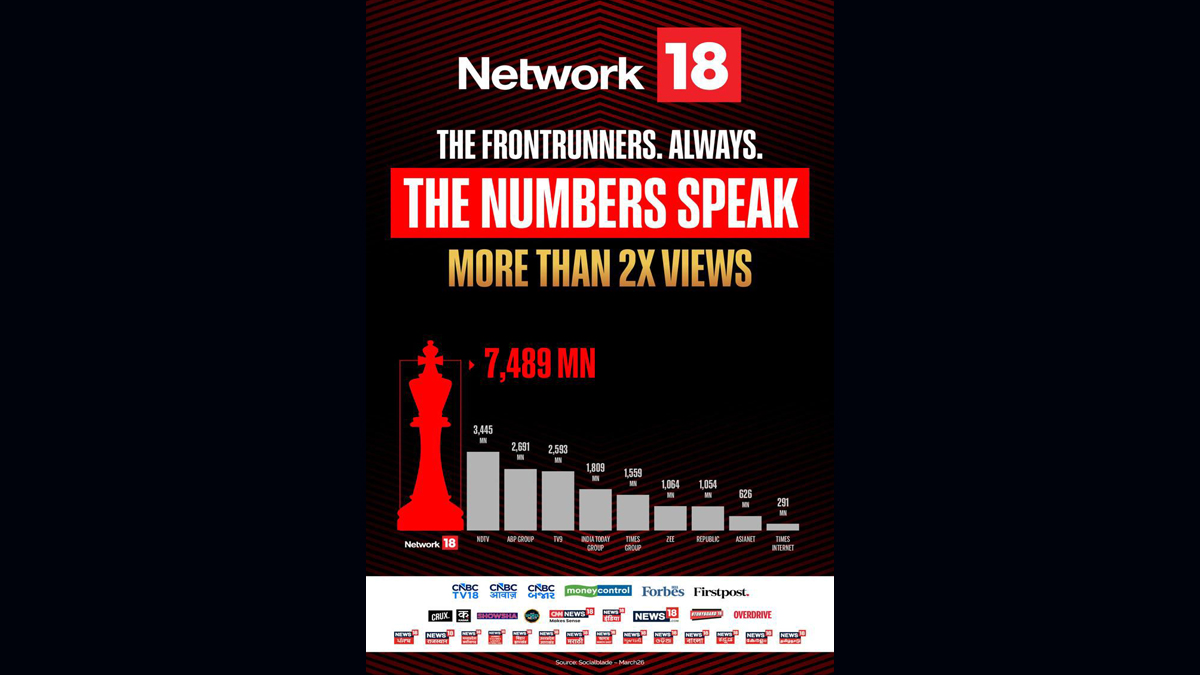
MUMBAI: When the world hit refresh on breaking news, Network18’s channels were already streaming ahead. As geopolitical tensions and war-driven headlines fuelled a surge in global news consumption, the network’s digital playbook delivered big clocking record Youtube viewership across English, Hindi and business news categories in March 2026.
At the forefront was CNN-News18, which emerged as the clear leader in the English news segment with 130 million live and video-on-demand views. The channel edged past competitors such as Times of India (126.5 million), Times Now (101.1 million), India Today (88.2 million) and NDTV (77.5 million), according to Databeings data for March.
In the Hindi news arena, News18 India delivered a commanding performance, racking up a staggering 3,297 million views on YouTube. The channel comfortably outpaced NDTV India, which recorded 3,119 million views, underlining its deep reach and consistent engagement with mass audiences, as per Playboard data.
The network’s dominance wasn’t confined to general news. In the Hindi business segment, CNBC Awaaz topped the charts with 92 million views, narrowly ahead of Zee Business (90 million) and well ahead of ET Now Swadesh (57 million). Meanwhile, its English counterpart CNBC-TV18 posted a strong 58 million views, reinforcing the network’s cross-category strength.
The spike in viewership reflects a broader shift in audience behaviour, with viewers increasingly turning to digital platforms particularly Youtube for real-time updates and in-depth coverage during high-intensity news cycles. For Network18, the numbers signal more than just scale; they underline the effectiveness of a multi-platform strategy that blends speed, credibility and continuous coverage.
In a month where the news never paused, it seems viewers chose to stay tuned where the stream never stopped.






