News Headline
Sony shows healthy advertising trends

MUMBAI: Sony, the second in command when one talks of general entertainment channels, has recorded a 25 per cent growth in revenue in the first half from January – September vis a vis the same period in 2003.
This jump has been attributed to the flurry of advertisers that Sony has witnessed in the last one year, reducing the channels dependence on the FMCG sector, which has been the advertising backbone of all channels. The push given by new categories in the TV advertising arena. They essentially being petroleum, four wheelers, consumer durables and telecom.
According to SET executive vice president (ad sales & revenue management) Rohit Gupta, most sectors have grown and in turn increased their spends on TV. Gupta also claims that SET accounted for the highest sell out of secondages in the first half of 2004 (April – September).

Looking at 8 am – 12 am, SET claims to be 15 per cent up in terms of FCT sold than the leading general entertainment channel Star Plus and third in the pecking order Zee TV.
Just to put that into perspective, Star Plus has a 10 minute cap which follows a 10 minute FCT + 2 minute promo format across the network. Sony and Zee TV on the other hand has no set cap and their FCT can vary depending on the demand.
Another point in note is the number of brands active on the
channel. The fact that advertising growth on TV has been a substantial reason. With new categories like four-wheelers, petroleum and telecom becoming major spenders on television, the dependence on the backbone of TV advertising, FMCG (fast moving consumer goods) have come down from 80 to 50 per cent, who usually tend to be the low yielding clients as most discounts are offered to them.
Gupta also said that in the past six months the effective rates of Sony have gone up by 20 per cent, although no figures were divulged.
The GRP game:
If one looks at figures that advertisers swear by, GRPs, SET here again seems to have a rosy tale to tell. Over the last six months SET has pretty much managed to sustain its GRPS – Its all day GRPs ranging from 199 – 191 -191 across the three quarters and prime time (8pm – 11pm) ranging from 106 – 97 – 100 across the three quarters.
Star Plus on the other hand seems to have lost GRPs across quarters with All day ranging from 740 in Q1 down 10 per cent to 665 in Q2 and down a further 14 per cent to 573 in Q3 in the C&S 4+ Hindi speaking markets. Prime time (8 pm – 11pm) saw Plus at 385 GRPs slide to 329 in Q2 down 15 per cent to 306.
Coming to Zee TV, the channel lags 30 per cent lower that Sony with its all day Q1, Q2, Q3 GRP’s being 149, 134 and 130 respectively and prime time (8 pm – 11pm) Q1, Q2, Q3 being 46, 39 and 41 respectively in the C&S 4+ Hindi speaking markets.
Another crucial stand taken by Sony was not taking every deal that came their way. “Today with more advertisers coming in, and Sony delivering in terms of GRP’s and TRP’s, we are actually turning down low yielding clients,” says Gupta.
Also, with the export embargo lifted off foreign cable and satellite, retail and local advertisers have also surfaced onto television who now do not have to produce any export certificate to advertise on TV, hence opening up new categories of advertisers for channels.
The lifting of this ban has led to the opening up of the categories allowing smaller brands to explore higher delivering mediums.
A drift has also been observed with more advertisers spending more on TV versus print. With Sony being a more economical buy, the channel seems to have benefited from this paradigm shift.
Gupta also states that the last two years saw a trend of CPRP (cost per rating point) benchmarks falling, but the trend now seems to be showing healthier signs. The corporate top-line and bottom-line results have also significantly contributed to the increase in advertising.
A key point also that Gupta pointed out was Sony’s focussed TG and their programming that is built around the 15 – 35 SEC A,B ensures that advertisers reach viewers to have the propensity to buy and a TG that influences buys.
Sony’s endeavour in consolidating the 10-10:30 pm band with Ye Meri Life Hain in addition to 9-10 pm with Jassi… and Kkusum seems to have worked. New shows Ayushmaan and Hum 2 Hain Na have given a boost to the 8-9pm band says Gupta.
“All in all, today advertisers are confident about Sony, and do not hesitate in placing their stakes, as we are delivering. Now with Indian Idol, proving to be a big success, the channel is definitely on its way in bridging the gap between its number two position and the number one.”



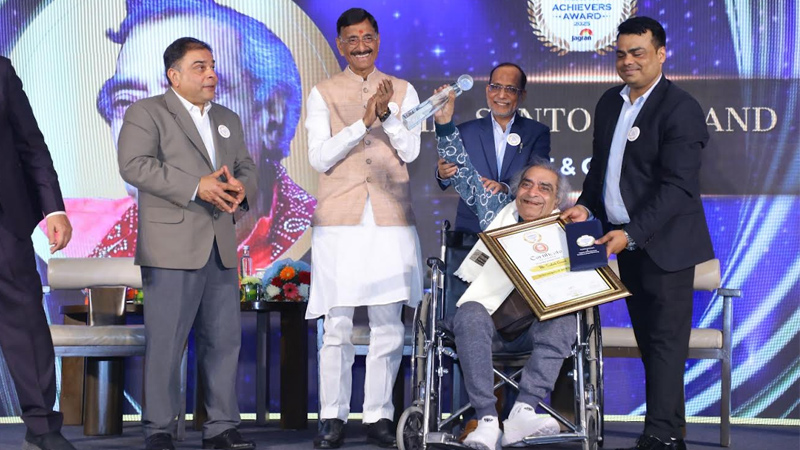
NEW DELHI: Hamdard Laboratories gathered a cross-section of India’s achievers in New Delhi on Friday, handing out the Hakeem Abdul Hameed Excellence Awards to figures who have left their mark across healthcare, education, sport, public service and the arts.
The ceremony, attended by minister of state for defence Sanjay Seth and senior officials from the ministry of Ayush, celebrated individuals whose work blends professional success with a sense of public purpose. It was as much a roll call of achievement as it was a reminder that influence is not measured only in profits or podiums, but in people reached and lives improved.
Among the headline awardees was Alakh Pandey, founder and chief executive of PhysicsWallah, recognised for turning affordable digital learning into a mass movement. On the sporting front, Arjuna Awardee and kabaddi player Sakshi Puniya was honoured for her contribution to the game and for pushing women’s participation onto bigger stages.
The cultural spotlight fell on veteran lyricist and poet Santosh Anand, whose songs have echoed across generations of Hindi cinema. At 97, Anand accepted the honour with characteristic humility, reflecting on a life shaped by perseverance and hope.
Healthcare honours spanned both modern and traditional systems. Manoj N. Nesari was recognised for strengthening Ayurveda’s place in national and global health frameworks. Padma shri Mohammed Abdul Waheed was honoured for his research-backed work in Unani medicine, while padma shri Mohsin Wali received recognition for his long-standing contribution to patient-centred care.
Education and social development also featured prominently. Padma shri Zahir Ishaq Kazi was honoured for decades of work in education, while former Meghalaya superintendent of Police T. C. Chacko was recognised for public service. Goonj founder Anshu Gupta received an award for his dignity-centred rural development initiatives, and the Hunar Shakti Foundation was honoured for empowering women and young girls through skill development.
The Lifetime Achievement Award went to former IAS officer Shailaja Chandra for her long career in public healthcare and governance, particularly in the traditional systems under Ayush.
Speaking at the event, Hamdard chairman Abdul Majeed said the awards were a tribute to those who combine excellence with empathy. “These awardees reflect Hakeem Sahib’s belief that healthcare, education and public service must ultimately serve humanity,” he said.
Minister Seth struck a forward-looking note, saying India’s young population gives the country a unique opportunity to become a global destination for learning, health and wellness by 2047.
The ceremony also featured the trailer launch of Unani Ki Kahaani, an upcoming documentary starring actor Jim Sarbh, set to premiere on Discovery on 11 February.
Instituted in memory of Unani scholar and educationist Hakeem Abdul Hameed, the awards have grown into a national platform that celebrates those building a more inclusive and resilient India. For one evening at least, the spotlight was not just on success, but on service with substance.






