Hardware
Sony cards speed past limits with blazing 1800 MB/s read and 1700 MB/s write

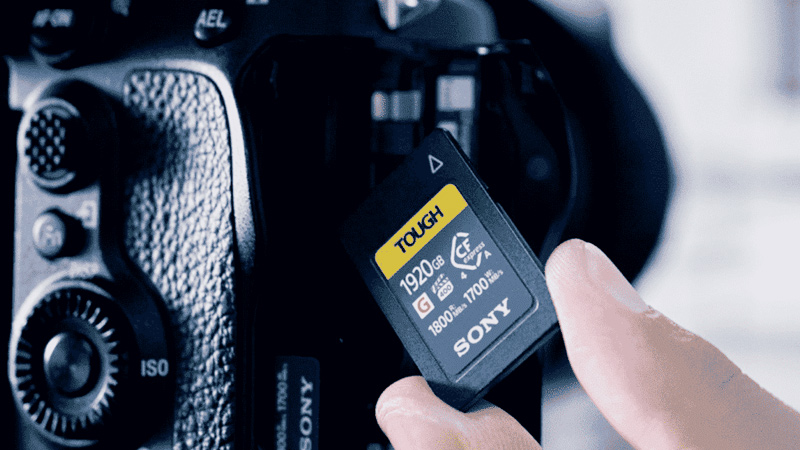
MUMBAI: When it comes to speed, Sony just hit fast-forward. The tech giant has launched its Cfexpress 4.0 Type A cards in India, promising blistering performance for professional creators with read speeds up to 1800 MB/s and write speeds up to 1700 MB/s more than double their predecessors.
The new CEA-G1920T (1920 GB, Rs 97,490) and CEA-G960T (960 GB, Rs 59,990) cards, along with the MRW-G3 card reader (Rs 17,990), hit stores and e-commerce platforms on 20 August 2025. Built for Sony’s Cinema Line and Alpha cameras, the cards are designed to handle the ever-demanding world of high-bitrate 4K and above video, long shoots, and instant data transfer.
The upgrades aren’t just about speed. With a minimum sustained write speed of 400 MB/s, these cards guarantee uninterrupted recording of cinematic-quality footage. Their durability has also been levelled up, the reinforced resin body is five times stronger than previous models and can survive drops from 7.5 metres. Bend resistance has been enhanced to withstand forces up to 150 newtons, making them ready for the chaos of on-location shoots.

The compact design means portability without compromise, supporting lightweight camera bodies while packing in serious storage muscle. Meanwhile, the MRW-G3 reader, built exclusively for Cfexpress Type A, supports USB 40 Gbps transfer speeds, ensuring that even massive files fly from card to system in record time. With its heat-dissipation design, the reader is also engineered for stability during prolonged workflows.
For photographers, videographers, and filmmakers juggling huge files under pressure, Sony’s latest launch isn’t just storage, it’s a workflow accelerator. With capacity, speed, and ruggedness in one pocket-sized package, these cards ensure creators spend less time waiting and more time making.







Hardware
India clears Rs 1.6 lakh crore semiconductor projects under Semicon India
Ten projects cleared as production begins and design ecosystem gathers pace

NEW DELHI: India’s push to become a global electronics powerhouse is gaining momentum, with the Semicon India Programme driving the creation of a full-fledged semiconductor ecosystem from design to manufacturing.
Launched in 2022, the programme aims to build capabilities across the entire value chain, including chip design, fabrication, assembly, testing and packaging. In just four years, the government has approved 10 semiconductor projects with a combined investment commitment of around Rs 1.6 lakh crore.
Two of these facilities have already begun commercial production, including units led by Micron Technology Inc. and Kaynes Technology India Limited. Two more plants are expected to go live later this year, signalling that India’s chip ambitions are moving from blueprint to factory floor.
The broader electronics manufacturing story has also seen sharp growth over the past decade. Production has jumped from roughly Rs 1.9 lakh crore in 2014-15 to about Rs 12 lakh crore in 2024-25, while exports have surged nearly eightfold. Mobile phone manufacturing, once heavily import-dependent, now meets almost all domestic demand and has become a major export driver.
Alongside manufacturing, the government is investing heavily in design capabilities. Through access to advanced chip design tools provided free to 315 universities, students and researchers have clocked over 200 lakh hours of usage. This effort has already resulted in 211 chip tape-outs from 75 institutions.
Support for startups is also picking up pace. Twenty-four chip design projects have been approved, targeting sectors such as surveillance, energy, communications and IoT. Of these, 14 companies have collectively raised over Rs 650 crore in venture funding, while several designs have progressed to fabrication, including at advanced nodes.
To strengthen supply chains, India has also signed semiconductor cooperation agreements with countries including the United States, Japan, the European Union, Singapore and the Netherlands. These partnerships aim to reduce global dependencies while boosting domestic capabilities.
The employment impact is equally significant. The electronics sector now supports an estimated 25 lakh jobs, with mobile manufacturing alone accounting for nearly half. As more semiconductor units come online under the India Semiconductor Mission, indirect job creation across supply chains is expected to rise further.
Sharing these updates in Parliament, Ministry of Electronics and Information Technology minister of state Jitin Prasada underscored the government’s focus on building a resilient, end-to-end semiconductor ecosystem.
With factories taking shape, designs moving to silicon and investments flowing in, India’s semiconductor story is steadily shifting gears from ambition to execution.






