Hardware
Sony and LiveU zoom in on future with bonded IP breakthrough at IBC 2025

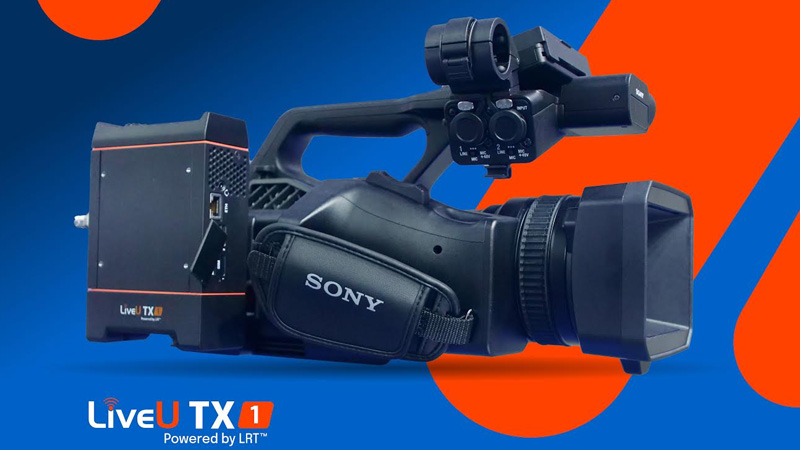
MUMBAI: When Sony meets LiveU, the broadcast world gets a sharper focus. At IBC 2025, the two tech titans announced a first-of-its-kind collaboration that promises to change how stories get from the field to the newsroom fast, reliable, and without the usual workflow headaches.
The star of the show? The new LiveU TX1, a compact transmission unit built specifically for Sony’s professional camera range. Think of it as a tiny powerhouse: it clips neatly onto cameras like Sony’s freshly launched PXW-Z300, turning them into mobile broadcast hubs. With its small form factor, TX1 slashes production timelines by offering ultra-fast file transfers and bonded IP connectivity on the go.
At its core is LiveU’s patented LRT (LiveU Reliable Transport) protocol, famed for keeping live feeds smooth, stable, and sharp even in tricky conditions. By combining multiple network connections, TX1 ensures resilient video performance that broadcasters can actually trust for mission-critical operations.

“Our customers want to be able to deliver files shot on camcorders from wherever the story takes them, back to their galleries, easily, swiftly and reliably,” said Sony Corporation head of media solutions business Masakazu Murata. “Through our collaboration with LiveU, the leading company in video-over-bonded-IP transmission, we are now able to offer customers a workflow integrated with Sony’s ecosystem even for mission-critical operations that require bonding. We look forward to working with LiveU to further streamline workflows and make a significant contribution to the broadcast industry.”
LiveU CEO and co-founder Samuel Wasserman said, “We are proud to announce this important collaboration with Sony, the global leader in electronics, gaming, entertainment, and imaging technologies. This partnership represents a strong vote of confidence in LiveU’s cutting-edge technology and the innovation we bring and will continue to bring to the market. I would like to thank the Sony team for their professional and collaborative spirit and wish us all great success on our shared journey.”
The deal signals more than just a shiny new gadget. It’s the start of a broader roadmap where Sony’s camera heritage and LiveU’s connectivity know-how combine to shape the next phase of broadcast production. Journalists, content creators, and live producers can expect fewer cables, faster turnaround, and workflows that keep pace with the news cycle.
While the TX1 made its debut at IBC 2025, broadcast professionals will need a little patience: the unit will be available through Sony’s accredited distributors and resellers, with release details scheduled for 2026.
For now, though, one thing is clear, when it comes to capturing the moment and sending it back in real time, Sony and LiveU are keeping the world’s broadcasters firmly in the picture.







Hardware
India clears Rs 1.6 lakh crore semiconductor projects under Semicon India
Ten projects cleared as production begins and design ecosystem gathers pace
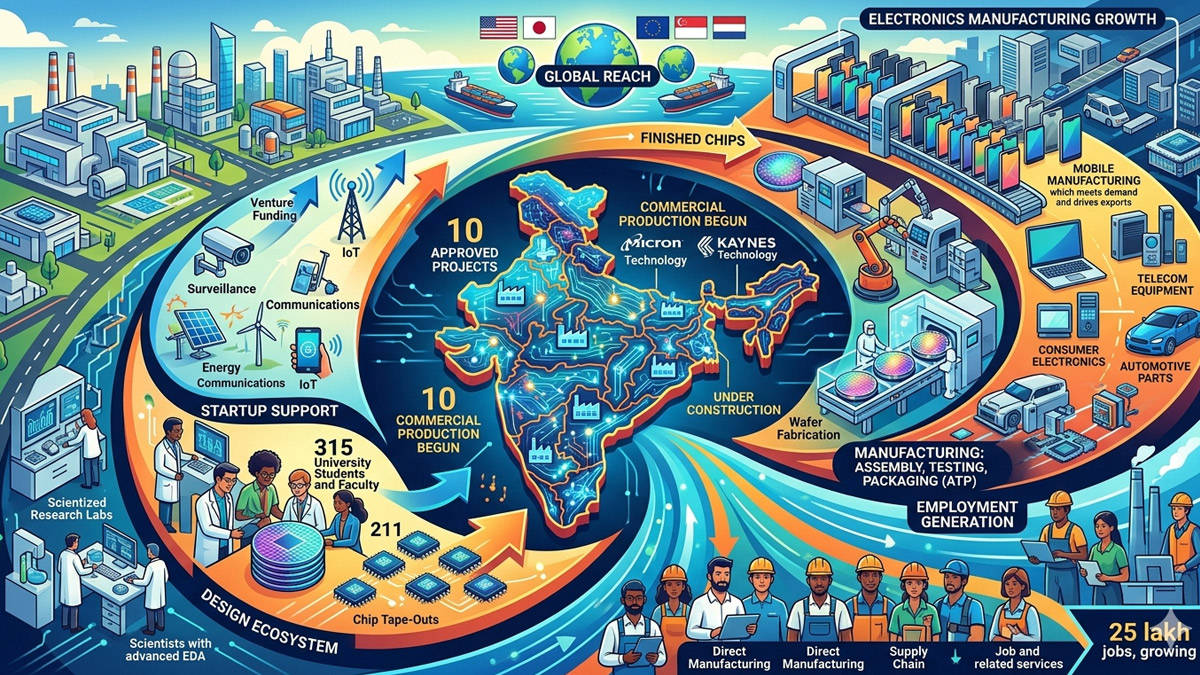
NEW DELHI: India’s push to become a global electronics powerhouse is gaining momentum, with the Semicon India Programme driving the creation of a full-fledged semiconductor ecosystem from design to manufacturing.
Launched in 2022, the programme aims to build capabilities across the entire value chain, including chip design, fabrication, assembly, testing and packaging. In just four years, the government has approved 10 semiconductor projects with a combined investment commitment of around Rs 1.6 lakh crore.
Two of these facilities have already begun commercial production, including units led by Micron Technology Inc. and Kaynes Technology India Limited. Two more plants are expected to go live later this year, signalling that India’s chip ambitions are moving from blueprint to factory floor.
The broader electronics manufacturing story has also seen sharp growth over the past decade. Production has jumped from roughly Rs 1.9 lakh crore in 2014-15 to about Rs 12 lakh crore in 2024-25, while exports have surged nearly eightfold. Mobile phone manufacturing, once heavily import-dependent, now meets almost all domestic demand and has become a major export driver.
Alongside manufacturing, the government is investing heavily in design capabilities. Through access to advanced chip design tools provided free to 315 universities, students and researchers have clocked over 200 lakh hours of usage. This effort has already resulted in 211 chip tape-outs from 75 institutions.
Support for startups is also picking up pace. Twenty-four chip design projects have been approved, targeting sectors such as surveillance, energy, communications and IoT. Of these, 14 companies have collectively raised over Rs 650 crore in venture funding, while several designs have progressed to fabrication, including at advanced nodes.
To strengthen supply chains, India has also signed semiconductor cooperation agreements with countries including the United States, Japan, the European Union, Singapore and the Netherlands. These partnerships aim to reduce global dependencies while boosting domestic capabilities.
The employment impact is equally significant. The electronics sector now supports an estimated 25 lakh jobs, with mobile manufacturing alone accounting for nearly half. As more semiconductor units come online under the India Semiconductor Mission, indirect job creation across supply chains is expected to rise further.
Sharing these updates in Parliament, Ministry of Electronics and Information Technology minister of state Jitin Prasada underscored the government’s focus on building a resilient, end-to-end semiconductor ecosystem.
With factories taking shape, designs moving to silicon and investments flowing in, India’s semiconductor story is steadily shifting gears from ambition to execution.






