Cable TV
Siti relooks at broadband as cable subscription drove revenues in FY18


BENGALURU: In FY 2017 (fiscal or year ended 31 March 2017, previous year), the Essel Group’s Siti Networks Ltd (Siti) was all gung-ho about broadband. In its annual report for fiscal 2017, the company said that it had become the largest multi-system operator (MSO) and a leading wired broadband services provider. The tone of the company’s 2017 annual report showed that Siti was fired up by the doubling of broadband revenue in FY 2017 as compared to FY 2016 to Rs 97 crore (about 8 per cent of total revenue for fiscal 2017) from Rs 48.6 crore (about 4 per cent of total revenue for fiscal 2016). The company’s broadband operations added 7.2 lakh home passes during the year taking the total footprint to 16.1 lakh homes. Broadband customer base grew to 2.28 lakh by Q4 2017 exit, up 73 per cent year-on-year (y-o-y). Further, Siti said in its FY 2017 annual report that it planned to channelise more capital to its broadband division, which it then felt was a highly scalable opportunity.
Cut to FY 2018 and the story has changed. Siti’s broadband operations with a total footprint of 16.8 lakh homes had a base of 2.5 lakh customers. Siti added just about 22,000 broadband subscribers in fiscal 2018, and y-o-y broadband revenues grew by only 4 per cent to Rs 101 crore in FY 2018.The company said that it was working on building a growth strategy in the sector.
Quoting from its fiscal 2018 Annual report:

“We are also looking closely at better and centralised inventory controls, besides identifying unsustainable locations running on IP bandwidth with the objective of phasing them out. We also aim to focus more aggressively on high definition (HD) penetration, broadband expansion, and improving monetisation in digital addressable system (DAS) phase III and IV areas.”
At another place in the 2018 annual report Siti states:
“In broadband, your company is looking to deepen its penetration levels in its existing markets to better utilise existing capital expenditure incurred. Going forward, we are also looking to arrive at an ideal business model that will allow us to grow profitably and sustainably in this segment, especially considering the disruptive pricing environment prevalent in mobile internet currently and the entry on new entities in wired broadband.”
It must be noted that broadband contributed to just about 8 percent and 7 percent to Siti’s revenues in FY 2017 and FY 2018 respectively. Cable business is and has been the major revenue earner for Siti.
While its broadband business has not met with Siti’s expectations, its cable business and more so subscription revenue has been the revenue growth driver. Cable subscription (Video) revenue in FY 2017 grew 39 per cent to Rs 569 crore as compared to Rs 410.2 crore in FY 2016. Siti’s cable subscription revenue grew 41 per cent in fiscal 2018 to Rs 799.7 crore as compared to the previous year. Carriage revenue, which had grown by 17 per cent in FY 2017 to Rs 300.1 crore from Rs 256.8 crore was almost stagnant in terms of growth in FY 2018. It grew by about 1.3 per cent to about Rs 303.8 crore in fiscal 2018. Siti’s activation revenue has also been almost constant and will taper off once its entire subscriber base has been digitised, since this is generally a one-time revenue. Activation revenue in FY-2016 was Rs 170.6 crore, it was Rs 170.1 crore in FY 2017 and was Rs 175 crore in FY 2018. Advertisement revenue had declined in FY 2017 to Rs 13.5 crore from Rs 32 crore in FY 2016 has increased in FY 2018 to Rs 18.5 crore.
Siti has yet to report profit after tax and reward its shareholders with dividends. But, the good thing is that Siti’s operating profits (EBITDA) without activation revenue have grown 2.6 times in FY 2018 to Rs 150.7 crore from Rs 58.6 crore. Overall EBITDA including activation has grown 41.9 per cent in FY 2018 to Rs 324.5 crore from Rs 241.2 crore in the previous year.
All numbers in this report are consolidated unless stated otherwise.
Siti’s position with regards to broadband is more of a norm rather than an exception. Many other MSOs’ and LCOs’ that have also been providing broadband internet services have had muted numbers from this business stream in FY 2018 as compared to the previous year. This implies either a slow growth or even de-growth of subscriber numbers, reduced ARPUs’ or even both.
Mukesh Dhirubhai Ambani’s Reliance Jio Infocomm Ltd (Jio) has been the biggest disrupter that has got both wireless and wireline internet service providers struggling to match up. With its plans to start FTTH wired internet services, with strategies that many in the industry term as ‘predatory’, it is likely to make the ground difficult to sustain and grow for incumbents.







Cable TV
Hathway Cable appoints Gurjeev Singh Kapoor as CEO
Leadership change comes as cable TV faces shrinking subscriber base and modest earnings pressure
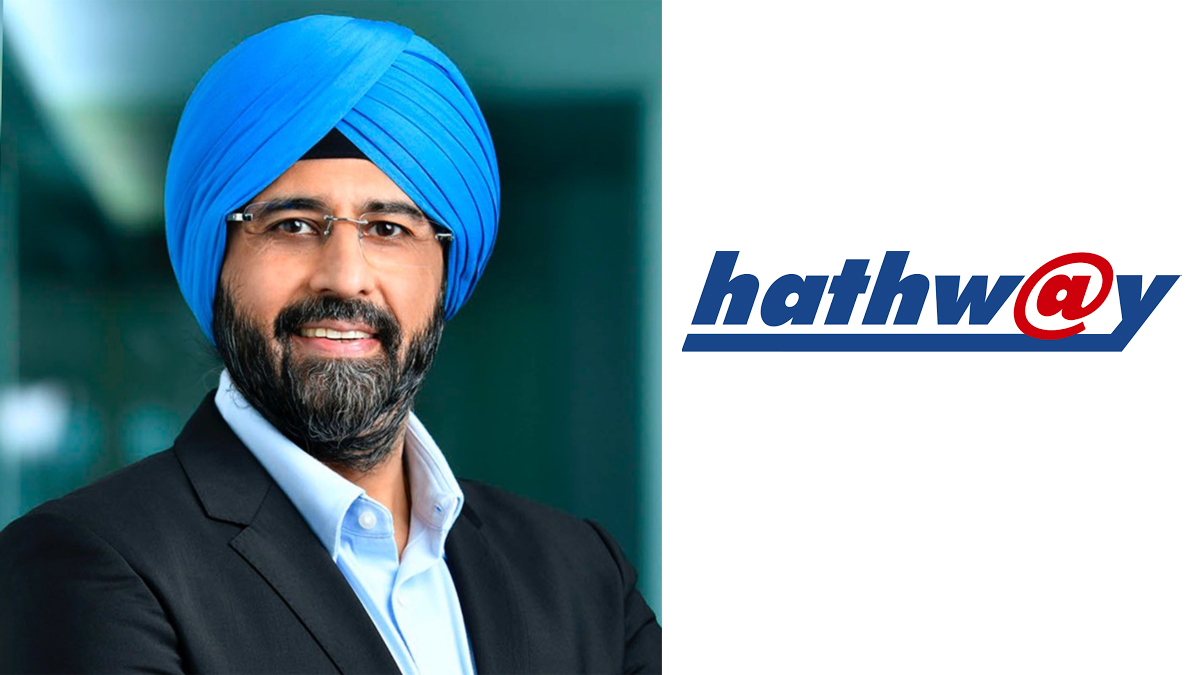
MUMBAI: Hathway Cable and Datacom has tapped industry veteran Gurjeev Singh Kapoor as chief executive officer, marking a leadership pivot at a time when India’s cable television business is under mounting strain.
Kapoor will take over from Tavinderjit Singh Panesar, who is set to retire in August after a long innings with the company. Panesar, chief executive since 2023, has held multiple leadership roles at Hathway, including his latest stint beginning in 2022.
Kapoor brings more than three decades of experience in media and entertainment. He most recently led distribution at The Walt Disney Company’s Star India business, now part of JioStar. His career spans television distribution and affiliate partnerships, with stints at Sony Pictures Networks India, Discovery Communications and Zee Entertainment.
Panesar, with over three decades in the industry, has worked across strategic planning, distribution and business development in media, broadcasting and manufacturing. His past associations include ESPN Star Sports, Star India, Apollo Tyres and JK Industries.
The transition lands as the cable sector grapples with structural disruption. Traditional operators are losing ground to streaming platforms, while telecom and broadband players tighten the squeeze with bundled offerings.
An EY report estimates India’s pay-TV base could shrink by a further 30 to 40 million households by 2030, taking the total down to 71 to 81 million. The slide follows a loss of nearly 40 million homes between 2018 and 2024, a contraction that has already wiped out more than 37,000 jobs in the local cable operator ecosystem.
Hathway’s numbers reflect the strain. The company reported a consolidated net profit of Rs 93 crore for FY25, down from Rs 99 crore a year earlier. Revenue inched up to Rs 2,040 crore from Rs 1,981 crore. As of December 2025, it had about 4.7 million cable TV subscribers and roughly 1.02 million broadband users.
Kapoor steps in with a familiar brief but a shrinking playbook. In a market where viewers are cutting cords faster than companies can reinvent them, the new chief executive inherits a business fighting to stay plugged in.







