Applications
Singleinterface unleashes AI beast to turn every storefront into a smart-selling machine

MUMBAI: Who says storefronts can’t be sexy? In a world where every “near me” search feels like roulette, Singleinterface has decided to load the dice.
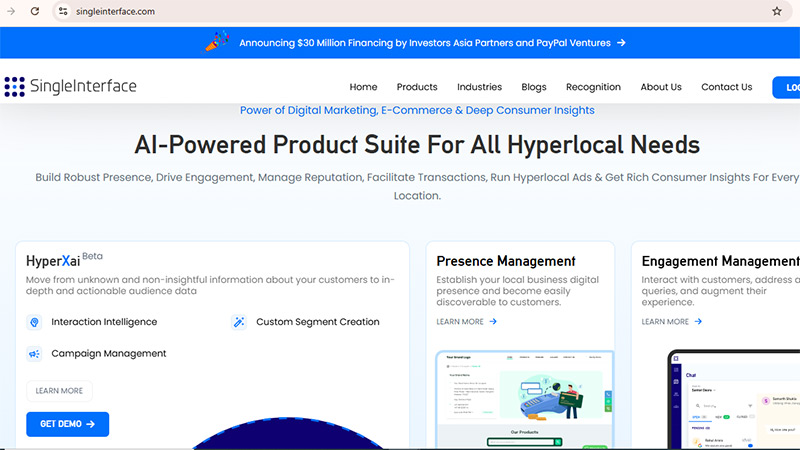
The Asia-based retail tech giant has flipped the switch on its next big thing: a full-stack AI platform called Singleinterface AI—designed to give every single store location across the country a neural upgrade.
Launched in New Delhi on 16 April 2025, the AI suite is packed tighter than a Diwali sweet box with modules like Presence AI, Pages AI, Reviews AI, Engagement AI, Campaigns AI, Interactions AI, Audience AI, Competition AI and the all-seeing Insights AI. If you’re a brand juggling hundreds of branches, it’s like getting a thousand digital managers for the price of one software.

“We believe the future of hyperlocal marketing and commerce is AI-native. It’s transforming how every storefront shows up in ‘near me’ searches, responds, and grows. With Singleinterface AI, we’re embedding enterprise-grade intelligence into every hyperlocal brand interaction,” said Singleinterface co-founder & CEO Tarun Sobhani.
So what does this beast actually do?
It makes brands smart—really smart. Presence AI keeps store listings up to date across Google, Apple Maps, car nav systems, and your grandma’s voice assistant. Pages AI whips up microsites faster than a barista pours your flat white. Reviews AI reads customer emotions (yes, really) and helps brands respond without sounding robotic.
Then there’s Engagement AI, which fuses CRM data with real-time messages so your Whatsapp replies are less generic and more Jedi. Campaigns AI makes sure your ads don’t die of fatigue and actually speak to the locals. Interactions AI transcribes every customer convo and tells you where you lost them (or won them). Audience AI finds your next big buyers based on movement patterns and weirdly smart behavioural tracking.
Competition AI, meanwhile, scopes out how your outlet stacks up to the chaiwala next door in “near me” wars. And finally, Insights AI pulls it all together in a 360° digital chakra view.
With over 400 multi-location brands on board—from F&B and telcos to education, finance and healthcare—Singleinterface is not just talking disruption. It’s bringing enterprise-level intelligence to every corner store and clinic with a pin code.

Applications
With 57 per cent single new users, Ashley Madison rebrands as discreet dating platform
Platform says majority of new members now identify as single

INDIA: Ashley Madison is shedding the “married-dating” label that defined it for two decades, repositioning itself as a platform for discreet dating in what it calls the post-social media age.
The rebrand, unveiled in India on 27 February, 2026, marks a structural shift in business model and identity. Once synonymous with married dating, the company now describes itself as the “premier destination for discreet dating” under a new tagline: Where Desire Meets Discretion.
The pivot is data-driven. Internal figures show that 57 per cent of global sign-ups between 1 January and 31 December, 2025 identified as single: a notable departure from the platform’s married core. The company argues that its community has already evolved beyond its original positioning.
“In an age where our lives have been constantly put on public display, privacy has become the new luxury,” said Ashley Madison chief strategy officer Paul Keable. He framed the platform’s offering as “ethical discretion” for singles, separated, divorced and non-monogamous users seeking private connections.
The shift also taps into wider digital fatigue. A global survey conducted by YouGov for Ashley Madison, covering 13,071 adults across Australia, Brazil, Canada, Germany, India, Italy, Mexico, Spain, Switzerland, the UK and the US, found mounting discomfort with hyper-public online lives.
Among dating app users, 30 per cent cited constant swiping and messaging as a source of fatigue, while 24 per cent pointed to pressure to curate public-facing profiles and early personal disclosure. Some 27 per cent said fears of screenshots or information being shared contributed to exhaustion; an equal share cited unwanted attention.
The retreat from oversharing appears broader. According to the survey, 46 per cent of adults actively try to keep most aspects of their life private online. Only 8 per cent feel comfortable sharing most aspects publicly, while 35 per cent say they are becoming more selective about what they disclose.
Ashley Madison is betting that this cultural recalibration towards controlled visibility can be monetised. By doubling down on privacy infrastructure and reframing itself around discretion rather than infidelity, the company is attempting to convert reputational baggage into a premium proposition.






