News Broadcasting
SET India defers acquisition of SET Singapore


MUMBAI: Sony Entertainment Television India has deferred the acquisition of sister company SET Singapore as its proposed initial public offering (IPO) is unlikely to happen for at least a year.
The decision to put off restructuring of the holding was taken because it would have attracted capital gains tax. “As the IPO is not happening now, we have decided to put on hold the buying of SET Singapore. The proposed restructuring transaction would have attracted capital gains tax,” says a company source.
SET India had obtained clearance from the Foreign Investment Promotion Board (FIPB) to acquire 100 per cent shares of SET Singapore through a share swap transaction. According to the proposal, one share of SET India was to be exchanged for 16 shares of SET Singapore. Post-restructuring, 60.65 per cent of the SET India equity would be with the Sony Pictures Entertainment (SPE) entities, 19.83 per cent with non-resident Indians and overseas corporate bodies, 7.68 per cent with foreign institutional investors and 11.84 per cent with Indian shareholders.

SET India’s proposed IPO is also on hold, the source says. SET India CEO Kunal Dasgupta, however, refused to comment on the issue. The company has long been weighing the option of going for an IPO.
According to the source, Dasgupta had made a presentation to Sony Pictures Entertainment (SPE) chairman and CEO Michael Lynton a few months ago on SET India’s growth prospects. In his presentation, he had listed an IPO as one of SET India’s plans. “SPE’s new CEO had called for presentations from its different entities. A few months back, Dasgupta earmarked SET India’s growth plans as including an IPO,” says the source.
SET India plans to acquire SET Singapore and consolidate operations before going in for an IPO. SET Singapore has invested in acquisition of television serials and Hindi feature films, besides ICC telecast rights for India and other parts of Asia till 2007, including two World Cup tournaments. In its FIPB application, Sony had said: “All major investments of SET Singapore are now close to maturity and are likely to become profitable in the near future. The benefits of these investments would accrue to SET India in the coming years through the process of consolidation. This will increase SET India’s valuation.”
The consolidation process, according to the source, will start only when SET India is more definite on when it is going to launch its IPO.







News Broadcasting
Network18 channels lead YouTube news viewership in March 2026
CNN-News18, News18 India and CNBC channels top categories with record views
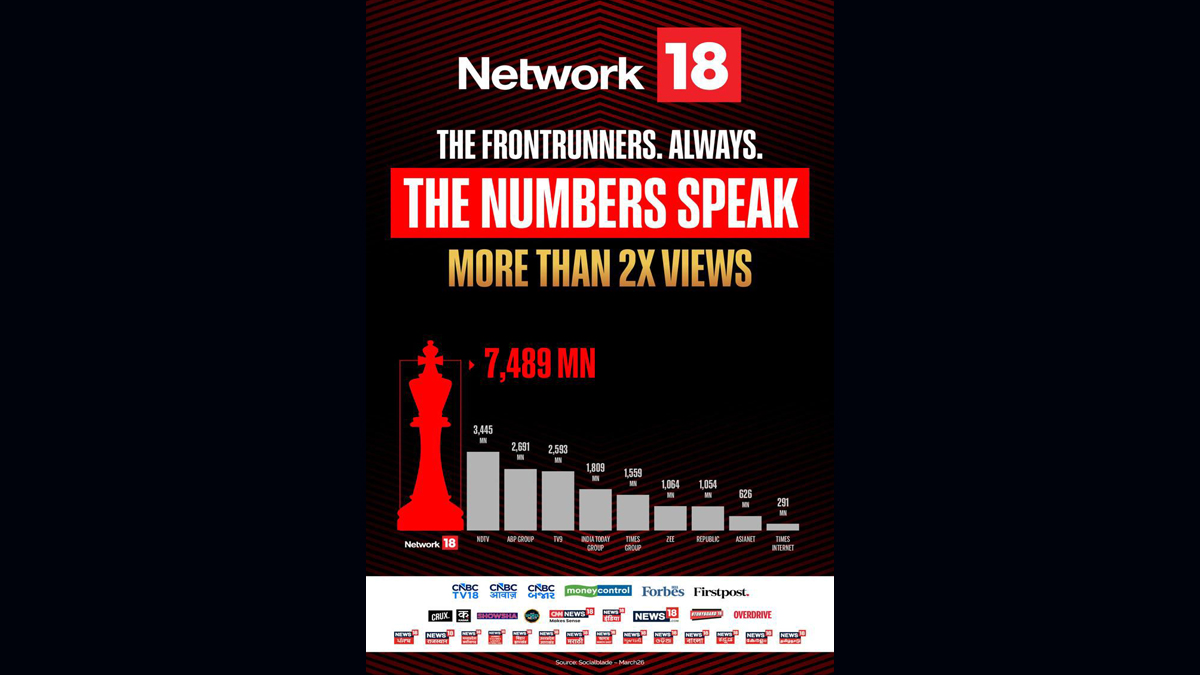
MUMBAI: When the world hit refresh on breaking news, Network18’s channels were already streaming ahead. As geopolitical tensions and war-driven headlines fuelled a surge in global news consumption, the network’s digital playbook delivered big clocking record Youtube viewership across English, Hindi and business news categories in March 2026.
At the forefront was CNN-News18, which emerged as the clear leader in the English news segment with 130 million live and video-on-demand views. The channel edged past competitors such as Times of India (126.5 million), Times Now (101.1 million), India Today (88.2 million) and NDTV (77.5 million), according to Databeings data for March.
In the Hindi news arena, News18 India delivered a commanding performance, racking up a staggering 3,297 million views on YouTube. The channel comfortably outpaced NDTV India, which recorded 3,119 million views, underlining its deep reach and consistent engagement with mass audiences, as per Playboard data.
The network’s dominance wasn’t confined to general news. In the Hindi business segment, CNBC Awaaz topped the charts with 92 million views, narrowly ahead of Zee Business (90 million) and well ahead of ET Now Swadesh (57 million). Meanwhile, its English counterpart CNBC-TV18 posted a strong 58 million views, reinforcing the network’s cross-category strength.
The spike in viewership reflects a broader shift in audience behaviour, with viewers increasingly turning to digital platforms particularly Youtube for real-time updates and in-depth coverage during high-intensity news cycles. For Network18, the numbers signal more than just scale; they underline the effectiveness of a multi-platform strategy that blends speed, credibility and continuous coverage.
In a month where the news never paused, it seems viewers chose to stay tuned where the stream never stopped.






