Budget
Sectoral wishlists for Budget 2024-25: What industries hope to see

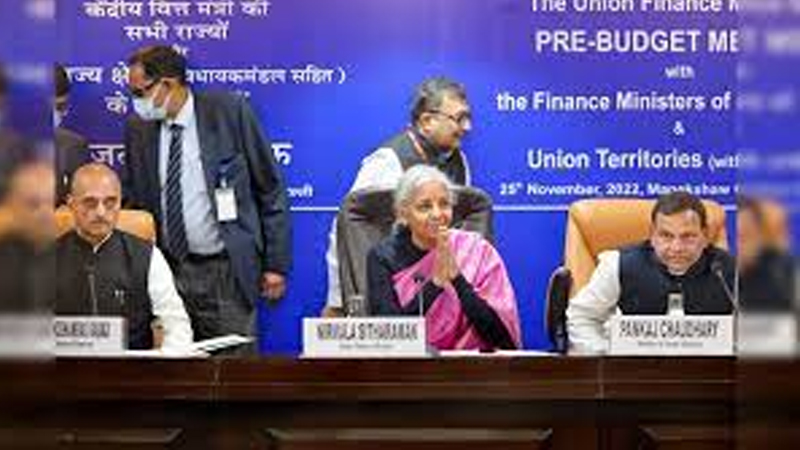
Mumbai: The Union Budget for 2024-25, scheduled to be presented on 1 February, is a highly anticipated event for every sector of the Indian economy. From infrastructure, Information technology, telecom, agriculture, healthcare, and human resources to education, stakeholders are eagerly waiting to see how the government’s financial roadmap will impact their industries. This article will delve into the key highlights and expectations for different sector’s industry leaders in Budget 2024-25, based on pre-budget consultations, industry reports, and expert analyses.
1. BIF president T V Ramachandran said, “India is undergoing rapid digital transformation on the back of continuous Government reforms. The recently notified Telecommunications Act 2023 is a game changer and will help catalyze the growth of the sector even further.
As Broadband India Forum, we would like to see the Union Budget 2024-25 focus on three important aspects viz.

● Facilitate affordable Broadband through Satcom through reasonably modest spectrum fees
● Budgetary support for the growth of Public Wi-Fi through waiver of duties & levies on equipment and on revenues
● Budgetary support to incentivize Fiber to the Building +Wi-Fi to enable rapid growth in Fixed Broadband, by way of reduction in statutory fees and levies and exemption of GST on service revenues
With the above measures, we hope that Union Budget will help accelerate the momentum of the reforms in the sector which has been set by other Government policies & measures”
2. Fujitsu global delivery centres head Manoj Nair said, “Major economies across the world are seeing a challenging macroeconomic situation with slowdowns that have affected various industries. Amid this period, it is the tech industry that is leading the charge in recovery with a positive outlook. The demand for IT skills, especially in the new-age technologies – AI, ML, analytics, data science and other digital capabilities continues to surge presenting an opportune time to GCCs to further scale and usher in the next phase of digital revolution in India. India is a leading hub of Global Capability Centers (GCCs) with 1500+ GCCs housed in India that play a crucial role in growth of the tech industry. According to EY, the domestic GCC market size is expected to hit US$110b by 2030 with the number of GCCs expected to scale to 2400. Over the past few years, there has been a major shift in how GCCs operate – from delivering cutting-edge services to becoming powerful innovation hubs. These GCCs, with their vast trove of STEM talent and heavy investments in technology and upskilling are uniquely positioned to spearhead digital transformation for customers. Our technical capabilities across AI, ML, data science, cloud, automation, enterprise applications are crucial to powering deep research and product development. “
“Now, as GCCs continue to invest in reskilling talent in the face of evolving tech landscape, building demand-based and niche skills in relevant areas, they are playing a crucial role in employment generation for India. With GCCs being a major engine for economic growth, Budget 2024 can play a key role in facilitating growth and sustainable development. GCCs require support and investment for infrastructure and growth environment. The Budget 2024 can help GCCs further scale and accelerate innovation at a faster rate as India emerges as the world’s technology and services hub.”
3. STT GDC India chief financial officer ) Bimal Khandelwal said, “As India charges ahead on its digital transformation journey, the upcoming budget offers a timely window to cultivate a world-class data center ecosystem that steers this advancement. We are hopeful of incentives to spur domestic manufacturing and infrastructure builds specially tailored for data centers’ massive scale and seamless connectivity needs. Attractive capital subsidies for setting up future-ready facilities and easy financing options to offset development costs will unleash growth. We also envision provisions that encourage the adoption of renewable energy to meet data centers’ clean power appetites. Additionally, preferential procurement directives favoring home-grown data centers will provide an upside. With an emphasis on nurturing a cutting-edge domestic data center industry, India can swiftly go up the technology value chain and cement dominance in delivering digital services globally. Having granted an infrastructure tag has remarkably expedited logistics. “
4. Fujitsu International Regions HR shared services head Sumit Sabharwal said, “As an HR leader, I eagerly anticipate the 2024 budget, urging the Government of India to prioritize robust investments in skill development. A strategic focus on honing our workforce’s capabilities will propel India’s IT industry to new heights, fostering innovation, and global competitiveness. The India artificial intelligence market size reached $ 680 million in 2022 and further it is expected to reach $3,935.5 million by 2028, showcasing a growth rate (CAGR) of 33.28% between 2023-2028. Data Science and Analytics have emerged as a game-changer across industries, with organizations harnessing data-driven insights to make informed decisions. With exponential growth in the digital realm, this field is expected to witness substantial opportunities in the coming years. The demand for STEM jobs in India has increased by 44% in the last 5 years. STEM skills will be a requirement for 80% of the jobs created in the next decade. To meet the increasing demands for STEM professionals in India’s rapidly growing technology, engineering, and manufacturing sectors, it becomes imperative to offer robust STEM education. For organizations, it has become necessary to provide upskilling and reskilling opportunities to existing employees. The Fourth Industrial Revolution is upon us, and STEM education will align closely with its demands. To keep up with this new information-based and technology-dependent world, India must scale up the innovation ladder with initiatives.”
5. Fujitsu JDU head Meghan Nandgaonkar shared his views saying that, “Technology has played an important role in India’s growth story. Our expectation from Budget 2024 furthers to boost technology solutions for sustainable society, green initiatives, agro-tech, etc., Additional focus on skilling initiatives for people engaged in traditional sectors, using technology and online delivery along with incentives for technology companies in Tier 2 and Tier 3 cities.”





MUMBAI: Anuj Singhal, managing editor at CNBC- AWAAZ and CNBC BAJAR, operates at the sharp end of India’s business news ecosystem. With over two decades in business journalism, he has earned credibility for decoding policy, markets and macro trends for millions of Hindi-speaking investors. Equal parts newsroom leader and market analyst, he shapes editorial direction while anchoring flagship shows that break down the economy, politics and corporate India in real time.
Known for cutting through jargon and hype, Singhal blends data, discipline and clarity — a mix that has made him one of the most trusted voices in Hindi business news.
In this interaction, he discusses the Union Budget, trade deals, newsroom strategy and what truly moves markets and ratings.
• What was the single most market-moving announcement in this Budget, and why?
The most market-moving element was the clear commitment to fiscal consolidation without compromising capex. The glide path on fiscal deficit reassured bond markets and foreign investors, while sustained public investment kept growth expectations intact. That balance removed a big overhang for both equities and debt.
• Do you see this Budget as growth-oriented, fiscally cautious, or politically calibrated?
This Budget is growth-led but fiscally disciplined. It avoids overt populism, stays within macro guardrails, and prioritises medium-term competitiveness over short-term optics. Politically, it is restrained; economically, it is deliberate. The message is clear: stability over spectacle.
• How is CNBC-AWAAZ programming different, especially in decoding trade deal impact?
CNBC-AWAAZ goes beyond headline reaction. We translate policy into portfolio impact — sector by sector, stock by stock.
On trade agreements, our focus is on:
-Earnings visibility
-Export competitiveness
-Currency implications
-Margin sustainability
We don’t treat trade deals as political milestones. We decode them as profit-and-loss events for corporate India and map them to FY earnings trajectories.
• Which sectors look like clear winners and laggards over the next 12–18 months?
The next 12–18 months favour sectors aligned with structural spending and supply-side strengthening.
– Clear beneficiaries:
Capital goods and infrastructure
Manufacturing linked to export chains and PLI ecosystems
Power, defence, and logistics
– Relative laggards:
Consumption segments dependent on immediate demand revival
Businesses facing margin pressure from global volatility or pricing power erosion
This is not a momentum-driven market environment. It is execution-driven. Balance-sheet strength and order visibility will matter more than narrative.
• One headline to sum up this Budget 2026 for India Inc?
“Steady Hands, Long-Term Vision: A Budget That Rewards Discipline Over Drama”.
• What editorial filters do you apply before calling something ‘market-positive’ or ‘negative’?
We apply three structured filters:
– First: Earnings translation — does this materially change earnings visibility or cash flow outlook?
– Second: Time horizon — is the impact immediate, cyclical, or structural?
– Third: Valuation context — good news priced in or not.
If a policy doesn’t move earnings or risk perception, we don’t oversell it.
• How has business news consumption changed around big policy events?**
There has been a clear behavioural shift. They’re less interested in what was said, more in what it means for their money. There’s also a clear shift toward second-screen consumption, with digital platforms complementing live TV. The audience seeks sharper accountability. Viewers no longer accept broad optimism or pessimism — they want frameworks, numbers, and sector mapping.
• CNBC-AWAAZ decisively outperformed on Budget Day. What editorial and distribution choices mattered most?
Three deliberate strategic choices:
– Preparation depth:
We build scenarios months in advance — deficit ranges, sectoral incentives, tax calibrations — so we’re ready with analysis the moment numbers are announced.
– Language of impact:
We translate macro policy into investor-friendly Hindi without diluting complexity. That bridges accessibility and sophistication.
– Integrated distribution:
Television, YouTube, and digital platforms operate as one editorial grid, not parallel silos. This ensures continuity of narrative.We stayed analytical while others stayed reactive.
• How different is your YouTube audience from your TV audience?
The behavioural differences are subtle but important. TV audiences prioritise authority, structured debate, and context. YouTube audiences want speed, clarity, and actionable insights — often sharper, sometimes more opinionated. However, both share one expectation: accuracy. The format evolves; the trust benchmark does not.
• How do you retain viewers after the budget speech ends?
By shifting from announcements to implications.Retention comes from shifting the narrative from announcement to implication. We break down sectoral breakouts, stock-level impact, and what to do next. The speech is just the trigger; analysis is the destination.
• Is Budget Day your biggest traffic day?
It is one of the biggest — but more importantly, it is among the deepest in engagement. Viewers spend longer durations, revisit segments, and seek follow-up programming. That indicates behavioural trust, not just traffic.
• What’s the first thing you personally track on Budget Day — the speech or the markets?
The markets. They’re the fastest truth-teller. The speech explains intent; markets reveal interpretation.
• Your personal Budget-day ritual?
Early morning prep, minimal distractions, and once the speech begins, complete immersion. For me, Budget Day is less about reaction and more about reading between the lines.
• What drove your Budget-day ratings dominance, and how are Budget and trade deals shaping markets now?
Our dominance came from credibility, consistency, and clarity.
As for markets, both the Budget and recent trade deals are reinforcing a narrative of policy stability and global integration, which supports valuations even amid global volatility.
For Singhal, the market is the final judge. Policies can promise and speeches can persuade, but prices reveal what investors truly believe. As India’s investor class grows more informed and more demanding, business journalism is shifting from commentary to calibration. The premium is on clarity, context and credibility. In a landscape flooded with noise, the real edge lies in interpretation. In the end, the markets listen to numbers, not narratives , and Singhal’s craft is helping viewers tell the difference.






