News Broadcasting
Sahara completes phase 1 of restructuring; Aditya is CEO

MUMBAI: Sahara One today officially announced the appointment of Shantonu Aditya as CEO of the company, while saying the restructuring of its media and entertainment business into three strategic units was complete.
The three arenas are the general entertainment television, motion pictures and movie channel businesses. Says restructuring initiative head Peter Isaac, “Aditya will head the initiatives that we enter in this business. Each unit will be an individual profit centre which will form a part of the larger corporate entity.” Aditya moves from SET Discovery where he was president of the company.
Plans are afoot to build the Sahara Film City soon. Sahara’s media and entertainment business was rebranded “Sahara One” last October with a new channel ID and promotions.

Speaking on his appointment, Aditya says: “I am delighted at the prospect of leading Sahara’s media & entertainment business. Having already become the market leader in Hindi Film content production with over six releases in the last eight months, Sahara One is poised to take giant strides in the near future.”
Adds Isaac: “We are pleased to have completed the first phase of the venture. The effort is moving ahead smoothly and business operations are being established within both time and cost targets.”
As already reported by indiantelevision.com, Sahara has now completed the first phase of restructuring the media and entertainment business into three strategic business units – “Sahara One” Entertainment Television, “Sahara One” Motion Pictures and “Sahara One” Filmy (the Hindi Film based entertainment channel). Plans are afoot to build the Sahara Film City soon for which detailed research has been completed and plans are being finalized.
Aditya’s core team is as follows: Purnendu Bose – COO “Sahara One” Television Channel; Sandeep Bhargava – COO, “Sahara One” Motion Pictures; Ashutosh – Business Head, “Sahara One” Filmy Channel; Avijit Mita – head programming, non-fiction & on-air programmes, “Sahara One” Entertainment Channel; Kumud Choudhary – head programming – fiction – “Sahara One” Entertainment Channel; Mukul Mishra – head on-air programmes, “Sahara One” Filmy Channel; and Soumen Ghosh Choudhary – head broadcast operations and engineering, “Sahara One” Entertainment Channel.





News Broadcasting
UDF poised to return to power in Kerala, says Manorama-CVoter survey
Massive opinion poll projects shift in Kerala politics ahead of 2026 Assembly elections.
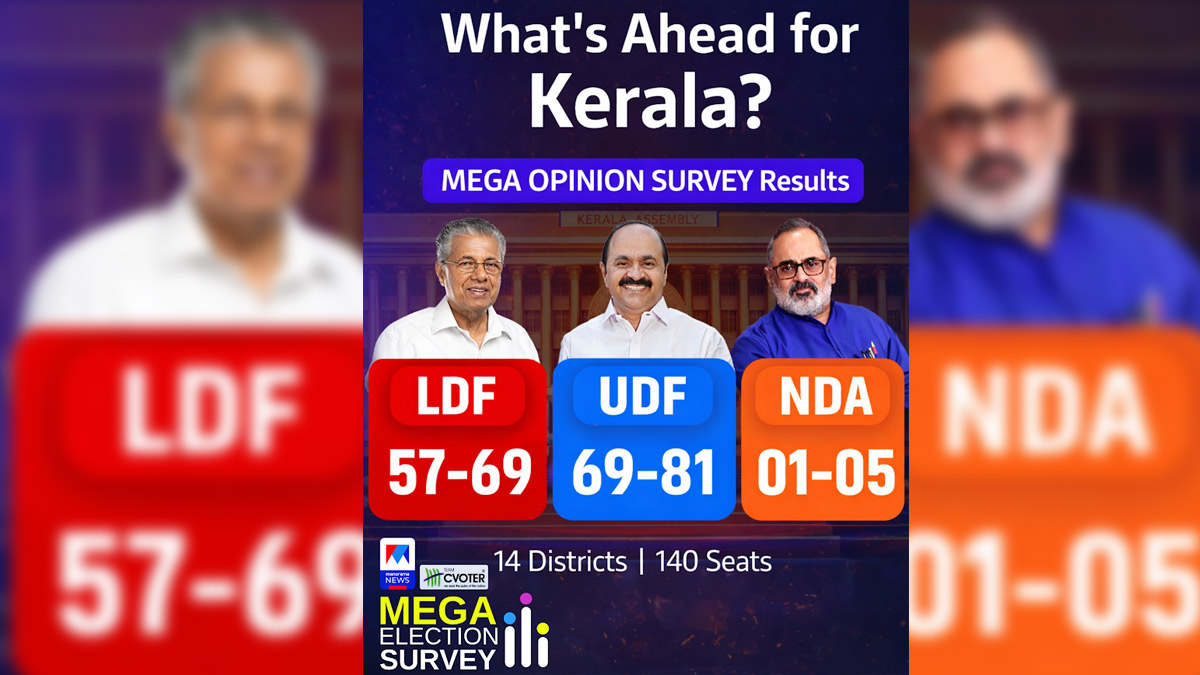
MUMBAI: The winds of change appear to be blowing through Kerala’s political landscape and this time, they seem to favour the United Democratic Front. A comprehensive mega opinion survey conducted by Manorama News in partnership with CVoter projects a potential comeback for the UDF in the upcoming Kerala Legislative Assembly Elections 2026. The survey, covering all 140 constituencies with a massive sample size of nearly 90,000 respondents, predicts the UDF could win between 69 and 81 seats.
The ruling Left Democratic Front (LDF) is expected to secure 57 to 69 seats, a significant drop from the 99 seats it won in the 2021 elections. This would mean the LDF losing 30 to 42 of its sitting seats. Meanwhile, the National Democratic Alliance (NDA), which drew a blank in 2021, is projected to open its account with 1 to 5 seats.
Region-wise, the UDF is expected to make strong gains in Malabar, winning 25 to 34 out of 48 seats, and in Central Kerala, where it could bag 29 to 33 out of 53 seats. In South Kerala, the LDF is likely to retain an edge with 21 to 25 seats, while the UDF may improve to 12 to 16 seats. The NDA could pick up 1 to 3 seats in the southern region.
The survey was conducted between 14 and 26 March 2026, with additional tracker and snap polls carried out from December 2025 to March 2026. A total of 89,693 respondents participated, ensuring representation across all demographics and social segments.
Manorama News has a strong track record of accuracy, with its previous projections closely matching the actual results of the 2019 and 2024 Lok Sabha elections as well as the 2021 Kerala Assembly polls.
In Kerala’s famously fierce political battles, this survey suggests the pendulum may be swinging back. Whether the final verdict matches these numbers or throws up another surprise, one thing is clear, the 2026 Assembly elections are shaping up to be one of the most keenly watched contests in the state’s history.






