News Broadcasting
Rwandan student wins BBC Afrique radio journalism competition

MUMBAI: A Rwandan student has won the BBC’s talent competition for best radio report in French. Nicolas Gatambi has been awarded the Grand Prix – a laptop computer – in a radio journalism competition with BBC Afrique, the BBC’s French for Africa service.
More than a hundred budding radio journalists participated in the competition, which invited them to produce a radio package on a subject of their choice. Competitors explored themes such as sexual harassment in universities, the plight of bereaved women, religion and other issues.
Gatambi’s package was about a man who lost both legs in a mine explosion, and his efforts to regain dignity and a family. He said, “It’s a dream come true. I am now a small celebrity in my town and amongst my fellow students.” BBC Afrique senior producer Michel Proust said, “We were impressed by the high quality and the originality of subjects chosen by the participants. The jury members said that they were struck by the sincerity and audacity of some of the reports. The winning entries were quite outstanding, and we were proud to broadcast these reports as part of the BBC Afrique output.”

The second prize went to Ghislaine Nentobo from Mbandaka, Democratic Republic of Congo, for her report on an original form of transport in her town, the “Nzela-Moto”. The third prize went to Cecilia Lima de Pina, a student from Luxembourg, for a report on a family of immigrants from Cape Verde. BBC Afrique is part of BBC World Service and is available on radio and online on bbcfrench.com. BBC World Service broadcasts programmes around the world in 43 languages and claims to have a global audience of 149 million listeners.






News Broadcasting
Network18 channels lead YouTube news viewership in March 2026
CNN-News18, News18 India and CNBC channels top categories with record views
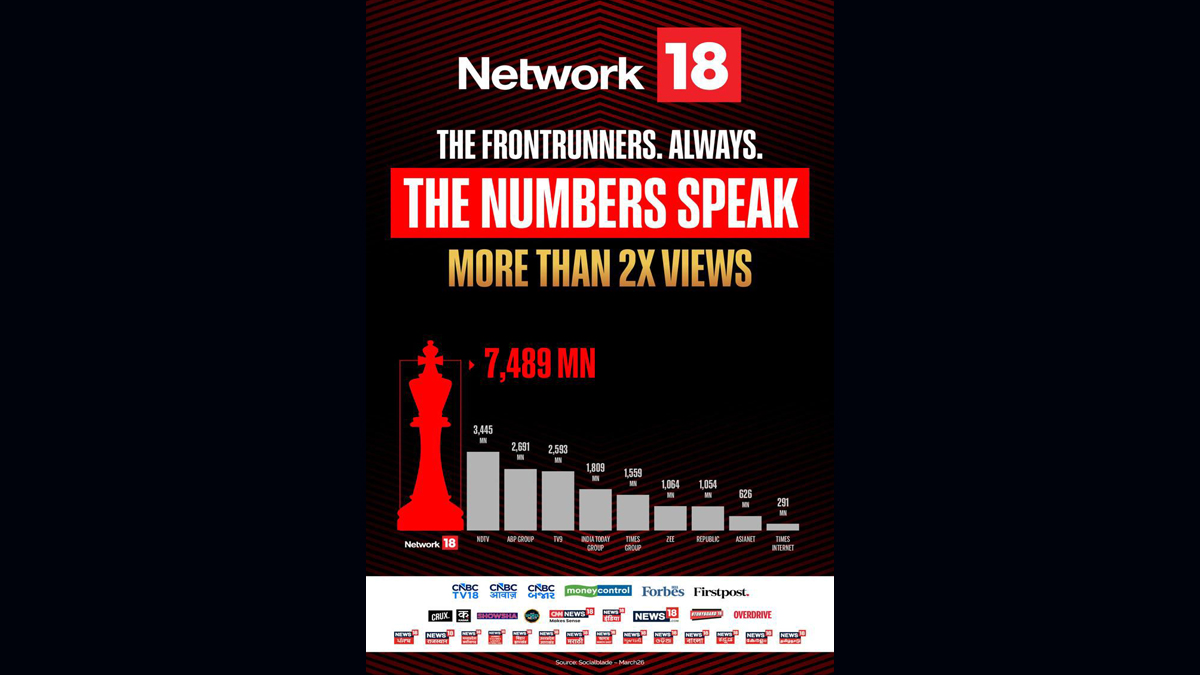
MUMBAI: When the world hit refresh on breaking news, Network18’s channels were already streaming ahead. As geopolitical tensions and war-driven headlines fuelled a surge in global news consumption, the network’s digital playbook delivered big clocking record Youtube viewership across English, Hindi and business news categories in March 2026.
At the forefront was CNN-News18, which emerged as the clear leader in the English news segment with 130 million live and video-on-demand views. The channel edged past competitors such as Times of India (126.5 million), Times Now (101.1 million), India Today (88.2 million) and NDTV (77.5 million), according to Databeings data for March.
In the Hindi news arena, News18 India delivered a commanding performance, racking up a staggering 3,297 million views on YouTube. The channel comfortably outpaced NDTV India, which recorded 3,119 million views, underlining its deep reach and consistent engagement with mass audiences, as per Playboard data.
The network’s dominance wasn’t confined to general news. In the Hindi business segment, CNBC Awaaz topped the charts with 92 million views, narrowly ahead of Zee Business (90 million) and well ahead of ET Now Swadesh (57 million). Meanwhile, its English counterpart CNBC-TV18 posted a strong 58 million views, reinforcing the network’s cross-category strength.
The spike in viewership reflects a broader shift in audience behaviour, with viewers increasingly turning to digital platforms particularly Youtube for real-time updates and in-depth coverage during high-intensity news cycles. For Network18, the numbers signal more than just scale; they underline the effectiveness of a multi-platform strategy that blends speed, credibility and continuous coverage.
In a month where the news never paused, it seems viewers chose to stay tuned where the stream never stopped.






