Hindi
Rowdy Rathore befits a B grade film of a bygone era

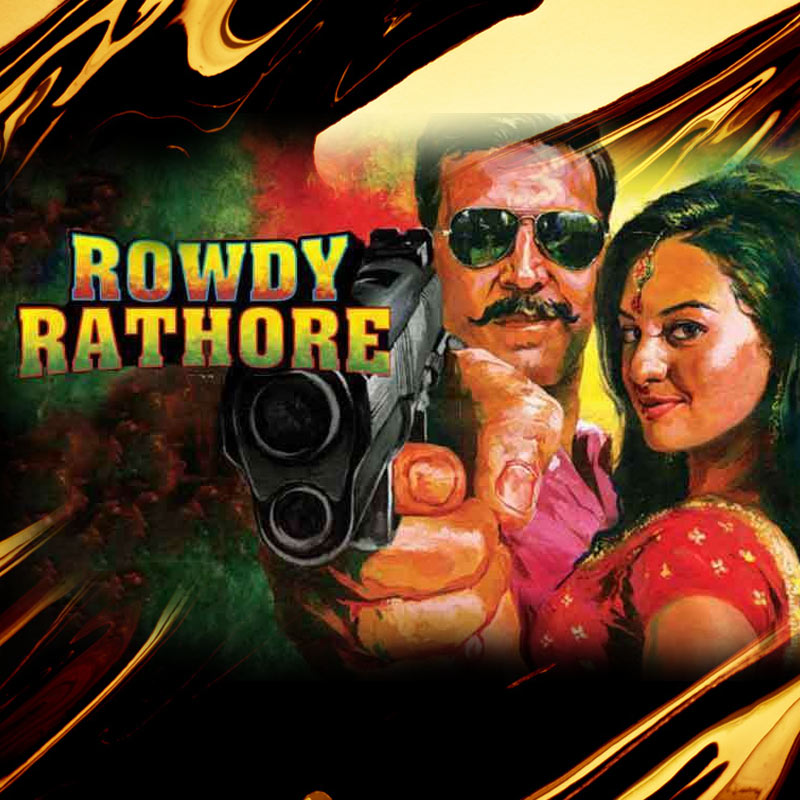
MUMBAI: Rowdy Rathore is an action thriller depicting its hero as a sort of superman. In the style of the good old 1970s and 80s, he is mightier than the combined might of scores of villains. A remake of Telugu hit Vikramarkudu, nothing seems to have changed in this Hindi version except the language and a few known supporting artistes, retaining the villain clan mainly from South.
 |
|
Producers: Sanjay Leela Bhansali, Ronnie Screwvala. |
The film aims at the masses, does not bother with finesse and lets minor details of crowds and costumes pass. The film has also been made in Tamil, Kannada and Bengali versions. The hero plays double role, which does not mean much since there few combined shots or drama on that count.
Akshay Kumar as Shiva is a petty thief doing small tricks with his sidekick, a rather dumb-witted Paresh Ganatra. In short, he is a small-time tapori indulging in small-time sleight-of-hand, picking up mostly gold ornaments and cell phones. Just to establish how petty he is, his den is filled with a municipal garden bench to a railway clock! On one of his outings he sees Sonakshi Sinha and it is love at first sight. She has come to Mumbai from Patna to attend a cousin‘s wedding. Now Shiva is chasing Sonakshi when not chasing his victims and soon enough, Sonakshi too reciprocates. It is time to reveal his cards and confess to her that he is a petty crook. She makes him promise that he will give it up from ‘tomorrow‘, not because ‘today‘ was less auspicious but to facilitate a change of track in the story.

Since Shiva has one last day before his promise takes effect, he decides to pull one major theft. He is lucky too, it would seem, because at the railway station a woman is flashing her money and advertising to anyone who will listen that the wooden chest she is carrying is full of gold. Shiva and his sidekick pick up the heavy chest. They open it to find a small girl sleeping soundly in the chest. The girl clings to Shiva and starts calling him papa.
It is now time for Akshay Kumar 2 to emerge. Akshay Kumar 2, ASP Vikram Singh Rathore, is a top cop with guts and a widower. He is much-decorated and much-transferred from one posting to another for his forthright ways of dealing with criminals. He has taken on the local don of a town in Bihar called Devgadh. While fighting with his goons there, he was badly hurt and carries a bullet wound in his head which aggravates every time his head is hurt but also miraculously heals instantly with water!
To demonstrate his hand-to-hand fighting skills to Shiva, he takes on the Devgadh goons again who have followed him to Mumbai where he has been brought on the sly by his loyal subordinates for treatment. The girl in the chest is his daughter who has been forced on to Shiva because he looks like the policeman. Vikram Singh succumbs to wounds inflicted on him in his demo fight.
Shiva must fill Vikram Singh‘s shoes and complete the job, that of cleansing Devgadh of its tyrant, Bapji (M Naseer). What follows is pure frontbencher fare as Shiva picks up from where Rathore left off.
Sonakshi Sinha drops in out of the blue to reclaim her love. A naach-gana routine follows before it is wrap up time. As in most south Indian films, the villagers are made witness and party to the demolition of the villain‘s empire as well as the villain.
The making of Rowdy Rathore is that befitting a B grade film of a bygone era. The treatment is just about passable. Music is loud, with only one song, Chinta ta ta chita chita.., being entertaining. Dialogue lacks the punch needed in such a film. Technically it is average.
It is an Akshay Kumar film all the way and he excels in action as usual. Sonakshi Sinha, made to vanish before interval and to emerge only towards end, is okay. Yashpal Sharma, doing a positive, restrained role for a change is very good. Paresh Ganatra makes his presence felt. M Naseer as the main villain is stereotype. Anant Jog and Mushtaq Khan are as usual.
Rowdy Rathore caters to single screen cinemas. Its appeal with the multiplex audience, especially in up-market localities, is compromised by the theme and treatment. That is where first cracks on its box office performance will show







Hindi
Rashmika Mandanna, Shanaya Kapoor and Naila Grrewal climb IMDb’s Indian celebrity rankings
Upcoming films and returning shows are driving fan interest across Bollywood and streaming

MUMBAI: Bollywood’s popularity contest has a new weekly scorecard, and the numbers are telling. IMDb’s Popular Indian Celebrities list for this week places Shanaya Kapoor at number six, buoyed by buzz around her film Tu Yaa Main. Naila Grrewal slots in at seven on the back of the returning comedy series Maamla Legal Hai, while Rashmika Mandanna climbs to eighth, riding mounting anticipation for Cocktail 2.
The list, available exclusively on the IMDb app for Android and iOS, tracks trending Indian entertainers and filmmakers each week, drawing on data from more than 200m monthly visits to the platform worldwide.
Further down the rankings, Raaka is keeping two of its biggest names in the spotlight. Deepika Padukone holds 11th position, with Allu Arjun close behind at 13th, as the film continues to find traction with audiences.
The list offers fans a weekly pulse on who is breaking through, who is holding steady, and who is fading. It is a barometer as unsparing as the box office itself.







