News Headline
‘Rolling out of Cas has been the most significant development’

Lots of consumer centric stipulations have been made in the said Regulations which, among other things, include establishment of call centres by DTH operators, redressal of consumer complaints within stipulated timeframes and the concept of Nodal Officers to be appointed by DTH operators.
Trai has also issued Interconnect Regulations for DTH services mandating the Broadcasters to come out with Reference Interconnect Offer (RIO) for DTH operators and provision of channels on a la-carte basis by broadcasters to DTH operators under the said RIO.
Trai has also come out with a Tariff Order for non-Cas areas whereby not only the price freeze, which was already in operation, has been continued, but now even the ceiling in respect of cable rates have also been provided at the retail level.

In addition, Trai has also stipulated the provision of a la carte channels to MSO/Broadcasters in non-Cas areas. The order has created a lot of hulchul in the industry.
| Cross media ownership issue and restriction in holding shares within electronic media and distribution sector may act as an impediment to the overall growth of the sector _____****_____ |
No previous order/Regulation of Trai had generated as much heat and controversy as the present Tariff order for non-Cas areas. While the MSO and cable operators have welcomed it, the broadcasters on the other hand have severely criticised it, as in their view their commercial interest have not been adequately taken care of by Trai. The broadcasters are arguing that the present tariff order would benefit only one segment – the MSOs as no a la-carte choice can be provided to consumers in non-addressable analog environment because of technological impediments. Their grievance is that the Regulator has not addressed the problem of “under-declaration”. The matter is currently sub judice in the TDSAT.
The Trai is in the process of issuing its recommendation to the government on IPTV and Mobile TV which would give further impetus to the proposed digitisation.
The Cable and Satellite Television sector is the only sector where both Service Tax and Entertainment Tax are levied at present which amounts to double taxation. It may be mentioned that levy of both service tax and entertainment tax ultimately make the services costlier for the consumers. It is pertinent to point out that when a movie/ film is shown in a cinema, only entertainment tax is levied and no service tax is charged for screening the movie in a cinema theatre.
Both DTH services and cable services are at present reeling under the heavy burden of multiple taxation and levies (such as license fee, service tax, entertainment tax, VAT on customer premises equipment which cumulatively add up to as high as 56 per cent) which are acting as an impediment to the growth and development of these services. Such a high multiple taxation and other levies vis-?-vis other sectors has resulted in these services becoming costlier and unaffordable for the masses.
Accordingly, to ensure proper growth and development of this sector, the multiple levies/ taxation structure needs to be rationalised.
Similarly, the customs duty structure on STBs and other equipments which are quite crucial for digitization also needs rationalisation in line with IT and Telecom sectors.
| It is imperative that to promote the growth of digital platforms, duty structure/concession applicable to IT and Telecom sector be extended to the broadcasting industry to provide a level playing field _____****_____ |
All in all, year 2007 has been excellent for the Broadcast, DTH and Cable sector, and would be remembered as the year in which the solid foundations have been laid for digitisation and to create an environment enabling the broadcasting and distribution sector to takeoff and move towards the path of growth and development at an accelerated pace.
In the present era of convergence the distinction between Broadcasting, Telecommunication and Information Technology is disappearing very fast. It is therefore imperative that in order to promote the growth of digital platforms, duty structure/concession applicable to IT and Telecom sector be extended to the broadcasting industry and it is treated as part of telecom infrastructure to provide a level playing field.
The need of the hour is to create the same kind of conducive environment by the government by creating level playing field and granting fiscal incentives and concessions to the sector as has been done for the telecom sector and this sector would also register phenomenal growth in coming years.





NEW DELHI: Hamdard Laboratories gathered a cross-section of India’s achievers in New Delhi on Friday, handing out the Hakeem Abdul Hameed Excellence Awards to figures who have left their mark across healthcare, education, sport, public service and the arts.
The ceremony, attended by minister of state for defence Sanjay Seth and senior officials from the ministry of Ayush, celebrated individuals whose work blends professional success with a sense of public purpose. It was as much a roll call of achievement as it was a reminder that influence is not measured only in profits or podiums, but in people reached and lives improved.
Among the headline awardees was Alakh Pandey, founder and chief executive of PhysicsWallah, recognised for turning affordable digital learning into a mass movement. On the sporting front, Arjuna Awardee and kabaddi player Sakshi Puniya was honoured for her contribution to the game and for pushing women’s participation onto bigger stages.
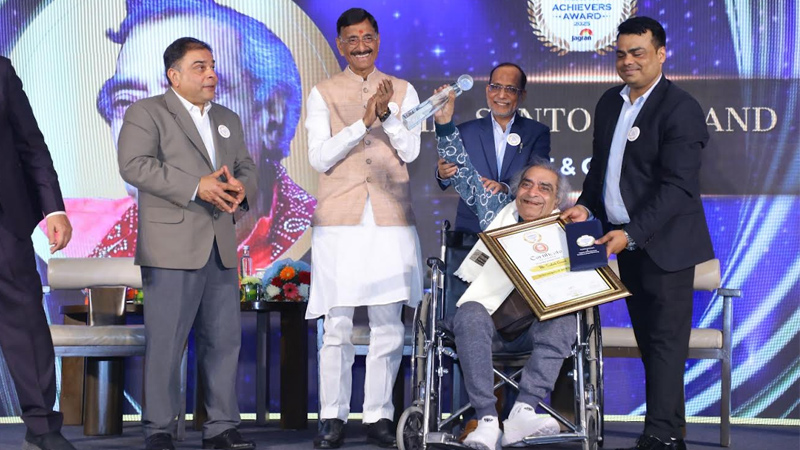
The cultural spotlight fell on veteran lyricist and poet Santosh Anand, whose songs have echoed across generations of Hindi cinema. At 97, Anand accepted the honour with characteristic humility, reflecting on a life shaped by perseverance and hope.
Healthcare honours spanned both modern and traditional systems. Manoj N. Nesari was recognised for strengthening Ayurveda’s place in national and global health frameworks. Padma shri Mohammed Abdul Waheed was honoured for his research-backed work in Unani medicine, while padma shri Mohsin Wali received recognition for his long-standing contribution to patient-centred care.
Education and social development also featured prominently. Padma shri Zahir Ishaq Kazi was honoured for decades of work in education, while former Meghalaya superintendent of Police T. C. Chacko was recognised for public service. Goonj founder Anshu Gupta received an award for his dignity-centred rural development initiatives, and the Hunar Shakti Foundation was honoured for empowering women and young girls through skill development.
The Lifetime Achievement Award went to former IAS officer Shailaja Chandra for her long career in public healthcare and governance, particularly in the traditional systems under Ayush.
Speaking at the event, Hamdard chairman Abdul Majeed said the awards were a tribute to those who combine excellence with empathy. “These awardees reflect Hakeem Sahib’s belief that healthcare, education and public service must ultimately serve humanity,” he said.
Minister Seth struck a forward-looking note, saying India’s young population gives the country a unique opportunity to become a global destination for learning, health and wellness by 2047.
The ceremony also featured the trailer launch of Unani Ki Kahaani, an upcoming documentary starring actor Jim Sarbh, set to premiere on Discovery on 11 February.
Instituted in memory of Unani scholar and educationist Hakeem Abdul Hameed, the awards have grown into a national platform that celebrates those building a more inclusive and resilient India. For one evening at least, the spotlight was not just on success, but on service with substance.








