News Headline
‘Rolling out of Cas has been the most significant development’

One of the most significant developments of the year has been the re-emergence of Zee Network and especially Zee TV as a clear market leader in the entertainment segment when it surpassed its closest rival Star. Its ‘reality show’ Sa Re Ga Ma Pa registered an all time high TRP/viewership amongst different age groups.
Zee Network has also launched a new youth centric family entertainment channel ‘Zee Next’ in December 2007. With BAG Films, NDTV, UTV and TV-18 also planning to bring channels of different genres, the viewers can expect a wide variety of content in 2008.
However, the year has not been so good for sports channels having cricket/BCCI rights as after losing legal battle they had to compulsorily share their feed with Doordarshan in respect of One Day and Test matches under the downlinking guidelines.

The attempt on the part of government to create consensus on the Broadcast Bill received a setback when certain entertainment channels and news channels opposed to the introduction of the Bill, forcing the government to defer its introduction. Most of the media houses have expressed the view that rather than the government stipulating content code by way of legislation, they would like to have a self-regulatory content code.
| With BAG Films, NDTV, UTV and TV-18 also planning to bring channels of different genres, the viewers can expect a wide variety of content in 2008 _____****_____ |
They apprehend that proposed bill and content code is an attempt on the part of the government to curb the freedom of press through the back door. However, at the same time there has been a vociferous demand from various section of society to impose some kind of control on the ‘unregulated content’ being currently beamed.
I am of the view that there is an imperative need to have a regulatory regime in the broadcasting sector and the Broadcast Bill is a step in the right direction. The proposed legislation contains various provisions which are not only in the public interest but also in the interest of the broadcast sector, which would not only bring order in the sector but would also stimulate the much needed investment so as to provide an opportunity to the sector develop and grow in a focused manner.
While there are certain provisions in the bill e.g. provisions pertaining to cross media ownership and restriction in holding shares within electronic media and distribution sector which may act as an impediment to the overall growth of the sector, the media sector has brought to the notice of the government that the present era is that of globalisation and consolidation by way of merger and acquisition, and these kind of restrictions act as barriers for accessing and optimally utilising the resources of capital formation for the growth and development of the sector.
The Indian media industry, especially Indian broadcasters have to compete with global media companies. In order to match the might of those companies, they must have adequate technology, capital and manpower resources. Thus, the process of capital formation is one of the key ingredients to acquire and accumulate competitive strength and these kinds of restrictions are unwarranted. The government has fairly agreed to review these provisions and has also entrusted the task of developing a draft content code to News Broadcasters Association.
| In my view the industry should welcome the Broadcast Regulator, as an effective Regulator protects both consumer interest and the industry from arbitrariness _____****_____ |
In my view the industry should welcome the institution of a Broadcast Regulator in as much as an effective Regulator protects the consumer interest and also protects the industry in question from arbitrariness and interference of the government of the day. The media industry has grown too large and too complex and as such it is in the interest of broadcasting sector itself to have a Regulator. However the Regulator must be autonomous, and independent of the Executive.
Towards the fag end of the year certain court orders and judgments have also come, in which there have been observations that Broadcasters/Media need to observe general community standards of decency and civility in news content, taking particular care to protect the interests and sensitivities of children and general family viewing. The Courts have directed the government to expeditiously bring the content code in the Broadcasting sector.
It is high time the industry responds to this and effectively works with the government in finalising an appropriate self-regulatory content code at the earliest.
There have been a lot of regulatory developments during the year. Trai has brought out Quality of Service Regulations for DTH which outline service bench marks to be followed by DTH operators. This particular Regulation mandated the commercial inter-operability for Set Top Boxes (STB) in DTH service.






NEW DELHI: Hamdard Laboratories gathered a cross-section of India’s achievers in New Delhi on Friday, handing out the Hakeem Abdul Hameed Excellence Awards to figures who have left their mark across healthcare, education, sport, public service and the arts.
The ceremony, attended by minister of state for defence Sanjay Seth and senior officials from the ministry of Ayush, celebrated individuals whose work blends professional success with a sense of public purpose. It was as much a roll call of achievement as it was a reminder that influence is not measured only in profits or podiums, but in people reached and lives improved.
Among the headline awardees was Alakh Pandey, founder and chief executive of PhysicsWallah, recognised for turning affordable digital learning into a mass movement. On the sporting front, Arjuna Awardee and kabaddi player Sakshi Puniya was honoured for her contribution to the game and for pushing women’s participation onto bigger stages.
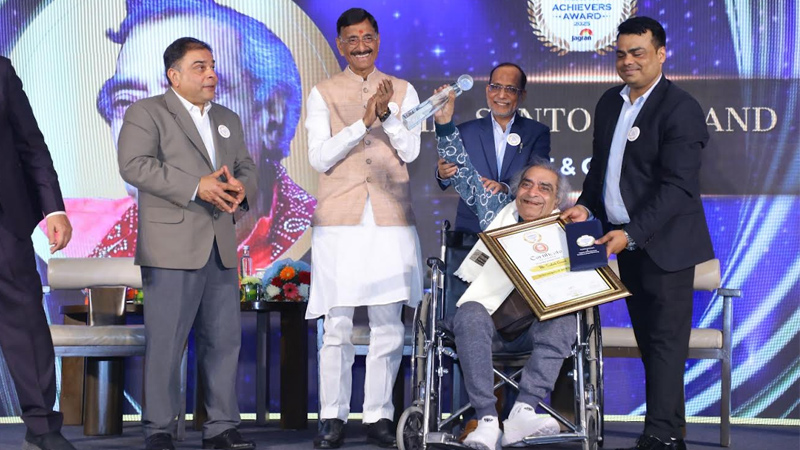
The cultural spotlight fell on veteran lyricist and poet Santosh Anand, whose songs have echoed across generations of Hindi cinema. At 97, Anand accepted the honour with characteristic humility, reflecting on a life shaped by perseverance and hope.
Healthcare honours spanned both modern and traditional systems. Manoj N. Nesari was recognised for strengthening Ayurveda’s place in national and global health frameworks. Padma shri Mohammed Abdul Waheed was honoured for his research-backed work in Unani medicine, while padma shri Mohsin Wali received recognition for his long-standing contribution to patient-centred care.
Education and social development also featured prominently. Padma shri Zahir Ishaq Kazi was honoured for decades of work in education, while former Meghalaya superintendent of Police T. C. Chacko was recognised for public service. Goonj founder Anshu Gupta received an award for his dignity-centred rural development initiatives, and the Hunar Shakti Foundation was honoured for empowering women and young girls through skill development.
The Lifetime Achievement Award went to former IAS officer Shailaja Chandra for her long career in public healthcare and governance, particularly in the traditional systems under Ayush.
Speaking at the event, Hamdard chairman Abdul Majeed said the awards were a tribute to those who combine excellence with empathy. “These awardees reflect Hakeem Sahib’s belief that healthcare, education and public service must ultimately serve humanity,” he said.
Minister Seth struck a forward-looking note, saying India’s young population gives the country a unique opportunity to become a global destination for learning, health and wellness by 2047.
The ceremony also featured the trailer launch of Unani Ki Kahaani, an upcoming documentary starring actor Jim Sarbh, set to premiere on Discovery on 11 February.
Instituted in memory of Unani scholar and educationist Hakeem Abdul Hameed, the awards have grown into a national platform that celebrates those building a more inclusive and resilient India. For one evening at least, the spotlight was not just on success, but on service with substance.






