News Broadcasting
Republic Network becomes the largest news network with 184 million reach


MUMBAI: Republic Network smashed the national news networks and commanded number one position with 184 million Reach. The viewership of Republic Bharat has increased by 228% over the period in the last five weeks doubling the reach to 138 million. Republic Bharat was ahead this week keeping its focus on its core agenda of Rashtravad and 100% news. In the English News genre, Republic TV continued its winning streak, being number one consistently since 95 weeks.
Republic Network elevated its news agenda by pulling out one exclusive after the other which set the agenda for national discourse. As the focus at the Front shifted to the ceasefire violations of Pakistan this week and how mortal shelling from across the border killed young children on the Indian side, Republic Bharat’s ‘Sarhad Par 100’ format ensured that the Bharat team was with the victims and brought their stories to the people across the country. With an aggressive deployment at Poonch, Sunderbani Sector, Mendhar, Rajouri, Nowshera along the LoC and Longewala, Hindumalkot, Jaisalmer, Pathankot and Attari at the International Border, Republic Bharat was the only news team bringing India the pulse and the on-ground breaking news from the Front.
While Team Bharat was ahead of the curve in terms of breaking news on the retaliatory action by the Indian Forces and the anti-terror encounters in Jammu and Kashmir, the channel changed the narrative on Sunday with its super exclusive video on the Baloch Army attacking Pakistan Army posts, which came days after the Pashtuns warned Pakistan. Taking its content play and journalism to fifth gear, for the first time on national television, Republic Bharat had put out clinching proof the IAF strikes against Pakistan after it accessed photos of the strike in Balakot and brought to its viewers specific information pertaining to the SPICE 2000 weapon used in India’s strike.

Not relenting even the day after getting the big exclusive of the Balakot pictures, Republic Bharat brought its viewers the maximum details on the Jammu terror attack within the breaking news format.
Republic Bharat’s swiftness and innovation while setting the agenda continued right to the last day of the week– when the Supreme Court announced a mediation on the Ayodhya case and the channel had a full-scale show with top Hindu saints and a live audience from Ayodhya to discuss the matter. On the final day of the week, Republic Bharat also put out the Republic TV-C-Voter Popularity poll was a daily tracker of political sentiment of 50,000 Indians over a period of above 60 days which reported the national sentiment of the electorate. Whether it was reporting from the front, taking on those who insult and politick over India’s forces, those who batted against nationalistic slogans of India, or it was setting the agenda for Election 2019:
With the aggressive strategy on content and with its pace of innovation in breaking the news and breaking the established mould in terms of format, Republic News Network is now officially topping the charts.


News Broadcasting
News18 India launches Command Centre war explainer with Arya
New show shifts from debates to decoding global conflicts and impacts
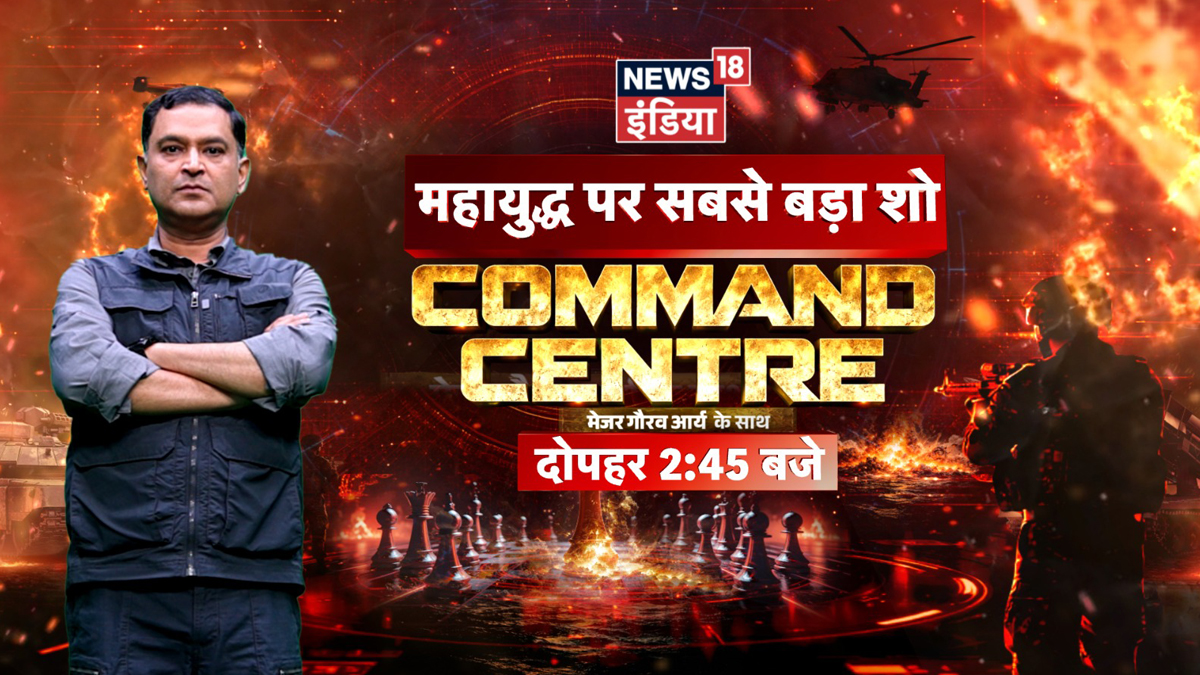
MUMBAI: News18 India has rolled out a new war-focused programme, Command Centre, featuring Gaurav Arya, as it looks to offer viewers a sharper, more grounded take on global conflicts amid rising tensions in West Asia.
Positioned as an “insider war room”, the show moves away from conventional panel debates and instead focuses on explaining military developments, decoding strategy and connecting global events to their everyday impact, from fuel prices to economic shifts.
The format leans heavily on visuals and data. The studio has been designed like a command hub, complete with large LED war maps, real-time graphics and an alert system to track developments as they unfold.
At the centre of it all is Arya, who brings his military background to simplify complex war strategies for viewers. His signature line, “Seedhi baat samjhiye”, anchors the show’s promise of clarity over noise.
News18 India managing editor Jyoti Kamal said, “Command Centre, featuring Major Gaurav Arya is designed to deliver accurate insights and a clear perspective on how evolving conflicts impact everyday life, from household budgets to national security. With expert voices analysing every development in real time, the show goes beyond headlines to decode what’s happening now, what it means, and what could come next.”
Echoing the intent, Gaurav Arya added, “In times of war, confusion is the biggest threat. With News18 India’s Command Centre, we are bringing viewers inside the war room, decoding strategies, tracking every escalation, and explaining, in the simplest terms, what it means for India and for every household. Seedhi baat samjhiye, this is where you understand not just what is happening, but what happens next.”
The weekday show will air in the afternoon slot and will also feature Gaurav Shukla, adding to its editorial depth.
With its mix of analysis, visuals and a clear focus on impact, the show reflects a broader shift in news consumption. Viewers are no longer just watching events unfold, they are looking to understand what those events mean for them.






