News Headline
Religious content shown on TV negative: PTC Study


MUMBAI: The Parents Television Council (PTC) in the US revealed in a new study that religious content on television is shown less frequently and more negatively on television.
The new study Faith in a Box 2005-2006 is a review of how religion is portrayed on prime time broadcast television.
PTC president L. Brent Bozell says, “The results of this study clearly show that the entertainment industry is not reflecting the strong religious beliefs of Americans in its television programming. The industry is in fact hostile to people of faith – no matter if the person is Christian, Jewish, or Muslim.

“After Mel Gibson’s film, The Passion of the Christ, there was a lot of talk that Hollywood finally had found religion. But with television, sadly that wasn’t true. In fact, it was the opposite. This study documents that after 2004, the portrayals of religion have been cut in half, and are now overwhelmingly more negative.
“The evidence is clear: On CBS’ Two and a Half Men, Charlie Sheen’s character uses the melody of ‘Joy to the World, the Lord has come,’ to sing ‘Joy to the Word, I’m getting laid.’ Fox’s The Family Guy proved to be especially sacrilegious and vile when it showed God in bed with a woman. These examples, and others, show that Hollywood has a clear distaste for religion.”
According to a recent Zogby/American Bible Society poll, 84 per cent of adults are not offended when they hear references to God or the Bible on network television shows, and 51 per cent say entertainment networks should develop shows with positive messages – and even specifically refer to God and the Bible.
“The irony is that reality shows such as Extreme Makeover: Home Edition and The Amazing Race, where real characters freely express themselves, faith and religion are positively portrayed. But in scripted shows, where Hollywood writers express their worldviews, faith and religion become four letter words – to the tune of 95.5% negative portrayals. This is an industry that is completely out of touch with reality,” Bozell continued.
In this seventh PTC study examining the treatment of religious content on television, an entire year of prime-time broadcast programming was analysed. The PTC examined a total of 2,271.5 hours of programming containing 1,425 treatments of religion.
Major findings:
Religion is shown less than in past years – There were half as many portrayals of religion in 2005-2006 (1,425) as in 2003-2004 (2,344).
Religion is portrayed more negatively – In 2005-2006, there were more negative depictions of religion than positive ones (35 per cent to 34 per cent). Depictions of aspects affiliated with organised religion (clergy, doctrine or laity) were mostly negative.
Reality shows are more positive towards religion – The format of the program was a significant factor in the portrayal which religion received. A majority (57.8 per cent) of the positive portrayals of religion were to be found on reality programs. By contrast, an overwhelming percentage (95.5 per cent) of the negative portrayals of religion came from such Hollywood-scripted drama and comedy programmes; only 4.5 per cent of negative portrayals of religion were found on reality shows.
Fox was by far the most anti-religious network – One in every two (49.3 per cent) portrayals of religion on the Fox network was negative. Long-time champion NBC came in second in negative depictions of religion, with well over a third (39.3%) of such portrayals being negative. Among other networks, over a third (35.4 per cent) of depictions of religion on UPN was also negative. ABC registered 30.4 per cent and CBS 29 per cent negative portrayals. The WB network featured the fewest negative depictions of religion (21 per cent).
Later hours of prime time are more negative towards religion – The number of negative portrayals increased steadily with each hour of prime-time. Negative treatments constituted 31.9 per cent of all treatments in the 8 pm hour, 33.9 per cent in the 9 pm hour and 44.4 per cent in the 10 pm hour. At no time during prime time, and on no network did the positive portrayal of religion even hit the 50% mark.
Laypersons – non-clerical individuals who profess religious faith – were treated most negatively by entertainment programs – Over half (50.8 per cent) of all entertainment television’s depictions of laity were negative. Only 26 per cent were positive.
Portrayal of religious institutions were critical – Close behind in negative portrayal were religious institutions (such as particular denominations, specific religious beliefs or direct references to Scripture), nearly half (47.6%) of which were negative. By contrast, only 18% of depictions of religious institutions were positive.
Clergy shown in a negative light – Prime-time television’s portrayal of clergy was also heavily weighted, with less than a third (30.4 per cent) of depictions of and references to clergy being positive, and another two-thirds being negative or ambiguous.
Simple religious faith shown positively – Only in depictions of religious faith – showing individuals making a simple declaration of belief in God or a higher power, or praying – was television’s portrayal of religion largely positive. Over two-thirds (69.6 per cent) of such portrayals were positive, with less than one-sixth (14.7 per cent) being negative.
“This study clearly documents the complete disconnect between Hollywood’s attitude toward religion and that of the American public,” Bozell concluded.



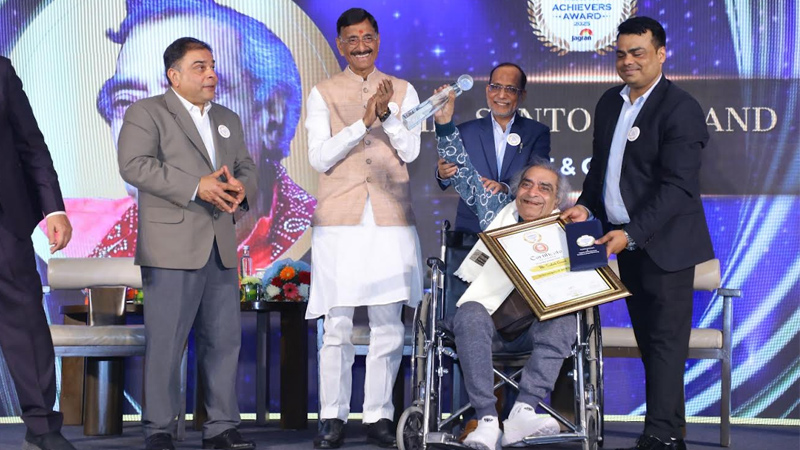
NEW DELHI: Hamdard Laboratories gathered a cross-section of India’s achievers in New Delhi on Friday, handing out the Hakeem Abdul Hameed Excellence Awards to figures who have left their mark across healthcare, education, sport, public service and the arts.
The ceremony, attended by minister of state for defence Sanjay Seth and senior officials from the ministry of Ayush, celebrated individuals whose work blends professional success with a sense of public purpose. It was as much a roll call of achievement as it was a reminder that influence is not measured only in profits or podiums, but in people reached and lives improved.
Among the headline awardees was Alakh Pandey, founder and chief executive of PhysicsWallah, recognised for turning affordable digital learning into a mass movement. On the sporting front, Arjuna Awardee and kabaddi player Sakshi Puniya was honoured for her contribution to the game and for pushing women’s participation onto bigger stages.
The cultural spotlight fell on veteran lyricist and poet Santosh Anand, whose songs have echoed across generations of Hindi cinema. At 97, Anand accepted the honour with characteristic humility, reflecting on a life shaped by perseverance and hope.
Healthcare honours spanned both modern and traditional systems. Manoj N. Nesari was recognised for strengthening Ayurveda’s place in national and global health frameworks. Padma shri Mohammed Abdul Waheed was honoured for his research-backed work in Unani medicine, while padma shri Mohsin Wali received recognition for his long-standing contribution to patient-centred care.
Education and social development also featured prominently. Padma shri Zahir Ishaq Kazi was honoured for decades of work in education, while former Meghalaya superintendent of Police T. C. Chacko was recognised for public service. Goonj founder Anshu Gupta received an award for his dignity-centred rural development initiatives, and the Hunar Shakti Foundation was honoured for empowering women and young girls through skill development.
The Lifetime Achievement Award went to former IAS officer Shailaja Chandra for her long career in public healthcare and governance, particularly in the traditional systems under Ayush.
Speaking at the event, Hamdard chairman Abdul Majeed said the awards were a tribute to those who combine excellence with empathy. “These awardees reflect Hakeem Sahib’s belief that healthcare, education and public service must ultimately serve humanity,” he said.
Minister Seth struck a forward-looking note, saying India’s young population gives the country a unique opportunity to become a global destination for learning, health and wellness by 2047.
The ceremony also featured the trailer launch of Unani Ki Kahaani, an upcoming documentary starring actor Jim Sarbh, set to premiere on Discovery on 11 February.
Instituted in memory of Unani scholar and educationist Hakeem Abdul Hameed, the awards have grown into a national platform that celebrates those building a more inclusive and resilient India. For one evening at least, the spotlight was not just on success, but on service with substance.






