iWorld
Reliance Jio capex at Rs 18k cr in Q1-18, Retail’s solid performance in FY-17

BENGALURU: The Mukesh Dhirubhai Ambani headed Reliance Industries Limited (RIL) reported its financial performance for the quarter / year ended 31 March 2017 (Q4-17/FY-17, current quarter/current year). RIL’s digital venture Reliance Jio Infocomm Limited (Jio) has been touted as the largest startup in the world with investments announced to the tune of Rs 1,50,000 crore. The company plans capex at Rs 18,000 crore for Q1-18. The company says that capex investments will drop sharply from Q2-18 onward. This is indeed a huge sum, when one considers the fact that its nearest peer and the largest telecom operator in terms of subscriber base until Jio overtook it, Bharti Airtel Limited (Airtel), had capex of Rs 20,591.9 crore during the entire financial year 2016. It may be noted that Airtel has operations in other geographies besides India, and the capex number mentioned above includes those countries also. RIL claims that Jio contributes to more than 80 percent of data consumption in India.
Further, RIL plans capex of Rs 2,500 crore for fiscal 2018 for its organized retail segment – Reliance Retail Limited (Retail segment) that had a phenomenal performance during FY-17. Reliance Retail reported revenue of Rs 33,765 crore for fiscal 2017, 60.2 percent more than the Rs 21,075 crore reported in the previous year. Quarter-on-quarter (q-o-q), the segment’s revenue in Q4-17 at Rs 10,332 crore was 18.9 percent more than the Rs 8,688 crore in Q3-17 and year-on-year (y-o-y) it was 83 percent more than the Rs 5,646 crore in Q4-16.
The Retail segment’s EBIT in FY-17 at Rs 784 crore (2.3 percent EBIT margin) was 55.6 percent more than the Rs 504 crore (2.4 percent EBIT margin) in the previous year. Q4-17 EBIT at Rs 243 crore (2.4 percent EBIT margin) was 5.2 percent more that Rs 231 crore (2.7 percent EBIT margin) and 89.8 percent more y-o-y than Rs 128 crore (2.3 percent EBIT margin).

The Retail segment’s Business PBIT in FY-17 at Rs 1,203 crore was 40.4 percent more than the Rs 857 crore in FY-16. Business PBIT in Q4-17 at Rs 366 crore was 9.9 percent more q-o-q than Rs 333 crore and 65.6 percent more y-o-y than Rs 221 crore.
RIL’s Revenue (turnover) increased by 12.3 percent in FY-17 to Rs 3,30,180 crore from Rs 2,93,298 crore in FY-16. The company’s revenue increased 10.3 percent q-o-q to Rs 92,889 crore in Q4-17 as compared to Rs 84,189 crore and increased 45.2 percent y-o-y from Rs 63,954 crore.
Overall RIL reported record annual consolidated net profit of Rs 29,901 crore in FY-17, up 18.8 percent as compared to the Rs 25,171 crore in FY-16. Consolidated net profit for Q4-17 at Rs 8,046 crore was 6.8 percent higher q-o-q as compared to Rs 7,533 crore and was 12.3 percent higher y-o-y than the Rs 7,167 crore.
Note: The unit of currency in this report is the Indian rupee – Rs (also conventionally represented by INR). The Indian numbering system or the Vedic numbering system has been used to denote money values. The basic conversion to the international norm would be:
(a) 100,00,000 = 100 lakh = 10,000,000 = 10 million = 1 crore.
(b) 10,000 lakh = 100 crore = 1 arab = 1 billion.






iWorld
Prime Video bets big on India with global originals, films and franchise expansion
Execs highlight scale, travelability and new IP bets as India anchors global strategy
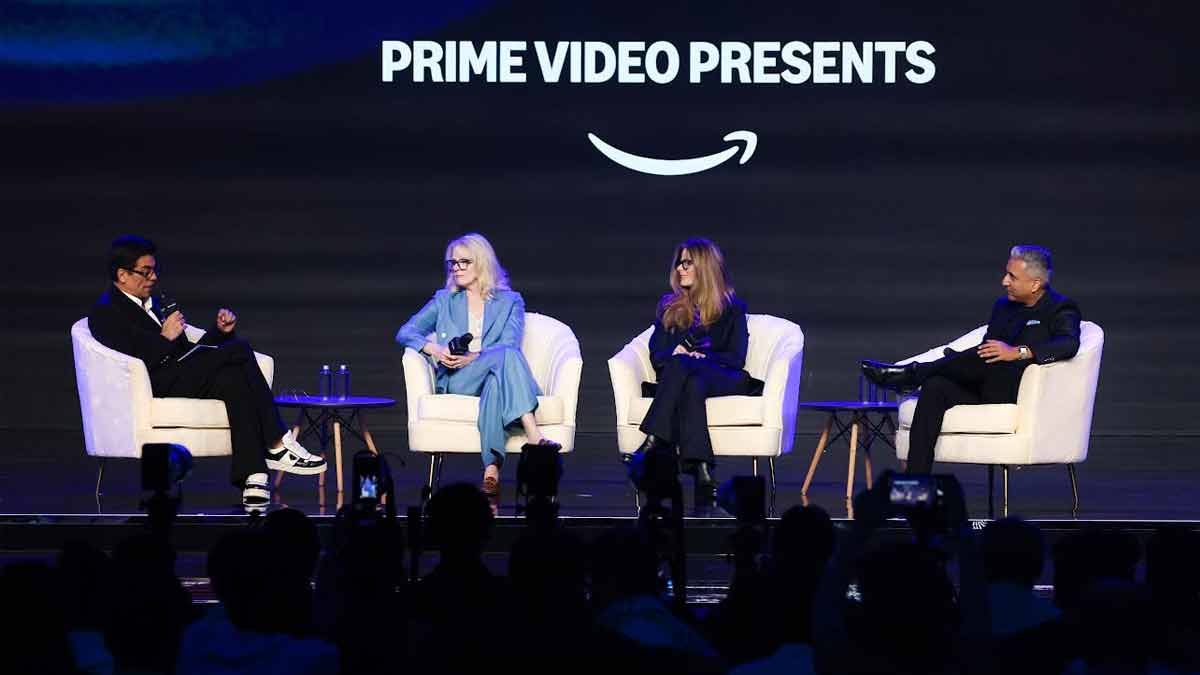
MUMBAI: At Prime Video Presents 2026, the message was clear and confident. India is not just part of the plan, it is central to it.
In a lively fireside chat hosted by filmmaker Karan Johar, Kelly Day, vice president of prime video and amazon mgm studios international, Nicole Clemens, vice president of international originals, and Gaurav Gandhi, vice president for Apac and Anz, laid out an ambitious roadmap. Think bigger stories, wider reach and a sharper focus on building franchises that travel.
Kelly Day, a regular visitor to India, set the tone early. Calling the country “one of the most important markets globally”, she pointed to the sheer scale and diversity of audiences as a driving force behind Prime Video’s growth. Indian Originals, she said, are not just local hits but global engines powering subscriptions and engagement.
That global appeal is already visible. According to Clemens, around 25 percent of viewership for Indian content now comes from outside the country. Shows rooted deeply in local culture are finding fans worldwide, proving that specificity, when paired with universal themes, travels well. From gritty dramas to sharp thrillers, Indian storytelling is increasingly crossing borders with ease.
Clemens, who joined recently to lead international originals, was particularly upbeat about India’s creative range. She highlighted a growing slate of over 100 shows in development and production, with more than 60 percent returning for multiple seasons. For her, the formula is simple. Authentic stories, told well, resonate everywhere.
Adding to the buzz, she teased new and returning titles, alongside a fresh superhero universe, the Kalyug Warriors. It signals a push into new genres while doubling down on familiar fan favourites.
If content is king, distribution is the clever courtier. Day outlined Prime Video’s layered business model in India, which blends subscription, rentals, add on channels and ad supported viewing through Amazon MX Player. The idea is straightforward. Give viewers choice, whether they want premium, free or pay per view.
India, she noted, has also become a testing ground for innovation. Tiered pricing, mobile only plans and language diversity have all been sharpened here before being exported to other markets. In many ways, the India playbook is now influencing global strategy.
For Gaurav Gandhi, the next chapter is about scale with intent. He outlined four priorities. Making Prime Video more accessible, pushing Indian content globally, building stronger franchises and supercharging the films business.
On films, the platform is moving beyond licensing into co productions and now theatrical releases in partnership with amazon mgm studios. These films will eventually stream on Prime Video, creating a full circle from cinema halls to living rooms across 240 countries.
Franchise building remains another key pillar. With hits like The Family Man, Mirzapur and Panchayat already enjoying multi season success, the focus is now on creating the next wave of enduring IP. Newer titles are already lining up for second seasons, signalling a steady pipeline.
What stood out through the conversation was a shared belief. Streaming in India is still in its early innings, and the runway is long. With a mix of local flavour and global ambition, Prime Video is betting that stories from India will not just stay at home, but travel far and wide.
Or as the executives seemed to suggest, the world is watching and India has plenty more to show.